back to art styles


Art lane
Loftline
An engine-agnostic style recipe: a wide hero, proof shots across subjects, and a portable prompt.
1 hero · 3 proofs
Prompt template
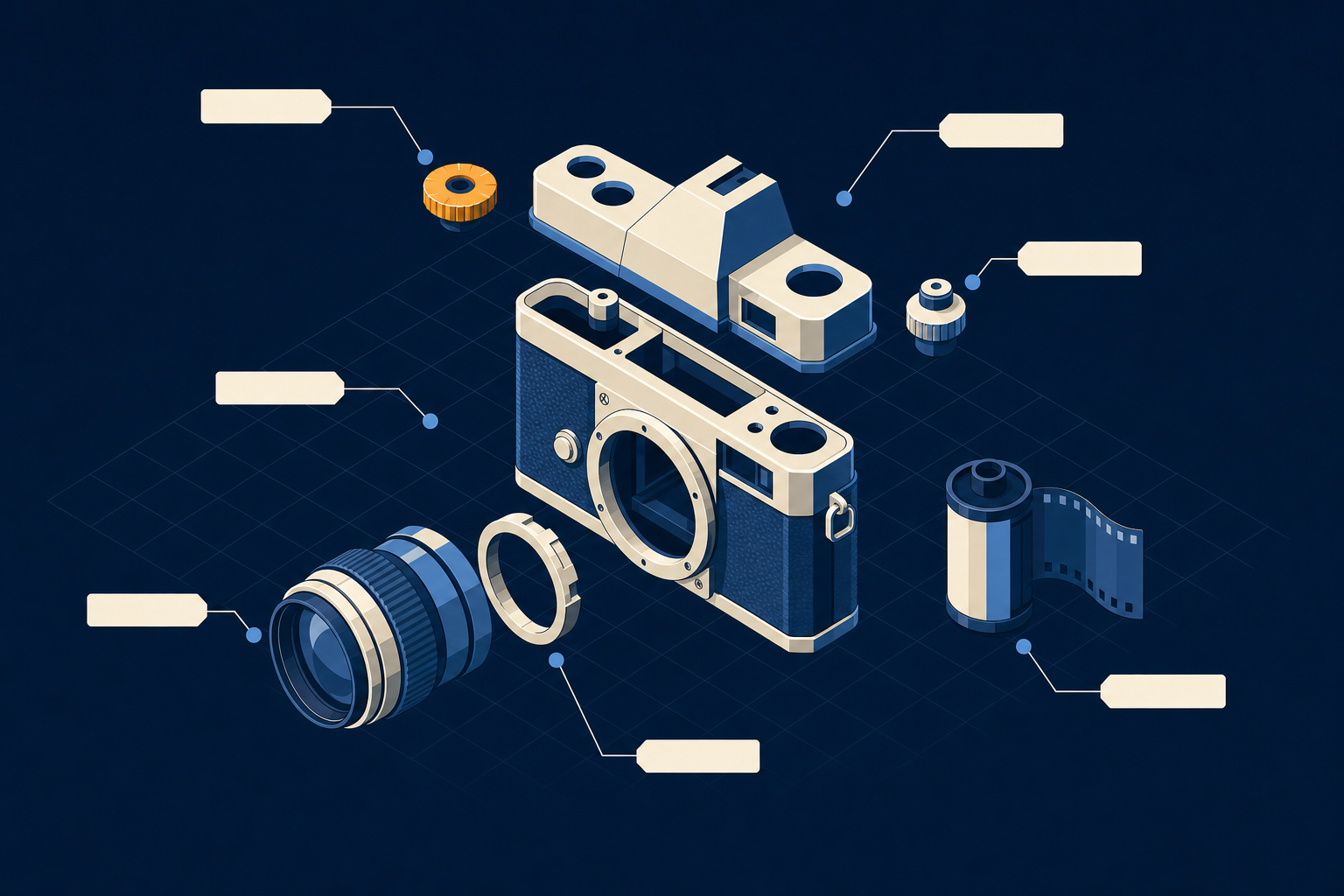
A clean isometric vector illustration of {subject} in true 30-degree axonometric projection with no perspective convergence. Render every form as crisp geometric solids with flat color fills and two-tone facet shading — one bright lit face, one mid-tone side face, one darker top facet — using hard vector edges, no gradients, no soft shading, no photographic texture, no outlines except where a facet meets. Pull the subject gently apart into an exploded view: separate its main components and float them a short distance along the projection axes with thin gaps between them. Annotate the key parts with small solid round callout dots, each joined by a thin straight orthogonal leader line to a blank rounded label tab set in the negative space. Lay a faint isometric measurement grid of light diamond lines beneath the whole subject as a quiet drafting cue. Use the palette {palette}: a deep dark ground, cool neutral facets, and reserved bright accent fills used like highlighters on only a few faces and the callout dots. Engineering-illustration precision, generous negative space, calm balanced composition. NO text, NO letters, NO logos, NO numbers visible.Slot recipes
hero — A wide exploded scene of {subject} grouped slightly off-center with calm open negative space on one side for an overlay; full isometric measurement grid beneath; a few accent facets and labelled callouts.
feature — A single {subject} exploded into 3-5 floating components, each tagged with a callout dot and leader line to a blank label tab; centered, generous margin.
avatar — A compact isometric solid representing {subject}, two-tone facet shading, one accent dot, no leader lines, square crop, lots of breathing room.
empty-state — A sparse {subject} as a single simple isometric solid resting on a faint grid with one inert callout dot and an empty label tab, mostly empty ground, quiet and calm.
illustration — An exploded axonometric diagram of {subject} on the measurement grid with multiple numbered-style callout dots and orthogonal leader lines reading as a clean technical figure.
isometricaxonometricvectorexploded-viewtechnical-illustration
Credits · in the lineage of
- Exploded-view technical illustrationTraditionPatent drawings, service manuals, and assembly diagrams that float a product's parts apart to show structure.
- Axonometric architectural drawingTraditionTrue-projection isometric plates from architecture and engineering, with leader lines and measured grids.
- Public-service / explainer infographicsTraditionLabelled, high-contrast diagram graphics that explain one idea quickly without metaphor.
A generated style is an aggregate of many influences — credit is given to the artists and traditions it draws on, not a claim of authorship.
images by gpt-image-2
Do
- · Keep true isometric (no perspective convergence) and flat two-tone facet shading.
- · Explode the subject into legible components with thin even gaps along the axes.
- · Reserve accent fills for a few faces and the callout dots; keep most facets cool neutral.
- · Tie every called-out part to a blank label tab with a thin straight leader line.
- · Leave generous negative space and a quiet measurement grid beneath.
Don't
- · Add perspective, soft blurred shadows, gradients, or photographic texture.
- · Crowd the frame or stack callouts until the figure is busy.
- · Render any text, numbers, or logos.
- · Lean on ink, sumi, letterpress, engraving, risograph, contour-line, or earth-survey treatments.
try it
remix with this style
Apply Loftline to any UI language and swap the palette — the preview takes this style's hero image.
Needs a Published language and palette to remix.