accent#3F6448
bg#E7EAE3
surface#FFFFFF
text#26322B
muted#556057
border#CDD3C8
surface 2#DBDFD8
copy#3B473F
on accent#FFFFFF
Herbier is a herbarium sheet used as an interface.
Its pictures are drawn in Pigment Wash.
Tokens, rules and the paired art style Pigment Wash.
Each face set in this language's own words.
Herbier
Herbier
Herbier is a herbarium sheet used as an interface.
Herbier is a herbarium sheet used as an interface.
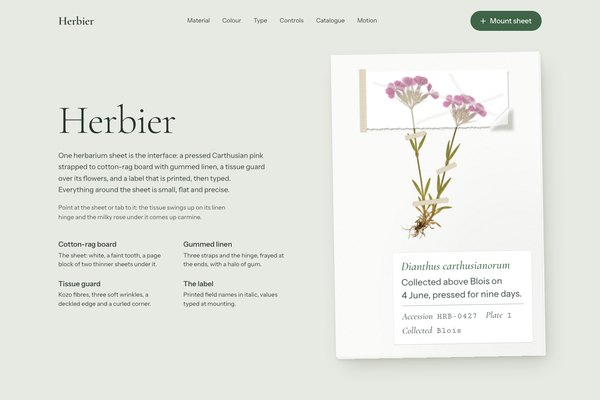
Herbier is a herbarium sheet used as an interface. The one real object is a sheet of cotton-rag board on a pale stone table: a pressed Carthusian pink strapped down with frayed, gummed linen, a tissue guard hinged over its flowers, and a label whose field names are printed and whose values are typed. Lift the tissue and the milky rose underneath comes up carmine. Everything around the sheet is small, flat and precise: names in Cormorant Garamond, copy in Instrument Sans, typed values in Cutive Mono, and one sage green for the action.
Calm catalogue density: one object and one light word per view, 128 to 136px between sections on desktop and 96px on phones, 48px controls, ledger rows around 60px parted by space, prose held to about 50 characters beside the object.
Phones (390px) stack to one column in the order name, sheet, lede and action, this week; hide non-essential nav links and ledger columns; the sheet takes 78% of the width. Tablets (768 to 1100px) put the copy beside the sheet with this week under the copy. Ultra-wide caps and centres content; only the landing hero spans the full width.
pigment-wash
Two kinds of image. The sheet and its parts are photographic: a real pressed plant scanned flat and cut out with its own alpha, and a pale green-grey stone table photographed from above under one soft light from the top left. The paired art style, Pigment Wash, paints the plates the herbarium makes from its sheets: the same plant at life size in translucent watercolour and fine ink on white paper.
Landing hero: the empty stone table (assets/hero.jpg) through var(--hero-image), with the live CSS sheet lying on it and the headline beside it; no text, no objects in the photograph. Inside pages: the cut-out plant on the sheet, and one Pigment Wash plate per page as a flat print on the table. Use Pigment Wash for plates, posters and prints only, never as a wash behind modules; keep its saturated translucent pigment and fine ink, and set the subject to the pressed plant with carmine, sap green, olive and straw on white.
# Herbier

## Philosophy

Herbier is a herbarium sheet used as an interface. The one real object is a sheet of cotton-rag board on a pale stone table: a pressed Carthusian pink strapped down with frayed, gummed linen, a tissue guard hinged over its flowers, and a label whose field names are printed and whose values are typed. Lift the tissue and the milky rose underneath comes up carmine. Everything around the sheet is small, flat and precise: names in Cormorant Garamond, copy in Instrument Sans, typed values in Cutive Mono, and one sage green for the action.

### Values

- One object is the interface: the herbarium sheet, rendered as a real thing with a use, and it is the only raised thing in a view.
- Material belongs to the object: cotton-rag board with tooth, woven linen with frayed ends and a gum halo, kozo tissue with fibres and a deckled edge. The page around it is flat colour.
- Depth is a verb. The tissue lifts only while you point at the sheet; the sheet lays down once on arrival.
- One hue family and one action green. Amber marks the one live state (in the press); carmine lives only in the plant.
- What the catalogue knows, the sheet says: accession, collector, locality and determination are real data, typed onto a printed label.
- Type is small and quiet with one big light word per view.

### Anti-Values

- Watercolour washes or pigment blooms behind modules.
- Pressed-leaf silhouettes clipped into corners as decoration.
- Cards, borders, rules and chips; states are words, not pills.
- Decorative accession codes and plate numbers as ornament (FOLIO HRB, PLATE 03).
- A second raised thing in a view, or the whole sheet twice on one page.
- Warm cream page grounds; the table is a pale green-grey stone and the sheet is white.

### Visual Character

- The sheet stands on a pale green-grey stone table (#E7EAE3) with table on every side: cotton-rag white (#FFFFFF) with a faint tooth, turned one degree as if laid by hand, a page block of two thinner sheets along its right and bottom edges, and a three-layer shadow tinted from the forest ink and press amber that falls down and to the right.
- A pressed Carthusian pink, photographed and cut out with its own alpha, is strapped to the sheet with three strips of woven linen (#EDE4CF) with frayed ends and an amber gum halo (#C4A05C).
- A kozo tissue guard, hinged on a linen strip at the left, lies over the flower heads at 46% milky white with long fibres, three soft wrinkles, a deckled lower edge that casts a hairline shadow across the flowers, and a free corner that curls up on a diagonal.
- The label sits in the lower right of the sheet: the binomial in sage-green italic Cormorant (#3F6448), a note in Instrument Sans, then italic printed field names with values typed in Cutive Mono over a printed rule.
- Around the object everything is flat: one green pill action per view, state words in colour instead of chips, lists and ledgers straight on the table, and one big light Cormorant word.

## Tokens

### Colors

| Name | Value |
|------|-------|
| bg | `#E7EAE3` |
| surface | `#FFFFFF` |
| surface_2 | `#DBDFD8` |
| text | `#26322B` |
| copy | `#3B473F` |
| muted | `#556057` |
| border | `#CDD3C8` |
| accent | `#3F6448` |
| on_accent | `#FFFFFF` |
| success | `#2F6B45` |
| warning | `#735619` |
| error | `#9B3A34` |
| info | `#2F5F6B` |
| linen | `#EDE4CF` |
| gum | `#C4A05C` |
| shade | `#3D3D26` |

### Derived

- **Surface 2**: color-mix(in srgb, var(--bg) 94%, var(--text))
- **Copy**: color-mix(in srgb, var(--text) 55%, var(--muted))
- **Shade**: color-mix(in srgb, var(--text) 70%, var(--warning))
- **Note**: Only the eleven role colours and the two strap materials (linen, gum) are literal. surface_2, copy and shade are mixed from the roles in CSS, so a palette swap carries the quiet pill, the copy and every shadow with it. Carmine is never a token: it lives only in the pressed plant.

### Typography

- **Heading Font**: Cormorant Garamond
- **Body Font**: Instrument Sans
- **Mono Font**: Cutive Mono
- **Heading Weight**: 300
- **Body Weight**: 400
- **Button Weight**: 500
- **Heading Transform**: none
- **Letter Spacing**: -0.02em on Cormorant display; 0 on body and mono
- **Line Height**: 1.6
- **Base Size**: 17px
- **Scale**: ["14.5px","17px","21px","28px","44px","72px","96px"]
- **Roles**: {"display":"Cormorant Garamond 300 for the one big light word of a view (72 or 96px hero, 44px section titles); 500 italic for Latin binomials; 500 roman for families; 600 for the wordmark and small serif titles (21 to 28px)","body":"Instrument Sans 400 at 17px for copy and control labels, 500 on buttons and link words, 14.5px for captions","mono":"Cutive Mono 400 only for values typed onto a label: accession numbers, dates, collector numbers, days in the press"}
- **Google Fonts Url**: https://fonts.googleapis.com/css2?family=Cormorant+Garamond:ital,wght@0,300;0,500;0,600;1,500&family=Instrument+Sans:wght@400;500&family=Cutive+Mono&display=swap

### Radii

- **None**: 0px
- **Sm**: 0px
- **Md**: 0px
- **Lg**: 0px
- **Full**: 9999px

### Shadows

- **Sheet**: inset -.17cqi -.17cqi 0 shade 10%, .37cqi .5cqi 0 -.03cqi (page-block sheet), .4cqi .57cqi .1cqi -.03cqi shade 22%, .77cqi 1.03cqi 0 -.07cqi (second sheet), .8cqi 1.1cqi .13cqi -.07cqi shade 20%, 0 .13cqi .2cqi shade 22%, .67cqi 1.33cqi 2cqi shade 13%, 3cqi 5.33cqi 9cqi -1.67cqi shade 22%
- **Lift**: 0 1px 2px color-mix(in srgb, var(--shade) 20%, transparent), 6px 12px 30px -10px color-mix(in srgb, var(--shade) 28%, transparent)
- **Strap**: drop-shadow(0 0 .2cqi gum 50%) drop-shadow(0 .12cqi .08cqi shade 32%)
- **Note**: One light from the top left. Shadows fall down and to the right in two layers (a tight contact shadow and a soft ambient one), tinted from the forest ink and the press amber, never grey. Only the object of a view, or an open overlay, carries them.

### Spacing

- **Base**: 8px
- **Scale**: [4,8,12,16,24,32,48,64,96,128]

### Surfaces

- **Treatment**: flat-stone-table-one-paper-object
- **Card Style**: No cards. Content sits straight on the pale stone table, parted by space and type value. The one raised thing is the herbarium sheet (cotton-rag white with a faint tooth, a page block of two thinner sheets, a three-layer tinted shadow). A white surface otherwise appears only as a form well or an open overlay, one per view.
- **Bg Pattern**: none on the page; the hero is a photographed stone table

### Borders

- **Default Width**: 0
- **Accent Width**: 0
- **Style**: none
- **Character**: No borders, rules or outlines in the interface. The only line is the printed rule on a herbarium label, which is part of the object. The border token colours tracks (progress, slider, switch off) and is never drawn as a line.

### Motion

- **Duration**: 750ms
- **Easing**: linear(0,.42 12%,.86 26%,1.04 40%,1.01 56%,.995 72%,1)
- **Settle**: cubic-bezier(.2,.7,.2,1)
- **Philosophy**: One verb: lift the tissue. Hovering or focusing the sheet swings the tissue guard up 103 degrees on its linen hinge with a small overshoot, and the milky rose under it comes up carmine. On arrival the sheet lays down onto the table once; sections rise as they enter. The settled state renders with no JavaScript; an inline script adds .anim to html to gate start states, and prefers-reduced-motion changes state at once.

## Rules

### Composition

- Give every view one object moment: the whole sheet in the hero, then parts of it (the label close up, a strap, a painted plate) in later views. Everything else in the view stays flat.
- Lay the sheet on the table with air on every side and never frame it in a card or panel.
- Put the headline, a short lede and one green action beside the object on the ground, never on a scrim or panel over it.
- Separate by space and value, never by boxes: ledgers, lists, hours and forms sit straight on the table. At most one white surface per view besides the object: a form's wells, an open record or an overlay.
- Show the whole sheet once per page.
- Keep one green pill per view; a second action is a quiet pill or a linen link.

### Hierarchy

- One big light word per view in Cormorant Garamond 300: 72px (96px from 1800px wide) in a hero, 44px for section titles, -0.02em tracking.
- Latin binomials in Cormorant 500 italic, families in 500 roman, both 21 to 28px; the binomial on a label is sage green.
- Instrument Sans 400 at 17px for copy and labels, 14.5px for captions and table heads, 500 on buttons and link words.
- Cutive Mono 400 only for typed values: accessions, dates, collector numbers, days in the press.
- Status is a coloured word (in the press in amber, ready to mount in green, beetle damage in madder, on loan in quiet ink), never a chip or pill.

### Density

Calm catalogue density: one object and one light word per view, 128 to 136px between sections on desktop and 96px on phones, 48px controls, ledger rows around 60px parted by space, prose held to about 50 characters beside the object.

### Signature Patterns

- The herbarium sheet: cotton-rag white on the stone table, 60:87, turned -1 degree, a page block of two thinner sheets and a three-layer tinted shadow, drawn in CSS around a photographed pressed plant (assets/specimen.webp).
- Gummed linen straps: woven linen with frayed ends through an SVG mask, a gum halo and a contact shadow; three across the stems and one as the tissue's hinge.
- The tissue guard: kozo fibres (assets/tissue-fibre.webp), three soft wrinkles, a deckled edge, a curled free corner and a ghost of the plant under it (assets/specimen-ghost.webp) that reads as milky rose.
- Lift the tissue: hover or focus on the sheet swings the tissue up 103 degrees about its left hinge over 750ms with a small overshoot; the ghost fades, the carmine comes up sharp, and the standing tissue throws a soft shadow beside the hinge.
- The printed and typed label: italic printed field names and Cutive Mono values under a printed rule, used on the sheet and, close up, as a later view.
- The linen link: a strip of linen is laid under the word on hover or focus, and the chosen tab keeps its strip.

## Layout

### Grid

- **Type**: object-first catalogue page
- **Max Width**: 1180px content on the landing and 1240px on the embodiment, 1320 to 1360px from 1800px wide; the landing hero stage caps at 1560px (2100px from 1800px)
- **Gutter**: 40px desktop, 20px phone
- **Column Behavior**: The landing hero runs three columns (copy, the sheet, this week) on minmax(0,1fr) auto minmax(0,1fr), two below 1100px and one below 760px. Section rows use minmax(0,6fr) minmax(0,5fr) splits, a ledger table and a four-column family index. Every track is minmax(0,1fr) and every grid child min-width:0.

### Whitespace

- **Section Gap**: 128 to 136px desktop, 96px phone
- **Card Gap**: no cards; ledger rows padded 18px, list items 22 to 26px apart, groups 44 to 96px apart
- **Content Padding**: content sits on the table aligned to the grid edge; overlays and the open record pad 28 to 32px
- **Approach**: The table is empty space by design: the sheet needs air on every side, and each view has one focal point.

### Density

- **Default**: comfortable
- **Comfortable**: {"button_height":"48px","input_height":"48px","row_height":"about 60px ledger rows with 18px padding"}

### Responsive

Phones (390px) stack to one column in the order name, sheet, lede and action, this week; hide non-essential nav links and ledger columns; the sheet takes 78% of the width. Tablets (768 to 1100px) put the copy beside the sheet with this week under the copy. Ultra-wide caps and centres content; only the landing hero spans the full width.

### Breakpoints

- **Mobile**: 390px
- **Phone Max**: 640px
- **Stack**: 760px
- **Tablet**: 1100px
- **Desktop**: 1280px
- **Ultrawide**: 1800px and 2560px

## Guidance

### Do

- Put the sheet at the centre of the first view, on the flat stone table with air all round.
- Let the tissue lift on hover and on keyboard focus, and make the sheet a focusable button with a label that says so.
- Use later views for parts of the sheet: the label close up, a strap, the painted plate.
- Write in the herbarium's own words: accession, determined, collected, days in the press, drawer, on loan.
- Spend green on one action per view and on binomials; amber only on in the press.
- Style every control: white square wells on the table, a 2px ink focus ring, green when chosen, pills for buttons.

### Don't

- Don't put watercolour washes, blooms or leaf silhouettes behind the interface.
- Don't frame content in cards, borders or rules, or turn states into chips.
- Don't show the whole sheet twice on a page or raise a second thing in the same view.
- Don't put a scrim or panel over the hero object; keep the headline beside it on the ground.
- Don't pair two green pills; make the second action quiet or a linen link.
- Don't use decorative codes, emoji or symbol glyphs; don't set numerals in Cormorant display, whose figures are old-style.

### Accessibility

WCAG AA and better on the stone table #E7EAE3: ink #26322B is 11.0:1, copy #3B473F 7.7:1, quiet ink #556057 5.4:1, green #3F6448 5.5:1, amber #735619 5.6:1, madder #9B3A34 5.7:1; white on green is 6.7:1. The sheet is a focusable button with an aria-label, and keyboard focus lifts the tissue; every control has a visible 2px ink focus ring; status is always a word, never colour alone. prefers-reduced-motion changes the tissue's state at once and skips the lay-down and reveals.

## Imagery Direction

### Pairs With

pigment-wash

### Summary

Two kinds of image. The sheet and its parts are photographic: a real pressed plant scanned flat and cut out with its own alpha, and a pale green-grey stone table photographed from above under one soft light from the top left. The paired art style, Pigment Wash, paints the plates the herbarium makes from its sheets: the same plant at life size in translucent watercolour and fine ink on white paper.

### Subjects

- pressed Carthusian pink, roots and all
- pale honed stone table from above
- a strip of gummed linen tape
- kozo tissue fibres
- watercolour plate of the pressed plant
- flower heads at life size

### Usage

Landing hero: the empty stone table (assets/hero.jpg) through var(--hero-image), with the live CSS sheet lying on it and the headline beside it; no text, no objects in the photograph. Inside pages: the cut-out plant on the sheet, and one Pigment Wash plate per page as a flat print on the table. Use Pigment Wash for plates, posters and prints only, never as a wash behind modules; keep its saturated translucent pigment and fine ink, and set the subject to the pressed plant with carmine, sap green, olive and straw on white.
---
version: "alpha"
name: "Herbier"
description: "Herbier is a herbarium sheet used as an interface. The one real object is a sheet of cotton-rag board on a pale stone table: a pressed Carthusian pink strapped down with frayed, gummed linen, a tissue guard hinged over its flowers, and a..."
colors:
  bg: "#E7EAE3"
  surface: "#FFFFFF"
  surface_2: "#DBDFD8"
  text: "#26322B"
  copy: "#3B473F"
  muted: "#556057"
  border: "#CDD3C8"
  accent: "#3F6448"
  on_accent: "#FFFFFF"
  success: "#2F6B45"
  warning: "#735619"
  error: "#9B3A34"
  info: "#2F5F6B"
  linen: "#EDE4CF"
  gum: "#C4A05C"
  shade: "#3D3D26"
typography:
  headline-lg:
    fontFamily: "Cormorant Garamond"
    fontSize: "2.075rem"
    fontWeight: 700
    lineHeight: 1.1
    letterSpacing: "-0.02em"
  headline-md:
    fontFamily: "Cormorant Garamond"
    fontSize: "1.66rem"
    fontWeight: 600
    lineHeight: 1.15
    letterSpacing: "-0.02em"
  body-md:
    fontFamily: "Instrument Sans"
    fontSize: "17px"
    fontWeight: 400
    lineHeight: 1.6
    letterSpacing: "-0.02em"
  label-md:
    fontFamily: "Cutive Mono"
    fontSize: "0.75rem"
    fontWeight: 600
    lineHeight: 1
    letterSpacing: "0.08em"
rounded:
  none: "0px"
  sm: "0px"
  md: "0px"
  lg: "0px"
  full: "9999px"
spacing:
  base: "8px"
  xs: "4px"
  sm: "8px"
  md: "12px"
  lg: "16px"
  xl: "24px"
  2xl: "32px"
  3xl: "48px"
  4xl: "64px"
  step-8: "96px"
  step-9: "128px"
components:
  color-reference-bg:
    backgroundColor: "{colors.bg}"
  color-reference-surface:
    backgroundColor: "{colors.surface}"
  color-reference-surface_2:
    backgroundColor: "{colors.surface_2}"
  color-reference-text:
    backgroundColor: "{colors.text}"
  color-reference-copy:
    backgroundColor: "{colors.copy}"
  color-reference-muted:
    backgroundColor: "{colors.muted}"
  color-reference-border:
    backgroundColor: "{colors.border}"
  color-reference-accent:
    backgroundColor: "{colors.accent}"
  color-reference-on_accent:
    backgroundColor: "{colors.on_accent}"
  color-reference-success:
    backgroundColor: "{colors.success}"
  color-reference-warning:
    backgroundColor: "{colors.warning}"
  color-reference-error:
    backgroundColor: "{colors.error}"
  color-reference-info:
    backgroundColor: "{colors.info}"
  color-reference-linen:
    backgroundColor: "{colors.linen}"
  color-reference-gum:
    backgroundColor: "{colors.gum}"
  color-reference-shade:
    backgroundColor: "{colors.shade}"
  button-primary:
    backgroundColor: "{colors.accent}"
    textColor: "{colors.on_accent}"
    typography: "{typography.label-md}"
    rounded: "{rounded.md}"
    padding: "{spacing.md}"
  card-surface:
    backgroundColor: "{colors.surface}"
    textColor: "{colors.text}"
    rounded: "{rounded.md}"
    padding: "{spacing.md}"
  input-default:
    backgroundColor: "{colors.surface}"
    textColor: "{colors.text}"
    rounded: "{rounded.md}"
    height: "44px"
---

# Herbier

## Overview

Herbier is a herbarium sheet used as an interface. The one real object is a sheet of cotton-rag board on a pale stone table: a pressed Carthusian pink strapped down with frayed, gummed linen, a tissue guard hinged over its flowers, and a label whose field names are printed and whose values are typed. Lift the tissue and the milky rose underneath comes up carmine. Everything around the sheet is small, flat and precise: names in Cormorant Garamond, copy in Instrument Sans, typed values in Cutive Mono, and one sage green for the action.

### Values

- One object is the interface: the herbarium sheet, rendered as a real thing with a use, and it is the only raised thing in a view.
- Material belongs to the object: cotton-rag board with tooth, woven linen with frayed ends and a gum halo, kozo tissue with fibres and a deckled edge. The page around it is flat colour.
- Depth is a verb. The tissue lifts only while you point at the sheet; the sheet lays down once on arrival.
- One hue family and one action green. Amber marks the one live state (in the press); carmine lives only in the plant.
- What the catalogue knows, the sheet says: accession, collector, locality and determination are real data, typed onto a printed label.
- Type is small and quiet with one big light word per view.

### Anti-Values

- Watercolour washes or pigment blooms behind modules.
- Pressed-leaf silhouettes clipped into corners as decoration.
- Cards, borders, rules and chips; states are words, not pills.
- Decorative accession codes and plate numbers as ornament (FOLIO HRB, PLATE 03).
- A second raised thing in a view, or the whole sheet twice on one page.
- Warm cream page grounds; the table is a pale green-grey stone and the sheet is white.

### Visual Character

- The sheet stands on a pale green-grey stone table (#E7EAE3) with table on every side: cotton-rag white (#FFFFFF) with a faint tooth, turned one degree as if laid by hand, a page block of two thinner sheets along its right and bottom edges, and a three-layer shadow tinted from the forest ink and press amber that falls down and to the right.
- A pressed Carthusian pink, photographed and cut out with its own alpha, is strapped to the sheet with three strips of woven linen (#EDE4CF) with frayed ends and an amber gum halo (#C4A05C).
- A kozo tissue guard, hinged on a linen strip at the left, lies over the flower heads at 46% milky white with long fibres, three soft wrinkles, a deckled lower edge that casts a hairline shadow across the flowers, and a free corner that curls up on a diagonal.
- The label sits in the lower right of the sheet: the binomial in sage-green italic Cormorant (#3F6448), a note in Instrument Sans, then italic printed field names with values typed in Cutive Mono over a printed rule.
- Around the object everything is flat: one green pill action per view, state words in colour instead of chips, lists and ledgers straight on the table, and one big light Cormorant word.

## Colors

Use the YAML color tokens as the normative palette. The prose below names the roles agents should preserve when generating UI.

| Token | Value |
|-------|-------|
| bg | `#E7EAE3` |
| surface | `#FFFFFF` |
| surface_2 | `#DBDFD8` |
| text | `#26322B` |
| copy | `#3B473F` |
| muted | `#556057` |
| border | `#CDD3C8` |
| accent | `#3F6448` |
| on_accent | `#FFFFFF` |
| success | `#2F6B45` |
| warning | `#735619` |
| error | `#9B3A34` |
| info | `#2F5F6B` |
| linen | `#EDE4CF` |
| gum | `#C4A05C` |
| shade | `#3D3D26` |

## Typography

Load the fonts from Google Fonts: https://fonts.googleapis.com/css2?family=Cormorant+Garamond:ital,wght@0,300;0,500;0,600;1,500&family=Instrument+Sans:wght@400;500&family=Cutive+Mono&display=swap

- **Headline-Lg**: Cormorant Garamond, 2.075rem, weight 700, line-height 1.1.
- **Headline-Md**: Cormorant Garamond, 1.66rem, weight 600, line-height 1.15.
- **Body-Md**: Instrument Sans, 17px, weight 400, line-height 1.6.
- **Label-Md**: Cutive Mono, 0.75rem, weight 600, line-height 1.

## Layout

### Spacing Tokens

- **Base**: `8px`
- **Xs**: `4px`
- **Sm**: `8px`
- **Md**: `12px`
- **Lg**: `16px`
- **Xl**: `24px`
- **2xl**: `32px`
- **3xl**: `48px`
- **4xl**: `64px`
- **Step-8**: `96px`
- **Step-9**: `128px`

### Grid

- **Type**: object-first catalogue page
- **Max Width**: 1180px content on the landing and 1240px on the embodiment, 1320 to 1360px from 1800px wide; the landing hero stage caps at 1560px (2100px from 1800px)
- **Gutter**: 40px desktop, 20px phone
- **Column Behavior**: The landing hero runs three columns (copy, the sheet, this week) on minmax(0,1fr) auto minmax(0,1fr), two below 1100px and one below 760px. Section rows use minmax(0,6fr) minmax(0,5fr) splits, a ledger table and a four-column family index. Every track is minmax(0,1fr) and every grid child min-width:0.

### Whitespace

- **Section Gap**: 128 to 136px desktop, 96px phone
- **Card Gap**: no cards; ledger rows padded 18px, list items 22 to 26px apart, groups 44 to 96px apart
- **Content Padding**: content sits on the table aligned to the grid edge; overlays and the open record pad 28 to 32px
- **Approach**: The table is empty space by design: the sheet needs air on every side, and each view has one focal point.

### Density

- **Default**: comfortable
- **Comfortable**: {"button_height":"48px","input_height":"48px","row_height":"about 60px ledger rows with 18px padding"}

### Responsive

Phones (390px) stack to one column in the order name, sheet, lede and action, this week; hide non-essential nav links and ledger columns; the sheet takes 78% of the width. Tablets (768 to 1100px) put the copy beside the sheet with this week under the copy. Ultra-wide caps and centres content; only the landing hero spans the full width.

### Breakpoints

- **Mobile**: 390px
- **Phone Max**: 640px
- **Stack**: 760px
- **Tablet**: 1100px
- **Desktop**: 1280px
- **Ultrawide**: 1800px and 2560px

## Elevation & Depth

### Shadows

- **Sheet**: inset -.17cqi -.17cqi 0 shade 10%, .37cqi .5cqi 0 -.03cqi (page-block sheet), .4cqi .57cqi .1cqi -.03cqi shade 22%, .77cqi 1.03cqi 0 -.07cqi (second sheet), .8cqi 1.1cqi .13cqi -.07cqi shade 20%, 0 .13cqi .2cqi shade 22%, .67cqi 1.33cqi 2cqi shade 13%, 3cqi 5.33cqi 9cqi -1.67cqi shade 22%
- **Lift**: 0 1px 2px color-mix(in srgb, var(--shade) 20%, transparent), 6px 12px 30px -10px color-mix(in srgb, var(--shade) 28%, transparent)
- **Strap**: drop-shadow(0 0 .2cqi gum 50%) drop-shadow(0 .12cqi .08cqi shade 32%)
- **Note**: One light from the top left. Shadows fall down and to the right in two layers (a tight contact shadow and a soft ambient one), tinted from the forest ink and the press amber, never grey. Only the object of a view, or an open overlay, carries them.

## Shapes

### Rounded

- **None**: `0px`
- **Sm**: `0px`
- **Md**: `0px`
- **Lg**: `0px`
- **Full**: `9999px`

### Surfaces

- **Treatment**: flat-stone-table-one-paper-object
- **Card Style**: No cards. Content sits straight on the pale stone table, parted by space and type value. The one raised thing is the herbarium sheet (cotton-rag white with a faint tooth, a page block of two thinner sheets, a three-layer tinted shadow). A white surface otherwise appears only as a form well or an open overlay, one per view.
- **Bg Pattern**: none on the page; the hero is a photographed stone table

### Borders

- **Default Width**: 0
- **Accent Width**: 0
- **Style**: none
- **Character**: No borders, rules or outlines in the interface. The only line is the printed rule on a herbarium label, which is part of the object. The border token colours tracks (progress, slider, switch off) and is never drawn as a line.

## Components

### Composition

- Give every view one object moment: the whole sheet in the hero, then parts of it (the label close up, a strap, a painted plate) in later views. Everything else in the view stays flat.
- Lay the sheet on the table with air on every side and never frame it in a card or panel.
- Put the headline, a short lede and one green action beside the object on the ground, never on a scrim or panel over it.
- Separate by space and value, never by boxes: ledgers, lists, hours and forms sit straight on the table. At most one white surface per view besides the object: a form's wells, an open record or an overlay.
- Show the whole sheet once per page.
- Keep one green pill per view; a second action is a quiet pill or a linen link.

### Hierarchy

- One big light word per view in Cormorant Garamond 300: 72px (96px from 1800px wide) in a hero, 44px for section titles, -0.02em tracking.
- Latin binomials in Cormorant 500 italic, families in 500 roman, both 21 to 28px; the binomial on a label is sage green.
- Instrument Sans 400 at 17px for copy and labels, 14.5px for captions and table heads, 500 on buttons and link words.
- Cutive Mono 400 only for typed values: accessions, dates, collector numbers, days in the press.
- Status is a coloured word (in the press in amber, ready to mount in green, beetle damage in madder, on loan in quiet ink), never a chip or pill.

### Density

Calm catalogue density: one object and one light word per view, 128 to 136px between sections on desktop and 96px on phones, 48px controls, ledger rows around 60px parted by space, prose held to about 50 characters beside the object.

### Signature Patterns

- The herbarium sheet: cotton-rag white on the stone table, 60:87, turned -1 degree, a page block of two thinner sheets and a three-layer tinted shadow, drawn in CSS around a photographed pressed plant (assets/specimen.webp).
- Gummed linen straps: woven linen with frayed ends through an SVG mask, a gum halo and a contact shadow; three across the stems and one as the tissue's hinge.
- The tissue guard: kozo fibres (assets/tissue-fibre.webp), three soft wrinkles, a deckled edge, a curled free corner and a ghost of the plant under it (assets/specimen-ghost.webp) that reads as milky rose.
- Lift the tissue: hover or focus on the sheet swings the tissue up 103 degrees about its left hinge over 750ms with a small overshoot; the ghost fades, the carmine comes up sharp, and the standing tissue throws a soft shadow beside the hinge.
- The printed and typed label: italic printed field names and Cutive Mono values under a printed rule, used on the sheet and, close up, as a later view.
- The linen link: a strip of linen is laid under the word on hover or focus, and the chosen tab keeps its strip.

## shadcn/ui Usage

When the target app uses shadcn/ui, copy DESIGN.md with shadcn instead of the plain DESIGN.md. It contains the same Katagami design-language source plus the shadcn/ui primitives, imports, theme variables, component recipes, and preview-shot guidance.

DESIGN.md with shadcn: `/language/en-01a0ecaf-149b-7383-be3c-eead7b7645c4/DESIGN.with-shadcn.md`.

Machine-readable companions for automation: `/language/en-01a0ecaf-149b-7383-be3c-eead7b7645c4/shadcn.json` (registry theme), `/language/en-01a0ecaf-149b-7383-be3c-eead7b7645c4/shadcn-components.md` (component recipes) and `/language/en-01a0ecaf-149b-7383-be3c-eead7b7645c4/shadcn-shots.json` (preview shots). The human-facing handoff is still DESIGN.md with shadcn.

Install recommended primitives with `npx shadcn@latest add button card input textarea select dialog sheet tabs badge separator checkbox switch slider tooltip dropdown-menu table`.

Use these primitives in shadcn apps:
- button
- card
- input
- textarea
- select
- dialog
- sheet
- tabs
- badge
- separator
- checkbox
- switch
- slider
- tooltip
- dropdown-menu
- table

Implementation rule for agents: import shadcn primitives from `@/components/ui/*`, apply the generated CSS variables first, then compose the language-specific recipes from the companion MD. Katagami remains the source of truth; shadcn names are the implementation surface.

## Do's and Don'ts

- Do Put the sheet at the centre of the first view, on the flat stone table with air all round.
- Do Let the tissue lift on hover and on keyboard focus, and make the sheet a focusable button with a label that says so.
- Do Use later views for parts of the sheet: the label close up, a strap, the painted plate.
- Do Write in the herbarium's own words: accession, determined, collected, days in the press, drawer, on loan.
- Do Spend green on one action per view and on binomials; amber only on in the press.
- Do Style every control: white square wells on the table, a 2px ink focus ring, green when chosen, pills for buttons.
- Don't Don't put watercolour washes, blooms or leaf silhouettes behind the interface.
- Don't Don't frame content in cards, borders or rules, or turn states into chips.
- Don't Don't show the whole sheet twice on a page or raise a second thing in the same view.
- Don't Don't put a scrim or panel over the hero object; keep the headline beside it on the ground.
- Don't Don't pair two green pills; make the second action quiet or a linen link.
- Don't Don't use decorative codes, emoji or symbol glyphs; don't set numerals in Cormorant display, whose figures are old-style.

### Accessibility

WCAG AA and better on the stone table #E7EAE3: ink #26322B is 11.0:1, copy #3B473F 7.7:1, quiet ink #556057 5.4:1, green #3F6448 5.5:1, amber #735619 5.6:1, madder #9B3A34 5.7:1; white on green is 6.7:1. The sheet is a focusable button with an aria-label, and keyboard focus lifts the tissue; every control has a visible 2px ink focus ring; status is always a word, never colour alone. prefers-reduced-motion changes the tissue's state at once and skips the lay-down and reveals.

## Imagery Direction

### Pairs With

pigment-wash

### Summary

Two kinds of image. The sheet and its parts are photographic: a real pressed plant scanned flat and cut out with its own alpha, and a pale green-grey stone table photographed from above under one soft light from the top left. The paired art style, Pigment Wash, paints the plates the herbarium makes from its sheets: the same plant at life size in translucent watercolour and fine ink on white paper.

### Subjects

- pressed Carthusian pink, roots and all
- pale honed stone table from above
- a strip of gummed linen tape
- kozo tissue fibres
- watercolour plate of the pressed plant
- flower heads at life size

### Usage

Landing hero: the empty stone table (assets/hero.jpg) through var(--hero-image), with the live CSS sheet lying on it and the headline beside it; no text, no objects in the photograph. Inside pages: the cut-out plant on the sheet, and one Pigment Wash plate per page as a flat print on the table. Use Pigment Wash for plates, posters and prints only, never as a wash behind modules; keep its saturated translucent pigment and fine ink, and set the subject to the pressed plant with carmine, sap green, olive and straw on white.
```json
{
  "$schema": "https://ui.shadcn.com/schema/registry-item.json",
  "name": "herbier",
  "type": "registry:theme",
  "title": "Herbier shadcn Theme",
  "cssVars": {
    "theme": {},
    "light": {
      "background": "#E7EAE3",
      "foreground": "#26322B",
      "card": "#FFFFFF",
      "card-foreground": "#26322B",
      "popover": "#FFFFFF",
      "popover-foreground": "#26322B",
      "primary": "#26322B",
      "primary-foreground": "#ffffff",
      "secondary": "#f4f4f5",
      "secondary-foreground": "#111111",
      "muted": "#556057",
      "muted-foreground": "#26322B",
      "accent": "#3F6448",
      "accent-foreground": "#ffffff",
      "destructive": "#9B3A34",
      "border": "#CDD3C8",
      "input": "#CDD3C8",
      "ring": "#3F6448",
      "chart-1": "#26322B",
      "chart-2": "#f4f4f5",
      "chart-3": "#3F6448",
      "chart-4": "#2F6B45",
      "chart-5": "#735619",
      "sidebar": "#FFFFFF",
      "sidebar-foreground": "#26322B",
      "sidebar-primary": "#26322B",
      "sidebar-primary-foreground": "#ffffff",
      "sidebar-accent": "#2F5F6B",
      "sidebar-accent-foreground": "#ffffff",
      "sidebar-border": "#CDD3C8",
      "sidebar-ring": "#3F6448",
      "radius": "0px"
    },
    "dark": {
      "background": "#0f1115",
      "foreground": "#f8fafc",
      "card": "#181b22",
      "card-foreground": "#f8fafc",
      "popover": "#181b22",
      "popover-foreground": "#f8fafc",
      "primary": "#26322B",
      "primary-foreground": "#ffffff",
      "secondary": "#252a33",
      "secondary-foreground": "#f8fafc",
      "muted": "#252a33",
      "muted-foreground": "#a1a1aa",
      "accent": "#3F6448",
      "accent-foreground": "#ffffff",
      "destructive": "#9B3A34",
      "border": "#303642",
      "input": "#303642",
      "ring": "#3F6448",
      "chart-1": "#26322B",
      "chart-2": "#f4f4f5",
      "chart-3": "#3F6448",
      "chart-4": "#2F6B45",
      "chart-5": "#735619",
      "sidebar": "#181b22",
      "sidebar-foreground": "#f8fafc",
      "sidebar-primary": "#26322B",
      "sidebar-primary-foreground": "#ffffff",
      "sidebar-accent": "#3F6448",
      "sidebar-accent-foreground": "#ffffff",
      "sidebar-border": "#303642",
      "sidebar-ring": "#3F6448",
      "radius": "0px"
    }
  },
  "meta": {
    "source": "katagami",
    "languageId": "en-01a0ecaf-149b-7383-be3c-eead7b7645c4",
    "slug": "herbier",
    "componentManifest": [
      "button",
      "card",
      "input",
      "textarea",
      "select",
      "dialog",
      "sheet",
      "tabs",
      "badge",
      "separator",
      "checkbox",
      "switch",
      "slider",
      "tooltip",
      "dropdown-menu",
      "table"
    ],
    "installCommand": "npx shadcn@latest add button card input textarea select dialog sheet tabs badge separator checkbox switch slider tooltip dropdown-menu table",
    "nativeTokenNames": {
      "colors": [
        "accent",
        "bg",
        "border",
        "copy",
        "error",
        "gum",
        "info",
        "linen",
        "muted",
        "on_accent",
        "shade",
        "success",
        "surface",
        "surface_2",
        "text",
        "warning"
      ],
      "derived": [
        "copy",
        "note",
        "shade",
        "surface_2"
      ],
      "typography": [
        "base_size",
        "body_font",
        "body_weight",
        "button_weight",
        "google_fonts_url",
        "heading_font",
        "heading_transform",
        "heading_weight",
        "letter_spacing",
        "line_height",
        "mono_font",
        "roles",
        "scale"
      ],
      "radii": [
        "full",
        "lg",
        "md",
        "none",
        "sm"
      ],
      "shadows": [
        "lift",
        "note",
        "sheet",
        "strap"
      ],
      "spacing": [
        "base",
        "scale"
      ],
      "surfaces": [
        "bg_pattern",
        "card_style",
        "treatment"
      ],
      "borders": [
        "accent_width",
        "character",
        "default_width",
        "style"
      ],
      "motion": [
        "duration",
        "easing",
        "philosophy",
        "settle"
      ]
    }
  }
}
```The art style its pictures are drawn in and the colours its tokens carry.
The theme variables are generated from the tokens. Component recipes and preview shots have not been written for this language yet.
For an app that uses shadcn/ui: the DESIGN.md plus the install list, theme variables, component recipes, preview shots and a starter TSX file, in one Markdown file.
The same pieces as separate files: theme, CSS, TSX starter, recipes and the preview contract.
npx shadcn@latest add button card input textarea select dialog sheet tabs badge separator checkbox switch slider tooltip dropdown-menu table:root {
--background: #E7EAE3;
--foreground: #26322B;
--card: #FFFFFF;
--card-foreground: #26322B;
--popover: #FFFFFF;
--popover-foreground: #26322B;
--primary: #26322B;
--primary-foreground: #ffffff;
--secondary: #f4f4f5;
--secondary-foreground: #111111;
--muted: #556057;
--muted-foreground: #26322B;
--accent: #3F6448;
--accent-foreground: #ffffff;
--destructive: #9B3A34;
--border: #CDD3C8;
--input: #CDD3C8;
--ring: #3F6448;
--chart-1: #26322B;
--chart-2: #f4f4f5;
--chart-3: #3F6448;
--chart-4: #2F6B45;
--chart-5: #735619;
--sidebar: #FFFFFF;
--sidebar-foreground: #26322B;
--sidebar-primary: #26322B;
--sidebar-primary-foreground: #ffffff;
--sidebar-accent: #2F5F6B;
--sidebar-accent-foreground: #ffffff;
--sidebar-border: #CDD3C8;
--sidebar-ring: #3F6448;
--radius: 0px;
}
.dark {
--background: #0f1115;
--foreground: #f8fafc;
--card: #181b22;
--card-foreground: #f8fafc;
--popover: #181b22;
--popover-foreground: #f8fafc;
--primary: #26322B;
--primary-foreground: #ffffff;
--secondary: #252a33;
--secondary-foreground: #f8fafc;
--muted: #252a33;
--muted-foreground: #a1a1aa;
--accent: #3F6448;
--accent-foreground: #ffffff;
--destructive: #9B3A34;
--border: #303642;
--input: #303642;
--ring: #3F6448;
--chart-1: #26322B;
--chart-2: #f4f4f5;
--chart-3: #3F6448;
--chart-4: #2F6B45;
--chart-5: #735619;
--sidebar: #181b22;
--sidebar-foreground: #f8fafc;
--sidebar-primary: #26322B;
--sidebar-primary-foreground: #ffffff;
--sidebar-accent: #3F6448;
--sidebar-accent-foreground: #ffffff;
--sidebar-border: #303642;
--sidebar-ring: #3F6448;
--radius: 0px;
}
import { Badge } from "@/components/ui/badge";
import { Button } from "@/components/ui/button";
import {
  Card,
  CardContent,
  CardDescription,
  CardFooter,
  CardHeader,
  CardTitle,
} from "@/components/ui/card";
import { Input } from "@/components/ui/input";
import { Tabs, TabsList, TabsTrigger } from "@/components/ui/tabs";

export function HerbierShadcnKit() {
  return (
    <section className="grid gap-4 rounded-[var(--radius)] border bg-background p-4 text-foreground">
      <div className="flex items-start justify-between gap-4">
        <div>
          <Badge variant="outline">shadcn/ui</Badge>
          <h2 className="mt-3 text-2xl font-semibold tracking-tight">Herbier</h2>
          <p className="mt-1 max-w-xl text-sm text-muted-foreground">
            Use the Katagami registry theme, then compose these shadcn primitives
            with the language-specific component recipes.
          </p>
        </div>
        <Button>Apply theme</Button>
      </div>

      <Tabs defaultValue="components">
        <TabsList>
          <TabsTrigger value="components">Components</TabsTrigger>
          <TabsTrigger value="states">States</TabsTrigger>
          <TabsTrigger value="export">Export</TabsTrigger>
        </TabsList>
      </Tabs>

      <Card>
        <CardHeader>
          <CardTitle>Component recipe</CardTitle>
          <CardDescription>
            Replace this starter content with the agent-authored product scene
            from components.md and preview-shots.json.
          </CardDescription>
        </CardHeader>
        <CardContent className="grid gap-3 sm:grid-cols-[1fr_auto]">
          <Input defaultValue="Tokenized shadcn surface" aria-label="Recipe name" />
          <Button variant="secondary">Preview state</Button>
        </CardContent>
        <CardFooter className="justify-between">
          <Badge>Ready</Badge>
          <Button variant="outline">Copy recipe</Button>
        </CardFooter>
      </Card>
    </section>
  );
}
{
  "$schema": "https://ui.shadcn.com/schema/registry-item.json",
  "name": "herbier",
  "type": "registry:theme",
  "title": "Herbier",
  "description": "One herbarium sheet on a pale stone table: flat, borderless controls around it, square white wells, pill buttons, one sage green action.",
  "cssVars": {
    "theme": {
      "font-sans": "Instrument Sans, system-ui, sans-serif",
      "font-mono": "Cutive Mono, ui-monospace, monospace",
      "font-display": "Cormorant Garamond, Georgia, serif",
      "radius": "0px"
    },
    "light": {
      "background": "#E7EAE3",
      "foreground": "#26322B",
      "card": "#FFFFFF",
      "card-foreground": "#26322B",
      "popover": "#FFFFFF",
      "popover-foreground": "#26322B",
      "primary": "#3F6448",
      "primary-foreground": "#FFFFFF",
      "secondary": "#DBDFD8",
      "secondary-foreground": "#26322B",
      "muted": "#DBDFD8",
      "muted-foreground": "#556057",
      "accent": "#DBDFD8",
      "accent-foreground": "#26322B",
      "destructive": "#9B3A34",
      "destructive-foreground": "#FFFFFF",
      "border": "transparent",
      "input": "transparent",
      "ring": "#26322B",
      "chart-1": "#26322B",
      "chart-2": "#3F6448",
      "chart-3": "#735619",
      "chart-4": "#2F5F6B",
      "chart-5": "#556057",
      "radius": "0px"
    },
    "dark": {
      "background": "#E7EAE3",
      "foreground": "#26322B",
      "card": "#FFFFFF",
      "card-foreground": "#26322B",
      "popover": "#FFFFFF",
      "popover-foreground": "#26322B",
      "primary": "#3F6448",
      "primary-foreground": "#FFFFFF",
      "secondary": "#DBDFD8",
      "secondary-foreground": "#26322B",
      "muted": "#DBDFD8",
      "muted-foreground": "#556057",
      "accent": "#DBDFD8",
      "accent-foreground": "#26322B",
      "destructive": "#9B3A34",
      "destructive-foreground": "#FFFFFF",
      "border": "transparent",
      "input": "transparent",
      "ring": "#26322B",
      "chart-1": "#26322B",
      "chart-2": "#3F6448",
      "chart-3": "#735619",
      "chart-4": "#2F5F6B",
      "chart-5": "#556057",
      "radius": "0px"
    }
  },
  "componentManifest": [
    "button",
    "card",
    "input",
    "textarea",
    "select",
    "dialog",
    "sheet",
    "tabs",
    "badge",
    "separator",
    "checkbox",
    "switch",
    "slider",
    "tooltip",
    "dropdown-menu",
    "table"
  ],
  "meta": {
    "nativeTokenNames": {
      "bg": "background",
      "surface": "card / popover",
      "surface_2": "secondary / muted / accent",
      "text": "foreground",
      "muted": "muted-foreground",
      "accent": "primary",
      "on_accent": "primary-foreground",
      "error": "destructive",
      "copy": "native only",
      "linen": "native only",
      "gum": "native only",
      "shade": "native only",
      "success": "native only",
      "warning": "native only",
      "info": "native only"
    },
    "note": "Herbier is a light-ground language by concept; the dark scope repeats the light values.",
    "componentManifest": [
      "button",
      "card",
      "input",
      "textarea",
      "select",
      "dialog",
      "sheet",
      "tabs",
      "badge",
      "separator",
      "checkbox",
      "switch",
      "slider",
      "tooltip",
      "dropdown-menu",
      "table"
    ]
  }
}
---
artifact: component-recipes-v1
language: herbier
author: katagami-agent
primitives: 16
---

# Herbier shadcn/ui Components

Author: `katagami-agent`

## Intent

Herbier dresses shadcn/ui as the precise, flat interface around one real object: a herbarium sheet of cotton-rag board with a pressed Carthusian pink strapped down in gummed linen, a tissue guard you can lift over its flowers, and a printed and typed label. The sheet is the only raised thing in a view, shown whole once per page. Nothing else is boxed: content sits straight on the pale stone table, parted by space; the only white surfaces are form wells, one open record or an overlay. Rectangles are square, buttons are pills, and sage green is spent on one action per view.

## Required primitives

button, card, input, textarea, select, dialog, sheet, tabs, badge, separator, checkbox, switch, slider, tooltip, dropdown-menu, table. Import them from `@/components/ui/*`; do not build a second component system.

## Token cues

```css
--background:#E7EAE3; --foreground:#26322B;
--card:#FFFFFF; --card-foreground:#26322B;
--popover:#FFFFFF; --popover-foreground:#26322B;
--primary:#3F6448; --primary-foreground:#FFFFFF;
--secondary:#DBDFD8; --secondary-foreground:#26322B;
--muted:#DBDFD8; --muted-foreground:#556057;
--accent:#DBDFD8; --accent-foreground:#26322B;
--destructive:#9B3A34;
--border:transparent; --input:transparent; --ring:#26322B;
--radius:0px;
--font-sans:"Instrument Sans"; --font-mono:"Cutive Mono"; --font-display:"Cormorant Garamond";
```

Native names are kept in the theme: `bg`, `surface`, `surface_2`, `copy`, `linen`, `gum`, `shade`, and the semantic `success` `#2F6B45`, `warning` `#735619`, `info` `#2F5F6B`.

## Visual character to preserve

- One object per view: the herbarium sheet on the table. Never put it in a Card.
- No borders, dividers, cards or chips. Rows and groups separate by space and type value; at most one white surface per view besides the object.
- Square rectangles (0) and pill buttons and switches (9999px).
- Sage green only on the primary action, binomials and chosen controls; amber only on in the press.
- Cormorant Garamond for names (300 for the one big light word, italic 500 for Latin), Instrument Sans for copy, Cutive Mono only for typed values.
- Shadows fall down and right from one top-left light, in two tinted layers, and only on the object or an open overlay.

## ShadSync visual profile

- family: herbarium-object
- material: flat stone table and white square wells around one cotton-rag sheet with linen and tissue
- contour: default, radius 0, pills for buttons
- border: none
- underlay: false
- grain: false
- stickerBadges: false
- motion: tissue lifts on a spring hinge; sheet lays down once
- density: comfortable
- accents: sage-green

## Signature component recipes

- **button:** `h-12 rounded-full px-6 font-medium text-[17px] whitespace-nowrap`, no border. `default` is `bg-primary text-primary-foreground`, optionally with a drawn 13px plus (Mount sheet); one per view. Hover mixes the green toward ink; active presses down 1px. `secondary` is the quiet stone pill `bg-secondary`; `ghost` is a linen link (green 500 text with a strip of `linen` scaled in under the word on hover); `destructive` is `text-destructive` on a 10% destructive tint, never a solid red block. Focus: `ring-2 ring-primary ring-offset-[3px] ring-offset-background`.
- **card:** no frame around content: `bg-transparent border-0 shadow-none p-0 gap-5`, grouped by space with a Cormorant title. `bg-card rounded-none` is reserved for an open record, one per view. Never wrap the sheet or a ledger in one.
- **input:** a square white well on the table: `h-12 rounded-none border-0 bg-card px-4 text-[17px]`. Typed values (accession, dates, collector numbers) set `font-mono`. Placeholder in `text-muted-foreground`. Focus is a 2px ink outline offset 2px.
- **textarea:** the input well at `min-h-[104px] py-3.5 leading-normal`, vertical resize only.
- **select:** the input well with a drawn 14px chevron in `muted-foreground`; `SelectContent` is a `bg-popover rounded-none py-2` panel with the lift shadow; items tint `bg-secondary` when highlighted and show a drawn tick when chosen.
- **dialog:** `bg-popover rounded-none p-8` with the two-layer lift shadow over a 40% table-colour overlay; Cormorant 500 title at 28px with no numerals (its figures are old-style), Instrument Sans body, a destructive-tint pill beside a linen link. Close is a 32px ghost with a drawn SVG cross.
- **sheet:** a right-side white record, `rounded-none p-7`: the binomial in green italic Cormorant, italic printed field names with Cutive Mono values, a short dated history, a quiet pill (Print label) and a linen link.
- **tabs:** `TabsList` has no tray (`bg-transparent p-0 gap-7`); triggers are words in `text-muted-foreground` at 17px; the active trigger takes `text-foreground` and a linen strip laid under the word. No underline, no fill.
- **badge:** a state word, not a pill: `bg-transparent p-0 text-[17px]` in the semantic colour (in the press in amber `#735619`, ready to mount in `#2F6B45`, beetle damage in `destructive`, out for imaging in `#2F5F6B`, mounted in ink, on loan in `muted-foreground`).
- **separator:** do not draw one. Use spacing (18px row padding, 44 to 96px between groups); if a primitive needs it, render it transparent.
- **checkbox:** 22px, `rounded-none bg-card border-0`; checked fills `bg-primary` with a drawn white tick that springs in.
- **switch:** a pill track `w-[46px] h-[26px]` in the native `border` token with a white knob; checked turns the track green and slides the knob on the spring ease.
- **slider:** a 4px round track in the native `border` token, green range, a 22px ink thumb; the value prints in Cutive Mono beside the label (Days in the press 9).
- **tooltip:** `bg-foreground text-background rounded-none px-3 py-2 text-[14.5px]` with a small square pointer and no shadow.
- **dropdown-menu:** a `bg-popover rounded-none py-2` panel with the lift shadow; 44px rows in copy ink with a Cutive Mono detail on the right, highlighted with `bg-secondary`, a drawn tick on the chosen row.
- **table:** the ledger. Rows sit on the page (`bg-transparent`, no dividers, 15 to 18px padding); accession in Cutive Mono `text-muted-foreground`, binomial in Cormorant italic at 21px, a 3px days-in-the-press track in `border` with an ink fill (green when done), the state word right-aligned. Hover and the open row tint `bg-card/55`. Below 640px each row stacks name and state over its track and hides accession and date columns.

### The herbarium sheet (the signature, outside shadcn)

The sheet is not a shadcn primitive. Build it once as a focusable button in a container sized with `container-type:inline-size`: a 60:87 white board with an SVG tooth and a page block of two thinner sheets, the cut-out pressed plant, three frayed linen straps with a gum halo, a tissue guard (fibre texture, wrinkles, deckled mask, curled corner, plant ghost beneath) on a linen hinge, and the printed and typed label. Hover or focus swings the tissue `rotateY(-103deg)` about its left edge over 750ms with a small overshoot; the ghost fades and the carmine comes up. Under `prefers-reduced-motion` the state changes at once.

## Preview shots

- `application-shell`: the mounting table. This morning's sheet on the table as the one object, the lede and one green Mount sheet pill beside it, and the press ledger with days bars and state words, all on the page with no panels.
- `detail-editor`: log a plant from the field. Collector and field number wells (one focused), a family select, habitat textarea, pressing radios, the days-in-the-press slider, the tissue-guard switch, a checked checkbox, one green Put in the press pill and a Clear linen link.
- `data-operations`: the catalogue. State tabs as words, an open sort menu, the catalogue ledger with state words, the open record of HRB-0427 and a dialog to withdraw a damaged sheet.

Each shot carries a renderable `scene` with headline, description, actions and rows, fields or stats.

## Implementation contract

- Start from local `@/components/ui/*` shadcn primitives and apply `/katagami/shadcn/herbier/registry-theme.json`.
- Keep `--border` and `--input` transparent; wells get their tone from `bg-card` on the table.
- Set `--radius: 0px` on rectangles; buttons and switches are `rounded-full`.
- One `default` (green) button per view; a second action is a quiet pill or a linen link.
- No Card frames around content; show the whole sheet once per page and use its parts later.
- Keep numerals in Instrument Sans or Cutive Mono, never in Cormorant display.
- Respect `prefers-reduced-motion`: skip the swing and the reveals, keep the state change.

## Copy-paste component example

```tsx
import { Button } from "@/components/ui/button";
import { Card, CardContent, CardHeader, CardTitle } from "@/components/ui/card";
import { Badge } from "@/components/ui/badge";

const press = [
  { acc: "HRB-0431", name: "Salvia nemorosa", day: 9, of: 9, state: "ready to mount", tone: "text-[#2F6B45]" },
  { acc: "HRB-0433", name: "Silene vulgaris", day: 7, of: 9, state: "in the press", tone: "text-[#735619]" },
  { acc: "HRB-0436", name: "Orchis purpurea", day: 5, of: 12, state: "in the press", tone: "text-[#735619]" },
];

export function InThePress() {
  return (
    <Card className="gap-4 rounded-none border-0 bg-transparent p-0 shadow-none">
      <CardHeader className="flex-row items-baseline justify-between p-0 pb-4">
        <CardTitle className="font-[Cormorant_Garamond] text-[44px] font-light tracking-[-0.02em]">In the press</CardTitle>
        <Badge className="bg-transparent p-0 text-[14.5px] font-normal text-muted-foreground">Blotters changed at nine</Badge>
      </CardHeader>
      <CardContent className="flex flex-col p-0">
        {press.map((r) => (
          <div key={r.acc} className="grid grid-cols-[96px_1fr_28%_auto] items-baseline gap-4 py-[18px]">
            <span className="font-mono text-[17px] text-muted-foreground">{r.acc}</span>
            <span className="font-[Cormorant_Garamond] text-[21px] italic font-medium">{r.name}</span>
            <span className="flex items-center gap-3">
              <span className="relative h-[3px] flex-1 overflow-hidden rounded-full bg-[#CDD3C8]">
                <span className="absolute inset-y-0 left-0 rounded-full bg-foreground" style={{ width: `${(r.day / r.of) * 100}%` }} />
              </span>
              <span className="font-mono text-[14.5px]">{r.day} of {r.of}</span>
            </span>
            <span className={`text-right text-[17px] ${r.tone}`}>{r.state}</span>
          </div>
        ))}
        <Button className="mt-6 h-12 self-start rounded-full px-6 text-[17px] font-medium">Mount sheet</Button>
      </CardContent>
    </Card>
  );
}
```
{
  "artifact": "katagami:shadcn-preview-shots",
  "version": "preview-shots-v1",
  "schema": "katagami:shadcn-preview-shots/renderable-v1",
  "renderable": true,
  "author": "katagami-agent",
  "requiresVisualProfile": true,
  "language": {
    "id": "en-019ef6e0-e0f3-7192-a363-c3f2dae853d2",
    "name": "Herbier",
    "slug": "herbier"
  },
  "installCommand": "npx shadcn@latest add button card input textarea select dialog sheet tabs badge separator checkbox switch slider tooltip dropdown-menu table",
  "primitives": [
    "button",
    "card",
    "input",
    "textarea",
    "select",
    "dialog",
    "sheet",
    "tabs",
    "badge",
    "separator",
    "checkbox",
    "switch",
    "slider",
    "tooltip",
    "dropdown-menu",
    "table"
  ],
  "identityNotes": [
    "One object per view: a herbarium sheet with a pressed Carthusian pink, gummed linen straps, a tissue guard and a printed and typed label, lying on a pale stone table.",
    "No borders, dividers, cards or chips; content sits on the table, parted by space, with at most one white surface per view.",
    "One sage green for the action and the Latin; amber only for in the press.",
    "Cormorant Garamond for names, Instrument Sans for copy, Cutive Mono only for typed values."
  ],
  "visualProfile": {
    "family": "herbarium-object",
    "material": "flat stone table and white square wells around one cotton-rag sheet with linen and tissue",
    "contour": "default",
    "border": "none",
    "underlay": false,
    "grain": false,
    "stickerBadges": false,
    "motion": "tissue lifts on a spring hinge; sheet lays down once",
    "density": "comfortable",
    "radius": [
      0,
      9999
    ],
    "accents": [
      "sage-green"
    ]
  },
  "componentRecipes": [
    {
      "primitive": "button",
      "intent": "48px pill (9999px), Instrument Sans 500 at 17px, no border, never wraps. Default is sage green with white text and an optional drawn plus, one per view; hover darkens toward ink, active presses 1px. Secondary is the quiet stone pill; ghost is a linen link whose strip is laid under the word on hover; destructive is madder text on a 10% madder tint. Focus is a 2px green ring offset by the table colour.",
      "recipe": "48px pill (9999px), Instrument Sans 500 at 17px, no border, never wraps. Default is sage green with white text and an optional drawn plus, one per view; hover darkens toward ink, active presses 1px. Secondary is the quiet stone pill; ghost is a linen link whose strip is laid under the word on hover; destructive is madder text on a 10% madder tint. Focus is a 2px green ring offset by the table colour."
    },
    {
      "primitive": "card",
      "intent": "No card frames: content sits on the table, grouped by space and a Cormorant title. The white card surface is kept for an open record or overlay, one per view, radius 0, no border. The herbarium sheet is its own component, never a Card.",
      "recipe": "No card frames: content sits on the table, grouped by space and a Cormorant title. The white card surface is kept for an open record or overlay, one per view, radius 0, no border. The herbarium sheet is its own component, never a Card."
    },
    {
      "primitive": "input",
      "intent": "A square white well on the table, 48px, radius 0, no border, 17px text; typed values (accession, dates) set Cutive Mono. Focus is a 2px ink outline offset 2px.",
      "recipe": "A square white well on the table, 48px, radius 0, no border, 17px text; typed values (accession, dates) set Cutive Mono. Focus is a 2px ink outline offset 2px."
    },
    {
      "primitive": "textarea",
      "intent": "The input well at 104px, vertical resize only, line-height 1.5.",
      "recipe": "The input well at 104px, vertical resize only, line-height 1.5."
    },
    {
      "primitive": "select",
      "intent": "The input well with a drawn 14px chevron in quiet ink; content is a white panel, radius 0, with the two-layer lift shadow and rows that tint stone when highlighted and show a drawn tick when chosen.",
      "recipe": "The input well with a drawn 14px chevron in quiet ink; content is a white panel, radius 0, with the two-layer lift shadow and rows that tint stone when highlighted and show a drawn tick when chosen."
    },
    {
      "primitive": "dialog",
      "intent": "A white panel, radius 0, 32px padding, with the same two-layer tinted shadow as the sheet; Cormorant 500 title at 28px with no numerals, Instrument Sans body, a destructive-tint pill beside a linen link; drawn SVG close.",
      "recipe": "A white panel, radius 0, 32px padding, with the same two-layer tinted shadow as the sheet; Cormorant 500 title at 28px with no numerals, Instrument Sans body, a destructive-tint pill beside a linen link; drawn SVG close."
    },
    {
      "primitive": "sheet",
      "intent": "A white side record, radius 0, 28px padding: binomial in green italic, printed italic field names with Cutive Mono values, a short history, a quiet pill and a linen link.",
      "recipe": "A white side record, radius 0, 28px padding: binomial in green italic, printed italic field names with Cutive Mono values, a short history, a quiet pill and a linen link."
    },
    {
      "primitive": "tabs",
      "intent": "Words on the table, no tray and no underline: inactive in quiet ink, the chosen tab in ink with a strip of linen laid under it.",
      "recipe": "Words on the table, no tray and no underline: inactive in quiet ink, the chosen tab in ink with a strip of linen laid under it."
    },
    {
      "primitive": "badge",
      "intent": "A state word in colour, no pill or dot: in the press in amber, ready to mount in green, beetle damage in madder, out for imaging in teal ink, mounted in ink, on loan in quiet ink.",
      "recipe": "A state word in colour, no pill or dot: in the press in amber, ready to mount in green, beetle damage in madder, out for imaging in teal ink, mounted in ink, on loan in quiet ink."
    },
    {
      "primitive": "separator",
      "intent": "Not drawn. Row padding and space between groups do the job; render it transparent if a primitive needs one.",
      "recipe": "Not drawn. Row padding and space between groups do the job; render it transparent if a primitive needs one."
    },
    {
      "primitive": "checkbox",
      "intent": "A 22px white square on the table; checked fills sage green with a drawn white tick that springs in.",
      "recipe": "A 22px white square on the table; checked fills sage green with a drawn white tick that springs in."
    },
    {
      "primitive": "switch",
      "intent": "A 46 by 26px pill track in the border token with a white knob; on turns the track green and slides the knob on the spring ease.",
      "recipe": "A 46 by 26px pill track in the border token with a white knob; on turns the track green and slides the knob on the spring ease."
    },
    {
      "primitive": "slider",
      "intent": "A 4px round track in the border token, green range, a 22px ink thumb; the value prints in Cutive Mono beside the label.",
      "recipe": "A 4px round track in the border token, green range, a 22px ink thumb; the value prints in Cutive Mono beside the label."
    },
    {
      "primitive": "tooltip",
      "intent": "An ink rectangle, radius 0, white 14.5px Instrument Sans text and a small square pointer; no shadow.",
      "recipe": "An ink rectangle, radius 0, white 14.5px Instrument Sans text and a small square pointer; no shadow."
    },
    {
      "primitive": "dropdown-menu",
      "intent": "A white panel, radius 0, with the two-layer lift shadow; 44px rows in copy ink with a Cutive Mono detail on the right, the highlighted row tinted stone.",
      "recipe": "A white panel, radius 0, with the two-layer lift shadow; 44px rows in copy ink with a Cutive Mono detail on the right, the highlighted row tinted stone."
    },
    {
      "primitive": "table",
      "intent": "The ledger: rows straight on the table with no dividers, parted by 15 to 18px padding; accession in Cutive Mono quiet ink, binomial in Cormorant italic, the state word in its colour on the right. Hover and the open row tint white at 55%. Below 640px each row stacks name and state over its days bar.",
      "recipe": "The ledger: rows straight on the table with no dividers, parted by 15 to 18px padding; accession in Cutive Mono quiet ink, binomial in Cormorant italic, the state word in its colour on the right. Hover and the open row tint white at 55%. Below 640px each row stacks name and state over its days bar."
    }
  ],
  "shots": [
    {
      "id": "application-shell",
      "title": "The mounting table",
      "viewport": "desktop",
      "primitives": [
        "button",
        "card",
        "badge",
        "table",
        "tabs",
        "tooltip",
        "slider"
      ],
      "composition": "The day's desk: a flat nav, this morning's sheet on the table as the one object with its tissue guard, a short lede and one green Mount sheet pill beside it, and the press ledger below with days-in-the-press bars and state words, all on the table with no panels.",
      "mustShow": [
        "the herbarium sheet with the tissue over the flowers",
        "one green Mount sheet pill",
        "amber in the press state words",
        "Cutive Mono accession numbers",
        "days-in-the-press bars"
      ],
      "avoid": [
        "borders or dividers",
        "cards or panels around content",
        "watercolour washes",
        "chips for states"
      ],
      "mustShowStates": [
        "tissue lifted on hover",
        "primary green button",
        "row hover",
        "chosen tab with its linen strip"
      ],
      "avoidRules": [
        "no borders",
        "no second raised object",
        "no emoji on buttons"
      ],
      "scene": {
        "eyebrow": "Thursday 13 June · the mounting table",
        "headline": "Carthusian pink",
        "description": "HRB-0427 came out of the press this morning after nine days. Strap the stems, hinge the tissue, type the label.",
        "primaryAction": "Mount sheet",
        "secondaryAction": "See the press",
        "stats": [
          {
            "label": "In the press",
            "value": "5 sheets",
            "tone": "warning"
          },
          {
            "label": "Ready to mount",
            "value": "1 sheet",
            "tone": "success"
          },
          {
            "label": "On loan",
            "value": "6 sheets"
          }
        ],
        "rows": [
          {
            "label": "HRB-0431 Salvia nemorosa",
            "value": "9 of 9 days",
            "status": "Ready to mount"
          },
          {
            "label": "HRB-0433 Silene vulgaris",
            "value": "7 of 9 days",
            "status": "In the press"
          },
          {
            "label": "HRB-0436 Orchis purpurea",
            "value": "5 of 12 days",
            "status": "In the press"
          }
        ]
      }
    },
    {
      "id": "detail-editor",
      "title": "Log a plant from the field",
      "viewport": "desktop",
      "primitives": [
        "card",
        "input",
        "select",
        "textarea",
        "checkbox",
        "switch",
        "slider",
        "button",
        "badge"
      ],
      "composition": "An intake form straight on the table: collector and field number wells, a family select, a habitat textarea, pressing radios, the days-in-the-press slider, the tissue-guard switch, a checked photographed-fresh checkbox, one green Put in the press pill and a Clear linen link.",
      "mustShow": [
        "focused field-number well with an ink ring",
        "custom select chevron",
        "checked green checkbox",
        "switch on in green",
        "slider at 9 days"
      ],
      "avoid": [
        "browser default controls",
        "outlined inputs",
        "grey borders",
        "rounded wells"
      ],
      "mustShowStates": [
        "focus ring in ink",
        "checked",
        "switch on",
        "primary button",
        "error hint in madder"
      ],
      "avoidRules": [
        "no borders",
        "no nested cards"
      ],
      "scene": {
        "eyebrow": "Field book of A. Morin",
        "headline": "Log a plant from the field",
        "description": "What goes into the press tonight. The accession is issued when you save and typed on the label at mounting.",
        "primaryAction": "Put in the press",
        "secondaryAction": "Clear",
        "fields": [
          {
            "label": "Collector",
            "value": "A. Morin",
            "type": "text"
          },
          {
            "label": "Field number",
            "value": "213",
            "type": "text"
          },
          {
            "label": "Family",
            "value": "Caryophyllaceae",
            "type": "select"
          },
          {
            "label": "Habitat and notes",
            "value": "Chalk slope above the Loire, south facing, with upright brome.",
            "type": "textarea"
          },
          {
            "label": "Days in the press",
            "value": "9",
            "type": "range"
          }
        ],
        "statuses": [
          "Focus",
          "Checked",
          "Locality needed"
        ]
      }
    },
    {
      "id": "data-operations",
      "title": "The catalogue",
      "viewport": "desktop",
      "primitives": [
        "tabs",
        "dropdown-menu",
        "table",
        "badge",
        "dialog",
        "sheet",
        "button",
        "separator"
      ],
      "composition": "State tabs as words, a sort menu open, the catalogue ledger on the table with state words, the open record of HRB-0427 as the one white surface, and a dialog to withdraw a damaged sheet.",
      "mustShow": [
        "chosen tab with its linen strip",
        "open sort menu with a drawn tick",
        "state words in amber, green, madder and teal ink",
        "destructive-tint Withdraw sheet"
      ],
      "avoid": [
        "row dividers",
        "solid red buttons",
        "status chips",
        "watercolour washes"
      ],
      "mustShowStates": [
        "active tab",
        "menu open",
        "row hover",
        "destructive action"
      ],
      "avoidRules": [
        "no dividers",
        "no second accent"
      ],
      "scene": {
        "eyebrow": "4,812 sheets · drawer 6 open",
        "headline": "The catalogue",
        "description": "HRB-0214, a pasque flower, has beetle damage and goes to the freezer before repair.",
        "primaryAction": "Print label",
        "secondaryAction": "Withdraw sheet",
        "rows": [
          {
            "label": "HRB-0427 Dianthus carthusianorum",
            "value": "Caryophyllaceae · 4 Jun 2026",
            "status": "Mounted"
          },
          {
            "label": "HRB-0402 Silene nutans",
            "value": "Caryophyllaceae · 12 May 2026",
            "status": "On loan"
          },
          {
            "label": "HRB-0436 Orchis purpurea",
            "value": "Orchidaceae · 3 Jun 2026",
            "status": "In the press"
          },
          {
            "label": "HRB-0214 Pulsatilla vulgaris",
            "value": "Ranunculaceae · 2 Apr 2025",
            "status": "Beetle damage"
          },
          {
            "label": "HRB-0359 Anemone nemorosa",
            "value": "Ranunculaceae · 9 Apr 2026",
            "status": "Out for imaging"
          }
        ],
        "statuses": [
          "Mounted",
          "In the press",
          "On loan",
          "Beetle damage"
        ]
      }
    }
  ],
  "qualityRules": {
    "do": [
      "Keep the herbarium sheet as the one object per view, shown whole once per page",
      "Separate with space and type value",
      "One green pill per view; a second action is quiet or a linen link",
      "Type accession numbers and dates in Cutive Mono"
    ],
    "dont": [
      "No borders or dividers",
      "No cards, chips or panels around content",
      "No watercolour washes or leaf silhouettes",
      "No second raised thing in a view",
      "No emoji on buttons"
    ]
  }
}
Keep Herbier and swap a palette and an art style onto it. The landing recolors live.
 Herbier