accent#FF2E88
bg#0A0E1A
surface#121829
text#F4F6FF
muted#A3ABCB
border#232C47
surface 2#18203A
accent 2#22E0FF
accent 3#FFB02E
Klieg is a night wayfinding language.
Its pictures are drawn in Halation.
Tokens, rules and the paired art style Halation.
Each face set in this language's own words.
Klieg
Klieg
Klieg is a night wayfinding language.
Klieg is a night wayfinding language.
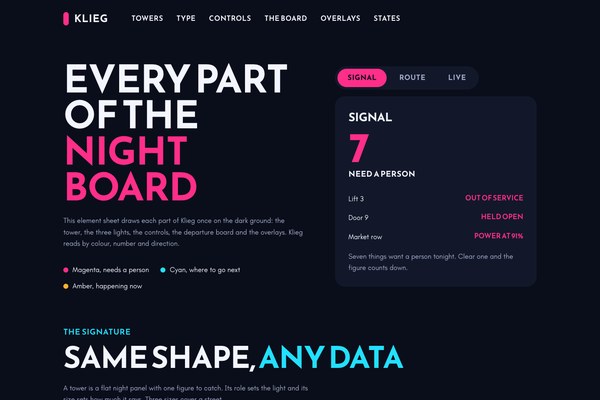
Klieg is a night wayfinding language. On a crowded street nobody reads a paragraph: you scan colour, number and the direction a sign points, then move. Klieg builds a page the same way. Everything sits on a deep blue-black ground, content lives in flat sign-towers with one big figure, and three lights do all the signalling: magenta for what needs a person, cyan for where to go next, amber for what is happening now. One full-strength night photograph per view supplies the glow, so the chrome stays flat and quiet, and type sits on calm ground, never on the busy part of the picture.
Generation 3 of Klieg, revised in place from the approved range-9 specimen (klieg-i, 2026-10-07). It keeps the night ground, the three lights, the lamp mark and the uppercase display, and replaces the spine, mono and glow system with flat sign-towers, new type and a calmer finish.
Scan-first and packed but parted: 8 to 20px gutters between towers and rows, 56 to 104px between sections, 17px minimum body text, and one muted sentence per tower.
Phones (390px) stack to one column, hide the nav links, swap both photographs for their tall crops with the type on the calm top half, and keep the departure board to line, destination and status. Tablets (834px) keep two-up towers, with the last spanning the row, and a single-column form. Above 1440px the content caps at 1200px and centres; only the hero and the band span the viewport.
halation-bloom
en-019efd92-d8a5-7640-a555-7664164f0bad
Long-exposure night photography in the Halation technique, run at full strength: bloom swells around every light, the wet street mirrors the neon, and the subject's edges glow against deep dark. Magenta, cyan and amber read as highlighter marks on the night. Each photograph keeps its brightest signage on one side and a calm dark wall on the other, where the words sit.
One full-bleed photograph at the top of the landing and one as a band lower down, painted with var(--hero-image) and var(--band-image), each in a wide crop and a tall crop for phones. Type sits on the calm dark wall (the top half of the tall crop on phones) and never on the bright side. The photograph's edge meets the flat ground with no fade, scrim or blur, and an embodiment uses the same photograph as one framed inset with its words on a flat surface beside it.
Gradient scrims or fades over the photograph, glass or blur panels over it, type on the bright side, a fourth hue, daylight, illustration, faces and readable signage text.
# Klieg

## Philosophy

Klieg is a night wayfinding language. On a crowded street nobody reads a paragraph: you scan colour, number and the direction a sign points, then move. Klieg builds a page the same way. Everything sits on a deep blue-black ground, content lives in flat sign-towers with one big figure, and three lights do all the signalling: magenta for what needs a person, cyan for where to go next, amber for what is happening now. One full-strength night photograph per view supplies the glow, so the chrome stays flat and quiet, and type sits on calm ground, never on the busy part of the picture.

### Values

- Read by colour, number and direction before any paragraph: the figure is the loudest thing in a tower.
- One shape, recoloured by role: the same sign-tower carries any data, and its role colour sits on the figure and the row words.
- Three lights used like highlighters on the night: magenta signals, cyan routes, amber marks what is live. A fourth colour is a mistake.
- The photograph carries the glow: bloom, wet street and bokeh live in the picture while the page stays flat.
- Type never sits on a busy picture: words go on the calm wall of the photograph or on a flat surface beside it.
- The page reads with no JavaScript, settled and lit.

### Anti-Values

- A stripe, rule or hairline on any side of a card, or a border in its place.
- Gradient scrims, glass, blur and glow laid over the photograph or the towers.
- A fourth accent, a pale ground, or semantic colours that read as primary.
- Tracked mono eyebrows, numbering with nothing to count, and arrow glyphs used as ornament.
- Long body copy as the main hierarchy device.

### Visual Character

- A deep blue-black ground #0A0E1A with flat tower panels #121829 and lifted controls #18203A, all at radius 24 or pill.
- Heavy uppercase Reem Kufi at -0.02em with one colour-pop word per headline, over plain 17 to 19px Teachers.
- The sign-tower: a title, one 64 to 104px figure in the role colour, a caption, three rows with the role colour on the value words, and one muted sentence.
- Three lights, magenta #FF2E88, cyan #22E0FF and amber #FFB02E, with the lamp mark (a 13 by 32px magenta pill) as the brand.
- Pill controls: 52px buttons with one glowing magenta primary, lifted-surface inputs, round lamp radios, rounded-square checkboxes and a switch that lights cyan.
- A full-strength night photograph in the Halation technique, bloom and wet reflections massed on one side and a calm dark wall on the other.
- A departure board of single lit strips at radius 16, parted by 8px gutters, each with a role chip, a lamp dot for state and an amber time.

### Lineage

> Generation 3 of Klieg, revised in place from the approved range-9 specimen (klieg-i, 2026-10-07). It keeps the night ground, the three lights, the lamp mark and the uppercase display, and replaces the spine, mono and glow system with flat sign-towers, new type and a calmer finish.

## Tokens

### Colors

| Name | Value |
|------|-------|
| bg | `#0A0E1A` |
| surface | `#121829` |
| surface_2 | `#18203A` |
| text | `#F4F6FF` |
| muted | `#A3ABCB` |
| border | `#232C47` |
| accent | `#FF2E88` |
| accent_2 | `#22E0FF` |
| accent_3 | `#FFB02E` |
| on_accent | `#0A0E1A` |
| success | `#4FE3C1` |
| warning | `#FFB02E` |
| error | `#FF7A5C` |
| info | `#22E0FF` |

### Typography

- **Heading Font**: Reem Kufi
- **Body Font**: Teachers
- **Heading Weight**: 700
- **Body Weight**: 400
- **Button Weight**: 700
- **Heading Transform**: uppercase
- **Letter Spacing**: -0.02em on display; -0.03em on tower figures; 0.03em to 0.05em on small uppercase labels and buttons
- **Base Size**: 17px
- **Line Height**: 1.6
- **Scale**: ["14.5px","17px","19px","22px","28px","36px","52px","72px","104px","132px"]
- **Google Fonts Url**: https://fonts.googleapis.com/css2?family=Reem+Kufi:wght@500;600;700&family=Teachers:wght@400;500;600;700&display=swap

### Radii

- **None**: 0px
- **Md**: 16px
- **Lg**: 24px
- **Full**: 9999px

### Shadows

- **Primary Glow**: 0 0 28px rgba(255,46,136,0.45), only on the one primary button
- **None**: everything else is flat; towers, menus and dialogs are lifted by a lighter surface, never by a shadow

### Spacing

- **Base**: 8px
- **Scale**: ["4px","8px","12px","16px","24px","32px","48px","64px","96px"]

### Surfaces

- **Treatment**: flat night panels on a deep blue-black ground, with one full-strength night photograph per view
- **Material**: Matte night surfaces in three tones: ground #0A0E1A, tower #121829 and lifted #18203A. Light is carried by the three colours and by the photograph, never by glass, blur or glow.
- **Card Style**: Sign-towers: flat #121829, radius 24px (16px on phones), no border, no stripe and no shadow. The role colour sits on the figure and on the row words.
- **Wells**: Inputs, selects, menus and dialogs sit on lifted #18203A; the track #232C47 is only a fill for sliders, switches, meters and unchecked marks.
- **Bg Pattern**: none; the ground is flat, and the photograph supplies the bloom

### Borders

- **Default Width**: 0
- **Style**: none
- **Character**: No borders, rules, hairlines or edge stripes on any side of any surface. Surfaces are parted by tone and by 8 to 20px gutters. The only outline in the language is the 3px cyan focus ring at a 3px offset.

### Motion

- **Duration**: 180ms
- **Easing**: cubic-bezier(0.2, 0, 0.1, 1)
- **Philosophy**: The page is settled and fully lit at load and reads with no JavaScript. Motion is limited to 180ms hover and focus changes, the cyan link sweep and the CSS-only role switch. prefers-reduced-motion removes the transitions.

### Controls

- **Height**: 52px (44 small, 58 large)
- **Radius**: 9999px on buttons, inputs, selects, tabs, chips and switches; 24px on textareas, menus, dialogs and towers; 16px on rows and items inside a 24px surface
- **Marks**: 36px checkbox with a 16px radius, 36px round radio, 64 by 36px switch, 36px slider handle on a 10px track

## Rules

### Composition

- Compose as a night street: a deep blue-black ground, the full-bleed photograph once at the top and once as a band, and the content in sign-towers on the ground between them.
- Put each answer in a sign-tower: one figure, three rows and one sentence. Choose the role first and let it set the light.
- Place words on the calm wall of the photograph or on a flat surface beside it, never on the bright side.
- Set three towers across on desktop, two on tablets (the last spans the row) and one on phones.

### Hierarchy

- One figure per tower at 64 to 104px in the role colour, then a 19px uppercase caption, then 17px rows.
- Headlines are uppercase Reem Kufi with one word in a light: section titles 36 to 72px, the hero 52 to 132px.
- Body is Teachers 400 at 17 to 19px, with muted #A3ABCB as the second tone.
- State is a lamp dot plus a word, never colour alone.

### Density

Scan-first and packed but parted: 8 to 20px gutters between towers and rows, 56 to 104px between sections, 17px minimum body text, and one muted sentence per tower.

### Signature Patterns

- The sign-tower: a flat 24px panel on the night ground carrying a title, one big figure, a caption, three rows and a sentence. It has no stripe, border or shadow.
- One shape, three lights: the role sets the light and the figure and the row words take it. Magenta signals, cyan routes, amber marks what is live.
- The lamp: a 13 by 32px magenta pill that marks the brand and, unlit in #232C47, an empty state.
- The night photograph: one full-strength Halation photograph per view, bloom on one side and a calm wall on the other, painted with var(--hero-image).
- The departure board: rows as separate lit strips, with a role chip, a lamp dot for state and an amber time.
- The role switch: choose Signal, Route or Live and the tower swaps its colour and its answer, in CSS alone.

## Layout

### Grid

- **Type**: night street of sign-towers between full-bleed photographs
- **Max Width**: 1200px content, centred; the hero and the band run edge to edge
- **Gutter**: 32px desktop, 16px phone
- **Column Behavior**: Towers sit three across above 1000px, two across on tablets with the last spanning the row, and one on phones; every grid child has min-width 0.

### Whitespace

- **Section Gap**: 56 to 104px, scaling with the viewport
- **Card Gap**: 8 to 20px of hard gutter between towers and rows
- **Content Padding**: 24 to 36px inside a tower, with 12px under its last row
- **Approach**: Gutters and tone do the separating. Space sits above every title, and the photograph keeps its own ground.

### Density

- **Default**: packed but parted
- **Comfortable**: {"button_height":"52px","input_height":"52px","row_height":"56 to 72px board rows"}

### Responsive

Phones (390px) stack to one column, hide the nav links, swap both photographs for their tall crops with the type on the calm top half, and keep the departure board to line, destination and status. Tablets (834px) keep two-up towers, with the last spanning the row, and a single-column form. Above 1440px the content caps at 1200px and centres; only the hero and the band span the viewport.

### Breakpoints

- **Mobile**: 390px
- **Phone Max**: 760px
- **Tablet**: 834px
- **Desktop**: 1280px
- **Wide**: 1440px
- **Ultrawide**: 2560px

## Guidance

### Do

- Put every answer in a sign-tower and let its role colour sit on the figure and the row words.
- Keep three lights on a deep night ground and give each one job.
- Lead with one big figure or word, then 17px rows; keep paragraphs short.
- Place type on a calm wall or a flat surface and give the photograph its own space.
- Pair state with a lamp dot and a word.
- Keep one primary button per view, the only glowing thing, and make other actions lifted pills or quiet words.
- Keep towers, menus, dialogs and rows at radius 16 or 24 and controls at 9999.

### Don't

- Don't add a stripe, rule, border or hairline to any side of a card.
- Don't lay a gradient scrim, glass or blur over the photograph or a tower.
- Don't add a fourth accent or let success, warning or error read as primary.
- Don't set type over the busy side of the picture.
- Don't use tracked mono eyebrows, numbering with nothing to count, or arrow glyphs.
- Don't glow any control except the one primary button.
- Don't wash the ground pale or box the nav into a pill.

### Accessibility

AA and better on the night ground: near-white #F4F6FF is 17.9:1 on #0A0E1A and 16.4:1 on a tower #121829; muted #A3ABCB is 8.5:1 on the ground, 7.8:1 on a tower and 7.1:1 on the lifted surface; magenta #FF2E88 is 5.5:1 on the ground and 5.1:1 on a tower; cyan #22E0FF is 12.1:1 and amber #FFB02E is 9.7:1 on a tower; the dark label #0A0E1A on each light is 5.5:1 or better; error #FF7A5C is 6.9:1 on a tower. State is always a word beside its lamp. The focus ring is 3px cyan at a 3px offset. The page and the role switch work with no JavaScript, and prefers-reduced-motion removes the transitions.

### Usage Context

Operations desks, dashboards and transit or venue boards, plus launch and event pages for products that run at night or at density: anywhere a person scans many live signals and must act on a few.

## Imagery Direction

### Pairs With

halation-bloom

### Art Style Id

en-019efd92-d8a5-7640-a555-7664164f0bad

### Summary

Long-exposure night photography in the Halation technique, run at full strength: bloom swells around every light, the wet street mirrors the neon, and the subject's edges glow against deep dark. Magenta, cyan and amber read as highlighter marks on the night. Each photograph keeps its brightest signage on one side and a calm dark wall on the other, where the words sit.

### Subjects

- a rain-soaked neon corridor of sign-towers
- a night viaduct over a station crossing
- a wet boulevard with reflected light streaks
- a single object rim-lit by night signage

### Usage

One full-bleed photograph at the top of the landing and one as a band lower down, painted with var(--hero-image) and var(--band-image), each in a wide crop and a tall crop for phones. Type sits on the calm dark wall (the top half of the tall crop on phones) and never on the bright side. The photograph's edge meets the flat ground with no fade, scrim or blur, and an embodiment uses the same photograph as one framed inset with its words on a flat surface beside it.

### Avoid

Gradient scrims or fades over the photograph, glass or blur panels over it, type on the bright side, a fourth hue, daylight, illustration, faces and readable signage text.
---
version: "alpha"
name: "Klieg"
description: "Klieg is a night wayfinding language. On a crowded street nobody reads a paragraph: you scan colour, number and the direction a sign points, then move. Klieg builds a page the same way. Everything sits on a deep blue-black ground, conten..."
colors:
  bg: "#0A0E1A"
  surface: "#121829"
  surface_2: "#18203A"
  text: "#F4F6FF"
  muted: "#A3ABCB"
  border: "#232C47"
  accent: "#FF2E88"
  accent_2: "#22E0FF"
  accent_3: "#FFB02E"
  on_accent: "#0A0E1A"
  success: "#4FE3C1"
  warning: "#FFB02E"
  error: "#FF7A5C"
  info: "#22E0FF"
typography:
  headline-lg:
    fontFamily: "Reem Kufi"
    fontSize: "2.075rem"
    fontWeight: 700
    lineHeight: 1.1
    letterSpacing: "-0.02em"
  headline-md:
    fontFamily: "Reem Kufi"
    fontSize: "1.66rem"
    fontWeight: 600
    lineHeight: 1.15
    letterSpacing: "-0.02em"
  body-md:
    fontFamily: "Teachers"
    fontSize: "17px"
    fontWeight: 400
    lineHeight: 1.5
    letterSpacing: "-0.02em"
  label-md:
    fontFamily: "Teachers"
    fontSize: "0.75rem"
    fontWeight: 600
    lineHeight: 1
    letterSpacing: "0.08em"
rounded:
  none: "0px"
  md: "16px"
  lg: "24px"
  full: "9999px"
spacing:
  base: "8px"
  xs: "4px"
  sm: "8px"
  md: "12px"
  lg: "16px"
  xl: "24px"
  2xl: "32px"
  3xl: "48px"
  4xl: "64px"
  step-8: "96px"
components:
  color-reference-bg:
    backgroundColor: "{colors.bg}"
  color-reference-surface:
    backgroundColor: "{colors.surface}"
  color-reference-surface_2:
    backgroundColor: "{colors.surface_2}"
  color-reference-text:
    backgroundColor: "{colors.text}"
  color-reference-muted:
    backgroundColor: "{colors.muted}"
  color-reference-border:
    backgroundColor: "{colors.border}"
  color-reference-accent:
    backgroundColor: "{colors.accent}"
  color-reference-accent_2:
    backgroundColor: "{colors.accent_2}"
  color-reference-accent_3:
    backgroundColor: "{colors.accent_3}"
  color-reference-on_accent:
    backgroundColor: "{colors.on_accent}"
  color-reference-success:
    backgroundColor: "{colors.success}"
  color-reference-warning:
    backgroundColor: "{colors.warning}"
  color-reference-error:
    backgroundColor: "{colors.error}"
  color-reference-info:
    backgroundColor: "{colors.info}"
  button-primary:
    backgroundColor: "{colors.accent}"
    textColor: "{colors.on_accent}"
    typography: "{typography.label-md}"
    rounded: "{rounded.md}"
    padding: "{spacing.md}"
  card-surface:
    backgroundColor: "{colors.surface}"
    textColor: "{colors.text}"
    rounded: "{rounded.md}"
    padding: "{spacing.md}"
  input-default:
    backgroundColor: "{colors.surface}"
    textColor: "{colors.text}"
    rounded: "{rounded.md}"
    height: "44px"
---

# Klieg

## Overview

Klieg is a night wayfinding language. On a crowded street nobody reads a paragraph: you scan colour, number and the direction a sign points, then move. Klieg builds a page the same way. Everything sits on a deep blue-black ground, content lives in flat sign-towers with one big figure, and three lights do all the signalling: magenta for what needs a person, cyan for where to go next, amber for what is happening now. One full-strength night photograph per view supplies the glow, so the chrome stays flat and quiet, and type sits on calm ground, never on the busy part of the picture.

### Values

- Read by colour, number and direction before any paragraph: the figure is the loudest thing in a tower.
- One shape, recoloured by role: the same sign-tower carries any data, and its role colour sits on the figure and the row words.
- Three lights used like highlighters on the night: magenta signals, cyan routes, amber marks what is live. A fourth colour is a mistake.
- The photograph carries the glow: bloom, wet street and bokeh live in the picture while the page stays flat.
- Type never sits on a busy picture: words go on the calm wall of the photograph or on a flat surface beside it.
- The page reads with no JavaScript, settled and lit.

### Anti-Values

- A stripe, rule or hairline on any side of a card, or a border in its place.
- Gradient scrims, glass, blur and glow laid over the photograph or the towers.
- A fourth accent, a pale ground, or semantic colours that read as primary.
- Tracked mono eyebrows, numbering with nothing to count, and arrow glyphs used as ornament.
- Long body copy as the main hierarchy device.

### Visual Character

- A deep blue-black ground #0A0E1A with flat tower panels #121829 and lifted controls #18203A, all at radius 24 or pill.
- Heavy uppercase Reem Kufi at -0.02em with one colour-pop word per headline, over plain 17 to 19px Teachers.
- The sign-tower: a title, one 64 to 104px figure in the role colour, a caption, three rows with the role colour on the value words, and one muted sentence.
- Three lights, magenta #FF2E88, cyan #22E0FF and amber #FFB02E, with the lamp mark (a 13 by 32px magenta pill) as the brand.
- Pill controls: 52px buttons with one glowing magenta primary, lifted-surface inputs, round lamp radios, rounded-square checkboxes and a switch that lights cyan.
- A full-strength night photograph in the Halation technique, bloom and wet reflections massed on one side and a calm dark wall on the other.
- A departure board of single lit strips at radius 16, parted by 8px gutters, each with a role chip, a lamp dot for state and an amber time.

### Lineage

> Generation 3 of Klieg, revised in place from the approved range-9 specimen (klieg-i, 2026-10-07). It keeps the night ground, the three lights, the lamp mark and the uppercase display, and replaces the spine, mono and glow system with flat sign-towers, new type and a calmer finish.

## Colors

Use the YAML color tokens as the normative palette. The prose below names the roles agents should preserve when generating UI.

| Token | Value |
|-------|-------|
| bg | `#0A0E1A` |
| surface | `#121829` |
| surface_2 | `#18203A` |
| text | `#F4F6FF` |
| muted | `#A3ABCB` |
| border | `#232C47` |
| accent | `#FF2E88` |
| accent_2 | `#22E0FF` |
| accent_3 | `#FFB02E` |
| on_accent | `#0A0E1A` |
| success | `#4FE3C1` |
| warning | `#FFB02E` |
| error | `#FF7A5C` |
| info | `#22E0FF` |

## Typography

Load the fonts from Google Fonts: https://fonts.googleapis.com/css2?family=Reem+Kufi:wght@500;600;700&family=Teachers:wght@400;500;600;700&display=swap

- **Headline-Lg**: Reem Kufi, 2.075rem, weight 700, line-height 1.1.
- **Headline-Md**: Reem Kufi, 1.66rem, weight 600, line-height 1.15.
- **Body-Md**: Teachers, 17px, weight 400, line-height 1.5.
- **Label-Md**: Teachers, 0.75rem, weight 600, line-height 1.

## Layout

### Spacing Tokens

- **Base**: `8px`
- **Xs**: `4px`
- **Sm**: `8px`
- **Md**: `12px`
- **Lg**: `16px`
- **Xl**: `24px`
- **2xl**: `32px`
- **3xl**: `48px`
- **4xl**: `64px`
- **Step-8**: `96px`

### Grid

- **Type**: night street of sign-towers between full-bleed photographs
- **Max Width**: 1200px content, centred; the hero and the band run edge to edge
- **Gutter**: 32px desktop, 16px phone
- **Column Behavior**: Towers sit three across above 1000px, two across on tablets with the last spanning the row, and one on phones; every grid child has min-width 0.

### Whitespace

- **Section Gap**: 56 to 104px, scaling with the viewport
- **Card Gap**: 8 to 20px of hard gutter between towers and rows
- **Content Padding**: 24 to 36px inside a tower, with 12px under its last row
- **Approach**: Gutters and tone do the separating. Space sits above every title, and the photograph keeps its own ground.

### Density

- **Default**: packed but parted
- **Comfortable**: {"button_height":"52px","input_height":"52px","row_height":"56 to 72px board rows"}

### Responsive

Phones (390px) stack to one column, hide the nav links, swap both photographs for their tall crops with the type on the calm top half, and keep the departure board to line, destination and status. Tablets (834px) keep two-up towers, with the last spanning the row, and a single-column form. Above 1440px the content caps at 1200px and centres; only the hero and the band span the viewport.

### Breakpoints

- **Mobile**: 390px
- **Phone Max**: 760px
- **Tablet**: 834px
- **Desktop**: 1280px
- **Wide**: 1440px
- **Ultrawide**: 2560px

## Elevation & Depth

### Shadows

- **Primary Glow**: 0 0 28px rgba(255,46,136,0.45), only on the one primary button
- **None**: everything else is flat; towers, menus and dialogs are lifted by a lighter surface, never by a shadow

## Shapes

### Rounded

- **None**: `0px`
- **Md**: `16px`
- **Lg**: `24px`
- **Full**: `9999px`

### Surfaces

- **Treatment**: flat night panels on a deep blue-black ground, with one full-strength night photograph per view
- **Material**: Matte night surfaces in three tones: ground #0A0E1A, tower #121829 and lifted #18203A. Light is carried by the three colours and by the photograph, never by glass, blur or glow.
- **Card Style**: Sign-towers: flat #121829, radius 24px (16px on phones), no border, no stripe and no shadow. The role colour sits on the figure and on the row words.
- **Wells**: Inputs, selects, menus and dialogs sit on lifted #18203A; the track #232C47 is only a fill for sliders, switches, meters and unchecked marks.
- **Bg Pattern**: none; the ground is flat, and the photograph supplies the bloom

### Borders

- **Default Width**: 0
- **Style**: none
- **Character**: No borders, rules, hairlines or edge stripes on any side of any surface. Surfaces are parted by tone and by 8 to 20px gutters. The only outline in the language is the 3px cyan focus ring at a 3px offset.

## Components

### Composition

- Compose as a night street: a deep blue-black ground, the full-bleed photograph once at the top and once as a band, and the content in sign-towers on the ground between them.
- Put each answer in a sign-tower: one figure, three rows and one sentence. Choose the role first and let it set the light.
- Place words on the calm wall of the photograph or on a flat surface beside it, never on the bright side.
- Set three towers across on desktop, two on tablets (the last spans the row) and one on phones.

### Hierarchy

- One figure per tower at 64 to 104px in the role colour, then a 19px uppercase caption, then 17px rows.
- Headlines are uppercase Reem Kufi with one word in a light: section titles 36 to 72px, the hero 52 to 132px.
- Body is Teachers 400 at 17 to 19px, with muted #A3ABCB as the second tone.
- State is a lamp dot plus a word, never colour alone.

### Density

Scan-first and packed but parted: 8 to 20px gutters between towers and rows, 56 to 104px between sections, 17px minimum body text, and one muted sentence per tower.

### Signature Patterns

- The sign-tower: a flat 24px panel on the night ground carrying a title, one big figure, a caption, three rows and a sentence. It has no stripe, border or shadow.
- One shape, three lights: the role sets the light and the figure and the row words take it. Magenta signals, cyan routes, amber marks what is live.
- The lamp: a 13 by 32px magenta pill that marks the brand and, unlit in #232C47, an empty state.
- The night photograph: one full-strength Halation photograph per view, bloom on one side and a calm wall on the other, painted with var(--hero-image).
- The departure board: rows as separate lit strips, with a role chip, a lamp dot for state and an amber time.
- The role switch: choose Signal, Route or Live and the tower swaps its colour and its answer, in CSS alone.

## shadcn/ui Usage

When the target app uses shadcn/ui, copy DESIGN.md with shadcn instead of the plain DESIGN.md. It contains the same Katagami design-language source plus the shadcn/ui primitives, imports, theme variables, component recipes, and preview-shot guidance.

DESIGN.md with shadcn: `/language/en-01a1379a-83fd-7f93-8ade-388498f2af63/DESIGN.with-shadcn.md`.

Machine-readable companions for automation: `/language/en-01a1379a-83fd-7f93-8ade-388498f2af63/shadcn.json` (registry theme), `/language/en-01a1379a-83fd-7f93-8ade-388498f2af63/shadcn-components.md` (component recipes) and `/language/en-01a1379a-83fd-7f93-8ade-388498f2af63/shadcn-shots.json` (preview shots). The human-facing handoff is still DESIGN.md with shadcn.

Install recommended primitives with `npx shadcn@latest add button card input textarea select dialog sheet tabs badge separator checkbox switch slider tooltip dropdown-menu table`.

Use these primitives in shadcn apps:
- button
- card
- input
- textarea
- select
- dialog
- sheet
- tabs
- badge
- separator
- checkbox
- switch
- slider
- tooltip
- dropdown-menu
- table

Implementation rule for agents: import shadcn primitives from `@/components/ui/*`, apply the generated CSS variables first, then compose the language-specific recipes from the companion MD. Katagami remains the source of truth; shadcn names are the implementation surface.

## Do's and Don'ts

- Do Put every answer in a sign-tower and let its role colour sit on the figure and the row words.
- Do Keep three lights on a deep night ground and give each one job.
- Do Lead with one big figure or word, then 17px rows; keep paragraphs short.
- Do Place type on a calm wall or a flat surface and give the photograph its own space.
- Do Pair state with a lamp dot and a word.
- Do Keep one primary button per view, the only glowing thing, and make other actions lifted pills or quiet words.
- Do Keep towers, menus, dialogs and rows at radius 16 or 24 and controls at 9999.
- Don't Don't add a stripe, rule, border or hairline to any side of a card.
- Don't Don't lay a gradient scrim, glass or blur over the photograph or a tower.
- Don't Don't add a fourth accent or let success, warning or error read as primary.
- Don't Don't set type over the busy side of the picture.
- Don't Don't use tracked mono eyebrows, numbering with nothing to count, or arrow glyphs.
- Don't Don't glow any control except the one primary button.
- Don't Don't wash the ground pale or box the nav into a pill.

### Accessibility

AA and better on the night ground: near-white #F4F6FF is 17.9:1 on #0A0E1A and 16.4:1 on a tower #121829; muted #A3ABCB is 8.5:1 on the ground, 7.8:1 on a tower and 7.1:1 on the lifted surface; magenta #FF2E88 is 5.5:1 on the ground and 5.1:1 on a tower; cyan #22E0FF is 12.1:1 and amber #FFB02E is 9.7:1 on a tower; the dark label #0A0E1A on each light is 5.5:1 or better; error #FF7A5C is 6.9:1 on a tower. State is always a word beside its lamp. The focus ring is 3px cyan at a 3px offset. The page and the role switch work with no JavaScript, and prefers-reduced-motion removes the transitions.

### Usage Context

Operations desks, dashboards and transit or venue boards, plus launch and event pages for products that run at night or at density: anywhere a person scans many live signals and must act on a few.

## Imagery Direction

### Pairs With

halation-bloom

### Art Style Id

en-019efd92-d8a5-7640-a555-7664164f0bad

### Summary

Long-exposure night photography in the Halation technique, run at full strength: bloom swells around every light, the wet street mirrors the neon, and the subject's edges glow against deep dark. Magenta, cyan and amber read as highlighter marks on the night. Each photograph keeps its brightest signage on one side and a calm dark wall on the other, where the words sit.

### Subjects

- a rain-soaked neon corridor of sign-towers
- a night viaduct over a station crossing
- a wet boulevard with reflected light streaks
- a single object rim-lit by night signage

### Usage

One full-bleed photograph at the top of the landing and one as a band lower down, painted with var(--hero-image) and var(--band-image), each in a wide crop and a tall crop for phones. Type sits on the calm dark wall (the top half of the tall crop on phones) and never on the bright side. The photograph's edge meets the flat ground with no fade, scrim or blur, and an embodiment uses the same photograph as one framed inset with its words on a flat surface beside it.

### Avoid

Gradient scrims or fades over the photograph, glass or blur panels over it, type on the bright side, a fourth hue, daylight, illustration, faces and readable signage text.
```json
{
  "$schema": "https://ui.shadcn.com/schema/registry-item.json",
  "name": "klieg",
  "type": "registry:theme",
  "title": "Klieg shadcn Theme",
  "cssVars": {
    "theme": {},
    "light": {
      "background": "#0A0E1A",
      "foreground": "#F4F6FF",
      "card": "#121829",
      "card-foreground": "#F4F6FF",
      "popover": "#121829",
      "popover-foreground": "#F4F6FF",
      "primary": "#F4F6FF",
      "primary-foreground": "#111111",
      "secondary": "#f4f4f5",
      "secondary-foreground": "#111111",
      "muted": "#A3ABCB",
      "muted-foreground": "#F4F6FF",
      "accent": "#FF2E88",
      "accent-foreground": "#ffffff",
      "destructive": "#FF7A5C",
      "border": "#232C47",
      "input": "#232C47",
      "ring": "#FF2E88",
      "chart-1": "#F4F6FF",
      "chart-2": "#f4f4f5",
      "chart-3": "#FF2E88",
      "chart-4": "#4FE3C1",
      "chart-5": "#FFB02E",
      "sidebar": "#121829",
      "sidebar-foreground": "#F4F6FF",
      "sidebar-primary": "#F4F6FF",
      "sidebar-primary-foreground": "#111111",
      "sidebar-accent": "#22E0FF",
      "sidebar-accent-foreground": "#111111",
      "sidebar-border": "#232C47",
      "sidebar-ring": "#FF2E88",
      "radius": "16px"
    },
    "dark": {
      "background": "#0f1115",
      "foreground": "#f8fafc",
      "card": "#181b22",
      "card-foreground": "#f8fafc",
      "popover": "#181b22",
      "popover-foreground": "#f8fafc",
      "primary": "#F4F6FF",
      "primary-foreground": "#111111",
      "secondary": "#252a33",
      "secondary-foreground": "#f8fafc",
      "muted": "#252a33",
      "muted-foreground": "#a1a1aa",
      "accent": "#FF2E88",
      "accent-foreground": "#ffffff",
      "destructive": "#FF7A5C",
      "border": "#303642",
      "input": "#303642",
      "ring": "#FF2E88",
      "chart-1": "#F4F6FF",
      "chart-2": "#f4f4f5",
      "chart-3": "#FF2E88",
      "chart-4": "#4FE3C1",
      "chart-5": "#FFB02E",
      "sidebar": "#181b22",
      "sidebar-foreground": "#f8fafc",
      "sidebar-primary": "#F4F6FF",
      "sidebar-primary-foreground": "#111111",
      "sidebar-accent": "#FF2E88",
      "sidebar-accent-foreground": "#ffffff",
      "sidebar-border": "#303642",
      "sidebar-ring": "#FF2E88",
      "radius": "16px"
    }
  },
  "meta": {
    "source": "katagami",
    "languageId": "en-01a1379a-83fd-7f93-8ade-388498f2af63",
    "slug": "klieg",
    "componentManifest": [
      "button",
      "card",
      "input",
      "textarea",
      "select",
      "dialog",
      "sheet",
      "tabs",
      "badge",
      "separator",
      "checkbox",
      "switch",
      "slider",
      "tooltip",
      "dropdown-menu",
      "table"
    ],
    "installCommand": "npx shadcn@latest add button card input textarea select dialog sheet tabs badge separator checkbox switch slider tooltip dropdown-menu table",
    "nativeTokenNames": {
      "colors": [
        "accent",
        "accent_2",
        "accent_3",
        "bg",
        "border",
        "error",
        "info",
        "muted",
        "on_accent",
        "success",
        "surface",
        "surface_2",
        "text",
        "warning"
      ],
      "typography": [
        "base_size",
        "body_font",
        "body_weight",
        "button_weight",
        "google_fonts_url",
        "heading_font",
        "heading_transform",
        "heading_weight",
        "letter_spacing",
        "line_height",
        "scale"
      ],
      "radii": [
        "full",
        "lg",
        "md",
        "none"
      ],
      "shadows": [
        "none",
        "primary_glow"
      ],
      "spacing": [
        "base",
        "scale"
      ],
      "surfaces": [
        "bg_pattern",
        "card_style",
        "material",
        "treatment",
        "wells"
      ],
      "borders": [
        "character",
        "default_width",
        "style"
      ],
      "motion": [
        "duration",
        "easing",
        "philosophy"
      ],
      "controls": [
        "height",
        "marks",
        "radius"
      ]
    }
  }
}
```The art style its pictures are drawn in and the colours its tokens carry.
The theme variables are generated from the tokens. Component recipes and preview shots have not been written for this language yet.
For an app that uses shadcn/ui: the DESIGN.md plus the install list, theme variables, component recipes, preview shots and a starter TSX file, in one Markdown file.
The same pieces as separate files: theme, CSS, TSX starter, recipes and the preview contract.
npx shadcn@latest add button card input textarea select dialog sheet tabs badge separator checkbox switch slider tooltip dropdown-menu table:root {
--background: #0A0E1A;
--foreground: #F4F6FF;
--card: #121829;
--card-foreground: #F4F6FF;
--popover: #121829;
--popover-foreground: #F4F6FF;
--primary: #F4F6FF;
--primary-foreground: #111111;
--secondary: #f4f4f5;
--secondary-foreground: #111111;
--muted: #A3ABCB;
--muted-foreground: #F4F6FF;
--accent: #FF2E88;
--accent-foreground: #ffffff;
--destructive: #FF7A5C;
--border: #232C47;
--input: #232C47;
--ring: #FF2E88;
--chart-1: #F4F6FF;
--chart-2: #f4f4f5;
--chart-3: #FF2E88;
--chart-4: #4FE3C1;
--chart-5: #FFB02E;
--sidebar: #121829;
--sidebar-foreground: #F4F6FF;
--sidebar-primary: #F4F6FF;
--sidebar-primary-foreground: #111111;
--sidebar-accent: #22E0FF;
--sidebar-accent-foreground: #111111;
--sidebar-border: #232C47;
--sidebar-ring: #FF2E88;
--radius: 16px;
}
.dark {
--background: #0f1115;
--foreground: #f8fafc;
--card: #181b22;
--card-foreground: #f8fafc;
--popover: #181b22;
--popover-foreground: #f8fafc;
--primary: #F4F6FF;
--primary-foreground: #111111;
--secondary: #252a33;
--secondary-foreground: #f8fafc;
--muted: #252a33;
--muted-foreground: #a1a1aa;
--accent: #FF2E88;
--accent-foreground: #ffffff;
--destructive: #FF7A5C;
--border: #303642;
--input: #303642;
--ring: #FF2E88;
--chart-1: #F4F6FF;
--chart-2: #f4f4f5;
--chart-3: #FF2E88;
--chart-4: #4FE3C1;
--chart-5: #FFB02E;
--sidebar: #181b22;
--sidebar-foreground: #f8fafc;
--sidebar-primary: #F4F6FF;
--sidebar-primary-foreground: #111111;
--sidebar-accent: #FF2E88;
--sidebar-accent-foreground: #ffffff;
--sidebar-border: #303642;
--sidebar-ring: #FF2E88;
--radius: 16px;
}
import { Badge } from "@/components/ui/badge";
import { Button } from "@/components/ui/button";
import {
  Card,
  CardContent,
  CardDescription,
  CardFooter,
  CardHeader,
  CardTitle,
} from "@/components/ui/card";
import { Input } from "@/components/ui/input";
import { Tabs, TabsList, TabsTrigger } from "@/components/ui/tabs";

export function KliegShadcnKit() {
  return (
    <section className="grid gap-4 rounded-[var(--radius)] border bg-background p-4 text-foreground">
      <div className="flex items-start justify-between gap-4">
        <div>
          <Badge variant="outline">shadcn/ui</Badge>
          <h2 className="mt-3 text-2xl font-semibold tracking-tight">Klieg</h2>
          <p className="mt-1 max-w-xl text-sm text-muted-foreground">
            Use the Katagami registry theme, then compose these shadcn primitives
            with the language-specific component recipes.
          </p>
        </div>
        <Button>Apply theme</Button>
      </div>

      <Tabs defaultValue="components">
        <TabsList>
          <TabsTrigger value="components">Components</TabsTrigger>
          <TabsTrigger value="states">States</TabsTrigger>
          <TabsTrigger value="export">Export</TabsTrigger>
        </TabsList>
      </Tabs>

      <Card>
        <CardHeader>
          <CardTitle>Component recipe</CardTitle>
          <CardDescription>
            Replace this starter content with the agent-authored product scene
            from components.md and preview-shots.json.
          </CardDescription>
        </CardHeader>
        <CardContent className="grid gap-3 sm:grid-cols-[1fr_auto]">
          <Input defaultValue="Tokenized shadcn surface" aria-label="Recipe name" />
          <Button variant="secondary">Preview state</Button>
        </CardContent>
        <CardFooter className="justify-between">
          <Badge>Ready</Badge>
          <Button variant="outline">Copy recipe</Button>
        </CardFooter>
      </Card>
    </section>
  );
}
{
  "$schema": "https://ui.shadcn.com/schema/registry-item.json",
  "name": "klieg",
  "type": "registry:theme",
  "title": "Klieg",
  "description": "A deep night ground with flat sign-towers recoloured by role: magenta signals, cyan routes, amber marks what is live. Pill controls, no borders or stripes, one glowing magenta primary.",
  "cssVars": {
    "theme": {
      "font-sans": "Teachers, system-ui, sans-serif",
      "font-mono": "Teachers, system-ui, sans-serif",
      "font-display": "Reem Kufi, system-ui, sans-serif",
      "radius": "24px"
    },
    "light": {
      "background": "#0A0E1A",
      "foreground": "#F4F6FF",
      "card": "#121829",
      "card-foreground": "#F4F6FF",
      "popover": "#18203A",
      "popover-foreground": "#F4F6FF",
      "primary": "#FF2E88",
      "primary-foreground": "#0A0E1A",
      "secondary": "#18203A",
      "secondary-foreground": "#F4F6FF",
      "muted": "#18203A",
      "muted-foreground": "#A3ABCB",
      "accent": "#232C47",
      "accent-foreground": "#F4F6FF",
      "destructive": "#FF7A5C",
      "destructive-foreground": "#0A0E1A",
      "border": "transparent",
      "input": "transparent",
      "ring": "#22E0FF",
      "chart-1": "#FF2E88",
      "chart-2": "#22E0FF",
      "chart-3": "#FFB02E",
      "chart-4": "#4FE3C1",
      "chart-5": "#FF7A5C",
      "radius": "24px"
    },
    "dark": {
      "background": "#0A0E1A",
      "foreground": "#F4F6FF",
      "card": "#121829",
      "card-foreground": "#F4F6FF",
      "popover": "#18203A",
      "popover-foreground": "#F4F6FF",
      "primary": "#FF2E88",
      "primary-foreground": "#0A0E1A",
      "secondary": "#18203A",
      "secondary-foreground": "#F4F6FF",
      "muted": "#18203A",
      "muted-foreground": "#A3ABCB",
      "accent": "#232C47",
      "accent-foreground": "#F4F6FF",
      "destructive": "#FF7A5C",
      "destructive-foreground": "#0A0E1A",
      "border": "transparent",
      "input": "transparent",
      "ring": "#22E0FF",
      "chart-1": "#FF2E88",
      "chart-2": "#22E0FF",
      "chart-3": "#FFB02E",
      "chart-4": "#4FE3C1",
      "chart-5": "#FF7A5C",
      "radius": "24px"
    }
  },
  "componentManifest": [
    "button",
    "card",
    "input",
    "textarea",
    "select",
    "dialog",
    "sheet",
    "tabs",
    "badge",
    "separator",
    "checkbox",
    "switch",
    "slider",
    "tooltip",
    "dropdown-menu",
    "table"
  ],
  "meta": {
    "nativeTokenNames": {
      "bg": "background",
      "surface": "card (the sign-tower)",
      "surface_2": "secondary / muted / popover (lifted pills, menus, dialogs)",
      "text": "foreground",
      "muted": "muted-foreground",
      "border": "native only (the track tone #232C47 rides on accent); --border stays transparent",
      "accent": "primary and chart-1 (magenta, Signal)",
      "accent_2": "ring and chart-2 (cyan, Route)",
      "accent_3": "chart-3 (amber, Live)",
      "on_accent": "primary-foreground",
      "success": "chart-4",
      "warning": "chart-3",
      "error": "destructive and chart-5",
      "info": "ring"
    },
    "note": "Klieg is a night language; the light scope repeats the dark values. The shadcn primary is the magenta button, the one action per view; cyan is the ring and the selected state, and amber is only for what is live.",
    "componentManifest": [
      "button",
      "card",
      "input",
      "textarea",
      "select",
      "dialog",
      "sheet",
      "tabs",
      "badge",
      "separator",
      "checkbox",
      "switch",
      "slider",
      "tooltip",
      "dropdown-menu",
      "table"
    ]
  }
}
---
artifact: component-recipes-v1
language: klieg
author: katagami-agent
primitives: 16
---

# Klieg shadcn/ui Components

Author: `katagami-agent`

## Intent

Klieg dresses shadcn/ui as a night wayfinding board: a deep blue-black ground, flat sign-towers (Cards) with one big figure whose role colour sits on the figure and the row words, pill controls, and three lights that each do one job. Nothing is boxed, striped or ruled: surfaces are parted by tone and 8 to 20px gutters, and lifted surfaces carry the inputs, menus and dialogs. One magenta button per view carries the only glow.

## Required primitives

button, card, input, textarea, select, dialog, sheet, tabs, badge, separator, checkbox, switch, slider, tooltip, dropdown-menu, table. Import them from `@/components/ui/*`; do not build a second component system.

## Token cues

```css
--background:#0A0E1A;
--foreground:#F4F6FF;
--card:#121829;
--card-foreground:#F4F6FF;
--popover:#18203A;
--popover-foreground:#F4F6FF;
--primary:#FF2E88;
--primary-foreground:#0A0E1A;
--secondary:#18203A;
--secondary-foreground:#F4F6FF;
--muted:#18203A;
--muted-foreground:#A3ABCB;
--accent:#232C47;
--accent-foreground:#F4F6FF;
--destructive:#FF7A5C;
--destructive-foreground:#0A0E1A;
--border:transparent;
--input:transparent;
--ring:#22E0FF;
--chart-1:#FF2E88;
--chart-2:#22E0FF;
--chart-3:#FFB02E;
--chart-4:#4FE3C1;
--chart-5:#FF7A5C;
--radius:24px;
```

Native names are kept in the theme: `surface_2`, `accent_2` and `accent_3` map to `secondary`, `ring` and `chart-3`; the track tone `#232C47` rides on shadcn `accent`, and `--border` stays transparent.

## Visual character to preserve

- The sign-tower is the Card: flat, 24px, one big figure in the role colour, three rows, one sentence. No stripe, ring or shadow on any side.
- Three lights, one job each: magenta signals and the primary action, cyan routes and selection and the focus ring, amber marks what is live.
- No borders, dividers or hairlines. Tone and 8 to 20px gutters part everything; lifted `#18203A` carries inputs, menus and dialogs.
- Pills for controls (`rounded-full`), 24px for surfaces, 16px for rows and items inside a surface.
- Reem Kufi uppercase for titles, figures, buttons and tabs; Teachers 400 at 17px for everything read.
- One glow in the language: the primary button. State is a lamp dot plus a word.

## ShadSync visual profile

- family: night-signage
- material: flat matte night panels with one full-strength night photograph
- contour: pill
- border: none
- underlay: False
- grain: False
- stickerBadges: False
- motion: 180ms hover and focus changes, a cyan link sweep
- density: packed but parted
- radius: 16, 24, 9999
- accents: magenta, cyan, amber

## Signature component recipes

- **button:** `h-[52px] rounded-full px-[30px] font-display text-[17px] font-bold uppercase tracking-[0.05em] whitespace-nowrap border-0`. `default` is `bg-primary text-primary-foreground` (magenta with a dark label) and the only glowing control, `shadow-[0_0_28px_rgba(255,46,136,0.45)]`, one per view; hover fills `bg-foreground` and active drops `translate-y-px`. `secondary` is `bg-secondary text-foreground hover:bg-accent`. `ghost` is a cyan word with a 3px sweep drawn under it (`after:origin-left after:scale-x-0 hover:after:scale-x-100`). `destructive` is `bg-secondary text-destructive` and fills coral on hover, never a solid block at rest. Sizes: `sm` is `h-11 px-[22px]` and `lg` is `h-[58px] px-[34px]`. Focus: `outline-[3px] outline-offset-[3px] outline-ring`.
- **card:** the sign-tower: `bg-card rounded-3xl border-0 shadow-none p-8 pb-3 gap-0` (`rounded-2xl` on phones). The title is the display face at 22 to 28px uppercase; one figure at `text-[clamp(64px,7vw,104px)]` takes the role colour (`text-primary` for Signal, `text-ring` for Route, `text-chart-3` for Live); rows are `flex justify-between pt-3` with the value in the role colour. No stripe, ring or shadow on any side. Never nest a Card in a Card.
- **input:** a lifted pill: `h-[52px] rounded-full border-0 bg-secondary px-[22px] text-[17px] shadow-none placeholder:text-muted-foreground hover:bg-accent`; focus is `outline-[3px] outline-offset-[3px] outline-ring` in cyan, not a border ring; an error turns the text `text-destructive` and prints the message beneath with a warning icon.
- **textarea:** the input pill at `min-h-[124px] rounded-3xl px-[22px] py-4 leading-[1.5]`, vertical resize only.
- **select:** the input pill with a custom 24px cyan chevron SVG at `right-5`; `SelectContent` is `bg-popover rounded-3xl p-2 border-0` and items are `rounded-2xl px-4 py-3` that take `bg-accent` when highlighted.
- **dialog:** `bg-popover rounded-3xl p-9 border-0 shadow-none` over a 70% night overlay (`bg-background/70`); a display-face title at 28px uppercase, a muted body, one magenta button and a quiet cyan word (Keep it open). It is lifted by its lighter fill, not by a shadow.
- **sheet:** a right-side `bg-popover rounded-l-3xl border-0` panel that slides in over 180ms on `cubic-bezier(.2,0,.1,1)`; it holds a board row's detail, with its figures in the display face.
- **tabs:** `TabsList` has no tray (`bg-transparent p-0 gap-2`); triggers are `h-11 rounded-full px-[22px] font-display uppercase tracking-[0.04em] text-muted-foreground`; the active trigger takes `bg-ring text-primary-foreground`. No underline and no bar.
- **badge:** a lamp and a word, not a filled pill: `bg-transparent p-0 gap-2.5 text-[17px] font-medium` with a 12px round dot before it (`bg-chart-4` lit, `bg-chart-3` boarding, `bg-destructive` dark or late, `bg-ring` rerouted). State is never colour alone.
- **separator:** do not draw one. Use 8 to 20px gutters between towers and rows and a change of tone between surfaces. There is no rule, border or hairline anywhere in the language.
- **checkbox:** `size-9 rounded-2xl border-0 bg-accent`; checked fills `bg-ring` with a drawn dark tick in `text-primary-foreground` at stroke 3.
- **switch:** a 64 by 36px `rounded-full bg-accent` track with a 28px `bg-muted-foreground` knob; checked turns the track `bg-ring` and the knob `bg-primary-foreground`, sliding 28px over 180ms.
- **slider:** a 10px `rounded-full bg-accent` track, a `bg-ring` range and a 28px `bg-foreground` round thumb; the value reads in the display face beside the label (62%).
- **tooltip:** `bg-foreground text-background rounded-2xl px-4 py-2.5 text-[17px] font-semibold`, no arrow, shown above its trigger on hover and focus.
- **dropdown-menu:** `bg-popover rounded-3xl p-2 border-0`; items are `rounded-2xl px-4 py-3 font-semibold` with a muted shortcut on the right and `bg-accent` when highlighted; a destructive item is `text-destructive` and sits apart by 8px of space, not by a line.
- **table:** the departure board. `border-separate border-spacing-y-2`; each row is its own strip: cells are `bg-card px-6 py-4`, the first cell `rounded-l-2xl` and the last `rounded-r-2xl`, and hover or the selected row takes `bg-secondary`. A cyan line chip, a lamp-dot state and an amber time in the display face. Header text is 14.5px `text-muted-foreground`; hide platform and time below 700px.

### The sign-tower and the role switch (the signature, outside shadcn)

The tower is a Card with a role. Set a `--c` custom property on it (magenta `#FF2E88` for Signal, cyan `#22E0FF` for Route, amber `#FFB02E` for Live) and let the figure and the row values read `color: var(--c)`. Nothing else on the tower changes: no stripe, ring, glow or shadow. The role switch is three radio inputs and a `~` sibling selector that shows the matching tower and fills the chosen pill with its light, so it works with no JavaScript. The photograph is one framed inset or the hero, painted with `var(--hero-image)`; type sits on a flat surface beside it or on its calm wall.

## Preview shots

- `application-shell`: The night board. The night ground with the lamp mark and plain nav words, a Signal sign-tower with its big magenta figure, the three board rows as lit strips with lamp-dot states, one magenta button and a near-white tooltip on a platform chip.
- `detail-editor`: Light a sign. A sign form on one lifted surface: a name pill, a corridor select with its cyan chevron, a sign-copy textarea, tell-me-by checkboxes, a lit-after-midnight switch, the brightness slider, a focused pill, an error pill, one magenta button and a quiet word.
- `data-operations`: The departure board. Word tabs for All lines, Boarding and Delayed, the platform menu open on a lifted surface, the departure board as lit strips with a cyan line chip, a lamp-dot state and an amber time, and a dialog asking to close a gate.

Each shot carries a renderable `scene` with headline, description, actions and rows or fields.

## Implementation contract

- Start from local `@/components/ui/*` shadcn primitives and apply `/katagami/shadcn/klieg/registry-theme.json`.
- Keep `--border` and `--input` transparent; the track tone `#232C47` is `--accent`, used for sliders, switches, meters and unchecked marks.
- Set `--radius: 24px`; buttons, inputs, tabs, chips and switches override it with `rounded-full`.
- One `default` (magenta) button per view; it is the only glowing control.
- No stripe, rule, border or hairline on any side of a Card or a row, and no separator lines.
- Keep type off the busy side of the photograph: no scrim, glass or blur.
- Respect `prefers-reduced-motion`: drop the 180ms transitions and the link sweep.

## Copy-paste component example

```tsx
import { Badge } from "@/components/ui/badge";
import { Button } from "@/components/ui/button";
import { Card, CardContent, CardHeader, CardTitle } from "@/components/ui/card";

const rows = [
  { label: "Lift 3", value: "Out of service", lamp: "bg-destructive" },
  { label: "Door 9", value: "Held open", lamp: "bg-chart-3" },
  { label: "Market row", value: "Power at 91%", lamp: "bg-chart-3" },
];

export function SignalTower() {
  return (
    <Card className="gap-0 rounded-3xl border-0 bg-card p-8 pb-3 shadow-none">
      <CardHeader className="p-0">
        <CardTitle className="font-display text-[28px] font-bold uppercase tracking-[-0.02em]">Signal</CardTitle>
      </CardHeader>
      <CardContent className="p-0">
        <p className="mt-3.5 font-display text-[clamp(64px,7vw,104px)] font-bold uppercase leading-[0.9] tracking-[-0.03em] text-primary">
          7
          <span className="mt-2 block text-[19px] leading-[1.2] tracking-[0.02em] text-foreground">need a person</span>
        </p>
        <ul className="mb-3.5 mt-5">
          {rows.map((r) => (
            <li key={r.label} className="mt-1.5 flex items-center justify-between gap-3 pt-3">
              <span>{r.label}</span>
              <Badge className="gap-2.5 bg-transparent p-0 text-[17px] font-medium text-primary">
                <span className={`size-3 rounded-full ${r.lamp}`} aria-hidden />
                {r.value}
              </Badge>
            </li>
          ))}
        </ul>
        <p className="my-5 text-muted-foreground">Seven things want a person tonight.</p>
        <Button className="mb-6 h-11 rounded-full px-[22px] font-display font-bold uppercase tracking-[0.05em] shadow-[0_0_28px_rgba(255,46,136,0.45)]">
          Send a guard
        </Button>
      </CardContent>
    </Card>
  );
}
```
{
  "artifact": "katagami:shadcn-preview-shots",
  "version": "preview-shots-v1",
  "schema": "katagami:shadcn-preview-shots/renderable-v1",
  "renderable": true,
  "author": "katagami-agent",
  "requiresVisualProfile": true,
  "language": {
    "id": "en-019efd9e-f923-72d0-991e-93036552815c",
    "name": "Klieg",
    "slug": "klieg"
  },
  "installCommand": "npx shadcn@latest add button card input textarea select dialog sheet tabs badge separator checkbox switch slider tooltip dropdown-menu table",
  "primitives": [
    "button",
    "card",
    "input",
    "textarea",
    "select",
    "dialog",
    "sheet",
    "tabs",
    "badge",
    "separator",
    "checkbox",
    "switch",
    "slider",
    "tooltip",
    "dropdown-menu",
    "table"
  ],
  "identityNotes": [
    "A sign-tower is a flat night panel with one big figure, and its role colour (magenta Signal, cyan Route, amber Live) sits on the figure and the row words.",
    "No borders, stripes, hairlines or dividers; surfaces are parted by tone and gutters, and the focus ring is the only outline.",
    "One magenta primary button per view, the only glowing control; state is a lamp dot plus a word.",
    "Reem Kufi uppercase for what is caught from across the hall, Teachers for what is read once you stop."
  ],
  "visualProfile": {
    "family": "night-signage",
    "material": "flat matte night panels with one full-strength night photograph",
    "contour": "pill",
    "border": "none",
    "underlay": false,
    "grain": false,
    "stickerBadges": false,
    "motion": "180ms hover and focus changes, a cyan link sweep",
    "density": "packed but parted",
    "radius": [
      16,
      24,
      9999
    ],
    "accents": [
      "magenta",
      "cyan",
      "amber"
    ]
  },
  "componentRecipes": [
    {
      "primitive": "button",
      "intent": "`h-[52px] rounded-full px-[30px] font-display text-[17px] font-bold uppercase tracking-[0.05em] whitespace-nowrap border-0`. `default` is `bg-primary text-primary-foreground` (magenta with a dark label) and the only glowing control, `shadow-[0_0_28px_rgba(255,46,136,0.45)]`, one per view; hover fills `bg-foreground` and active drops `translate-y-px`. `secondary` is `bg-secondary text-foreground hover:bg-accent`. `ghost` is a cyan word with a 3px sweep drawn under it (`after:origin-left after:scale-x-0 hover:after:scale-x-100`). `destructive` is `bg-secondary text-destructive` and fills coral on hover, never a solid block at rest. Sizes: `sm` is `h-11 px-[22px]` and `lg` is `h-[58px] px-[34px]`. Focus: `outline-[3px] outline-offset-[3px] outline-ring`.",
      "recipe": "`h-[52px] rounded-full px-[30px] font-display text-[17px] font-bold uppercase tracking-[0.05em] whitespace-nowrap border-0`. `default` is `bg-primary text-primary-foreground` (magenta with a dark label) and the only glowing control, `shadow-[0_0_28px_rgba(255,46,136,0.45)]`, one per view; hover fills `bg-foreground` and active drops `translate-y-px`. `secondary` is `bg-secondary text-foreground hover:bg-accent`. `ghost` is a cyan word with a 3px sweep drawn under it (`after:origin-left after:scale-x-0 hover:after:scale-x-100`). `destructive` is `bg-secondary text-destructive` and fills coral on hover, never a solid block at rest. Sizes: `sm` is `h-11 px-[22px]` and `lg` is `h-[58px] px-[34px]`. Focus: `outline-[3px] outline-offset-[3px] outline-ring`."
    },
    {
      "primitive": "card",
      "intent": "the sign-tower: `bg-card rounded-3xl border-0 shadow-none p-8 pb-3 gap-0` (`rounded-2xl` on phones). The title is the display face at 22 to 28px uppercase; one figure at `text-[clamp(64px,7vw,104px)]` takes the role colour (`text-primary` for Signal, `text-ring` for Route, `text-chart-3` for Live); rows are `flex justify-between pt-3` with the value in the role colour. No stripe, ring or shadow on any side. Never nest a Card in a Card.",
      "recipe": "the sign-tower: `bg-card rounded-3xl border-0 shadow-none p-8 pb-3 gap-0` (`rounded-2xl` on phones). The title is the display face at 22 to 28px uppercase; one figure at `text-[clamp(64px,7vw,104px)]` takes the role colour (`text-primary` for Signal, `text-ring` for Route, `text-chart-3` for Live); rows are `flex justify-between pt-3` with the value in the role colour. No stripe, ring or shadow on any side. Never nest a Card in a Card."
    },
    {
      "primitive": "input",
      "intent": "a lifted pill: `h-[52px] rounded-full border-0 bg-secondary px-[22px] text-[17px] shadow-none placeholder:text-muted-foreground hover:bg-accent`; focus is `outline-[3px] outline-offset-[3px] outline-ring` in cyan, not a border ring; an error turns the text `text-destructive` and prints the message beneath with a warning icon.",
      "recipe": "a lifted pill: `h-[52px] rounded-full border-0 bg-secondary px-[22px] text-[17px] shadow-none placeholder:text-muted-foreground hover:bg-accent`; focus is `outline-[3px] outline-offset-[3px] outline-ring` in cyan, not a border ring; an error turns the text `text-destructive` and prints the message beneath with a warning icon."
    },
    {
      "primitive": "textarea",
      "intent": "the input pill at `min-h-[124px] rounded-3xl px-[22px] py-4 leading-[1.5]`, vertical resize only.",
      "recipe": "the input pill at `min-h-[124px] rounded-3xl px-[22px] py-4 leading-[1.5]`, vertical resize only."
    },
    {
      "primitive": "select",
      "intent": "the input pill with a custom 24px cyan chevron SVG at `right-5`; `SelectContent` is `bg-popover rounded-3xl p-2 border-0` and items are `rounded-2xl px-4 py-3` that take `bg-accent` when highlighted.",
      "recipe": "the input pill with a custom 24px cyan chevron SVG at `right-5`; `SelectContent` is `bg-popover rounded-3xl p-2 border-0` and items are `rounded-2xl px-4 py-3` that take `bg-accent` when highlighted."
    },
    {
      "primitive": "dialog",
      "intent": "`bg-popover rounded-3xl p-9 border-0 shadow-none` over a 70% night overlay (`bg-background/70`); a display-face title at 28px uppercase, a muted body, one magenta button and a quiet cyan word (Keep it open). It is lifted by its lighter fill, not by a shadow.",
      "recipe": "`bg-popover rounded-3xl p-9 border-0 shadow-none` over a 70% night overlay (`bg-background/70`); a display-face title at 28px uppercase, a muted body, one magenta button and a quiet cyan word (Keep it open). It is lifted by its lighter fill, not by a shadow."
    },
    {
      "primitive": "sheet",
      "intent": "a right-side `bg-popover rounded-l-3xl border-0` panel that slides in over 180ms on `cubic-bezier(.2,0,.1,1)`; it holds a board row's detail, with its figures in the display face.",
      "recipe": "a right-side `bg-popover rounded-l-3xl border-0` panel that slides in over 180ms on `cubic-bezier(.2,0,.1,1)`; it holds a board row's detail, with its figures in the display face."
    },
    {
      "primitive": "tabs",
      "intent": "`TabsList` has no tray (`bg-transparent p-0 gap-2`); triggers are `h-11 rounded-full px-[22px] font-display uppercase tracking-[0.04em] text-muted-foreground`; the active trigger takes `bg-ring text-primary-foreground`. No underline and no bar.",
      "recipe": "`TabsList` has no tray (`bg-transparent p-0 gap-2`); triggers are `h-11 rounded-full px-[22px] font-display uppercase tracking-[0.04em] text-muted-foreground`; the active trigger takes `bg-ring text-primary-foreground`. No underline and no bar."
    },
    {
      "primitive": "badge",
      "intent": "a lamp and a word, not a filled pill: `bg-transparent p-0 gap-2.5 text-[17px] font-medium` with a 12px round dot before it (`bg-chart-4` lit, `bg-chart-3` boarding, `bg-destructive` dark or late, `bg-ring` rerouted). State is never colour alone.",
      "recipe": "a lamp and a word, not a filled pill: `bg-transparent p-0 gap-2.5 text-[17px] font-medium` with a 12px round dot before it (`bg-chart-4` lit, `bg-chart-3` boarding, `bg-destructive` dark or late, `bg-ring` rerouted). State is never colour alone."
    },
    {
      "primitive": "separator",
      "intent": "do not draw one. Use 8 to 20px gutters between towers and rows and a change of tone between surfaces. There is no rule, border or hairline anywhere in the language.",
      "recipe": "do not draw one. Use 8 to 20px gutters between towers and rows and a change of tone between surfaces. There is no rule, border or hairline anywhere in the language."
    },
    {
      "primitive": "checkbox",
      "intent": "`size-9 rounded-2xl border-0 bg-accent`; checked fills `bg-ring` with a drawn dark tick in `text-primary-foreground` at stroke 3.",
      "recipe": "`size-9 rounded-2xl border-0 bg-accent`; checked fills `bg-ring` with a drawn dark tick in `text-primary-foreground` at stroke 3."
    },
    {
      "primitive": "switch",
      "intent": "a 64 by 36px `rounded-full bg-accent` track with a 28px `bg-muted-foreground` knob; checked turns the track `bg-ring` and the knob `bg-primary-foreground`, sliding 28px over 180ms.",
      "recipe": "a 64 by 36px `rounded-full bg-accent` track with a 28px `bg-muted-foreground` knob; checked turns the track `bg-ring` and the knob `bg-primary-foreground`, sliding 28px over 180ms."
    },
    {
      "primitive": "slider",
      "intent": "a 10px `rounded-full bg-accent` track, a `bg-ring` range and a 28px `bg-foreground` round thumb; the value reads in the display face beside the label (62%).",
      "recipe": "a 10px `rounded-full bg-accent` track, a `bg-ring` range and a 28px `bg-foreground` round thumb; the value reads in the display face beside the label (62%)."
    },
    {
      "primitive": "tooltip",
      "intent": "`bg-foreground text-background rounded-2xl px-4 py-2.5 text-[17px] font-semibold`, no arrow, shown above its trigger on hover and focus.",
      "recipe": "`bg-foreground text-background rounded-2xl px-4 py-2.5 text-[17px] font-semibold`, no arrow, shown above its trigger on hover and focus."
    },
    {
      "primitive": "dropdown-menu",
      "intent": "`bg-popover rounded-3xl p-2 border-0`; items are `rounded-2xl px-4 py-3 font-semibold` with a muted shortcut on the right and `bg-accent` when highlighted; a destructive item is `text-destructive` and sits apart by 8px of space, not by a line.",
      "recipe": "`bg-popover rounded-3xl p-2 border-0`; items are `rounded-2xl px-4 py-3 font-semibold` with a muted shortcut on the right and `bg-accent` when highlighted; a destructive item is `text-destructive` and sits apart by 8px of space, not by a line."
    },
    {
      "primitive": "table",
      "intent": "the departure board. `border-separate border-spacing-y-2`; each row is its own strip: cells are `bg-card px-6 py-4`, the first cell `rounded-l-2xl` and the last `rounded-r-2xl`, and hover or the selected row takes `bg-secondary`. A cyan line chip, a lamp-dot state and an amber time in the display face. Header text is 14.5px `text-muted-foreground`; hide platform and time below 700px.",
      "recipe": "the departure board. `border-separate border-spacing-y-2`; each row is its own strip: cells are `bg-card px-6 py-4`, the first cell `rounded-l-2xl` and the last `rounded-r-2xl`, and hover or the selected row takes `bg-secondary`. A cyan line chip, a lamp-dot state and an amber time in the display face. Header text is 14.5px `text-muted-foreground`; hide platform and time below 700px."
    }
  ],
  "shots": [
    {
      "id": "application-shell",
      "title": "The night board",
      "viewport": "desktop",
      "primitives": [
        "button",
        "card",
        "badge",
        "table",
        "separator",
        "tooltip"
      ],
      "composition": "The night ground with the lamp mark and plain nav words, a Signal sign-tower with its big magenta figure, the three board rows as lit strips with lamp-dot states, one magenta button and a near-white tooltip on a platform chip.",
      "mustShow": [
        "a sign-tower with one big figure in the role colour",
        "one magenta button with the only glow",
        "lamp dots beside state words",
        "board rows as separate strips"
      ],
      "avoid": [
        "a stripe or border on any side of a card",
        "gradient scrims or glass",
        "a fourth accent colour",
        "tracked mono eyebrows"
      ],
      "mustShowStates": [
        "primary button",
        "needs a person",
        "near budget",
        "lit"
      ],
      "avoidRules": [
        "no borders",
        "no stripes",
        "no glow except the primary",
        "no emoji on buttons"
      ],
      "scene": {
        "eyebrow": "North hall, night desk",
        "headline": "Seven things need a person",
        "description": "Lift 3 is out, door 9 is held open and market row is at 91% power. Clear them from the board.",
        "primaryAction": "Send a guard",
        "secondaryAction": "Dim for the night",
        "rows": [
          {
            "label": "Lift 3",
            "value": "Out of service since 22:10",
            "status": "Needs a person"
          },
          {
            "label": "Door 9",
            "value": "Held open, one of one",
            "status": "Needs a person"
          },
          {
            "label": "Market row",
            "value": "Power at 91%",
            "status": "Near budget"
          },
          {
            "label": "North gate",
            "value": "3,870 through now",
            "status": "Lit"
          }
        ]
      }
    },
    {
      "id": "detail-editor",
      "title": "Light a sign",
      "viewport": "desktop",
      "primitives": [
        "card",
        "input",
        "select",
        "textarea",
        "checkbox",
        "switch",
        "slider",
        "button",
        "badge"
      ],
      "composition": "A sign form on one lifted surface: a name pill, a corridor select with its cyan chevron, a sign-copy textarea, tell-me-by checkboxes, a lit-after-midnight switch, the brightness slider, a focused pill, an error pill, one magenta button and a quiet word.",
      "mustShow": [
        "a focused pill with a cyan ring",
        "a custom cyan select chevron",
        "checked cyan checkbox",
        "switch on in cyan",
        "an error in coral text with an icon"
      ],
      "avoid": [
        "browser default controls",
        "outlined inputs",
        "square corners"
      ],
      "mustShowStates": [
        "focus ring",
        "checked",
        "switch on",
        "error",
        "primary button"
      ],
      "avoidRules": [
        "no borders",
        "no nested cards"
      ],
      "scene": {
        "eyebrow": "Corridor 7, north arcade",
        "headline": "Light a sign",
        "description": "Name it, pick the corridor and set how bright it burns. It goes live on the board the moment you save.",
        "primaryAction": "Save the sign",
        "secondaryAction": "Cancel",
        "fields": [
          {
            "label": "Sign name",
            "value": "North arcade, Corridor 7",
            "type": "text"
          },
          {
            "label": "Corridor",
            "value": "Corridor 7, main boulevard",
            "type": "select"
          },
          {
            "label": "Sign copy",
            "value": "Open until 02:00. Second bowl half price after midnight.",
            "type": "text"
          },
          {
            "label": "Brightness",
            "value": "62%",
            "type": "range"
          }
        ],
        "statuses": [
          "Focus",
          "Checked",
          "Lit"
        ]
      }
    },
    {
      "id": "data-operations",
      "title": "The departure board",
      "viewport": "desktop",
      "primitives": [
        "tabs",
        "dropdown-menu",
        "table",
        "badge",
        "dialog",
        "sheet",
        "button",
        "separator"
      ],
      "composition": "Word tabs for All lines, Boarding and Delayed, the platform menu open on a lifted surface, the departure board as lit strips with a cyan line chip, a lamp-dot state and an amber time, and a dialog asking to close a gate.",
      "mustShow": [
        "the active tab filled cyan",
        "the open platform menu",
        "a late row with a coral lamp",
        "the Close gate 4 dialog on a lifted surface"
      ],
      "avoid": [
        "row dividers",
        "solid red buttons",
        "a left bar on any row"
      ],
      "mustShowStates": [
        "active tab",
        "menu open",
        "row hover",
        "destructive word"
      ],
      "avoidRules": [
        "no dividers",
        "no stripes",
        "no fourth accent"
      ],
      "scene": {
        "eyebrow": "Harbour Hall, 23:40 to 00:32",
        "headline": "Rows you can read from the door",
        "description": "Five departures tonight. Line 2 is late and platform 5 is the only change.",
        "primaryAction": "Reroute line 2",
        "secondaryAction": "Close gate 4",
        "rows": [
          {
            "label": "Line 4, Harbour North",
            "value": "23:47",
            "status": "Boarding"
          },
          {
            "label": "Line 7, Kaji East",
            "value": "23:52",
            "status": "On time"
          },
          {
            "label": "Line 2, Old Market",
            "value": "00:04",
            "status": "Late 8 min"
          },
          {
            "label": "Line 4, Tower Bridge",
            "value": "00:17",
            "status": "On time"
          },
          {
            "label": "Line 9, Airport",
            "value": "00:25",
            "status": "New platform"
          }
        ],
        "statuses": [
          "Boarding",
          "On time",
          "Late 8 min",
          "New platform"
        ]
      }
    }
  ],
  "qualityRules": {
    "do": [
      "Put each answer in a sign-tower with one big figure in the role colour",
      "Part surfaces with tone and 8 to 20px gutters",
      "One magenta action per view",
      "Pair every state with a lamp dot and a word"
    ],
    "dont": [
      "No stripe, border, rule or hairline on any side of a card",
      "No gradient scrim, glass or blur",
      "No fourth accent colour",
      "No glow except the primary button",
      "No emoji on buttons"
    ]
  }
}
Keep Klieg and swap a palette and an art style onto it. The landing recolors live.
 Klieg