accent#A3161E
bg#F4EFE4
surface#E8DDCB
text#1E1B18
muted#6D5444
border#BBAE98
on accent#F7F4EC
success#4F6247
warning#7A5A2A
Kissaten is a quiet interface language for machine rooms kept as neighbourhood coffee shops.
Tokens and rules, ready for an agent to follow.
Each face set in this language's own words.
Kissaten
Kissaten
Kissaten is a quiet interface language for machine rooms kept as neighbourhood coffee shops.
Kissaten is a quiet interface language for machine rooms kept as neighbourhood coffee shops.
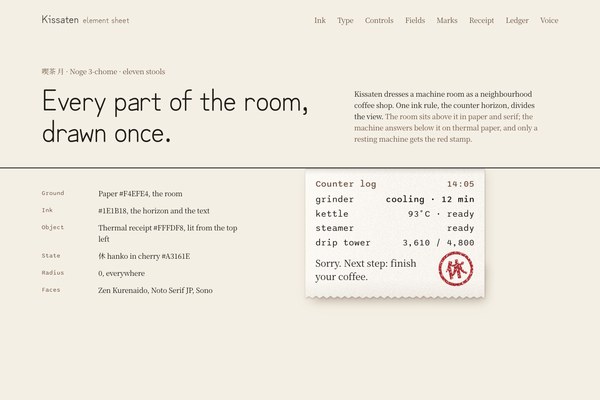
Kissaten is a quiet interface language for machine rooms kept as neighbourhood coffee shops. One ink rule, the counter horizon, divides the view: the room above it in warm paper, a soft hand and a fine serif, and the machine below it. The machine answers on one real object: a strip of thermal receipt paper fed out from under the counter, lit from the top left, carrying the log and a plain apology, and stamped with a cherry 休 hanko when a machine is resting. Everything else stays flat, small and precise, so the receipt is the only raised thing in a view.
Generation 3 of Kissaten, revised in place from the approved Inspora specimen (.p-kissaten-i, 2026-09-27). It keeps today's cream, ink, muted, the ink button, the faces, the order and the counter horizon, and turns the machine pane into one real object: a thermal receipt with a 休 hanko.
Calm product-page density: 128px between sections on desktop and 96px on phones, 18 to 28px row padding, one button per view, prose held to about 60 characters.
Phones (390px) stack to one column, keep only Hours in the nav, show the plain-paper side of the hero plate with the copy above the counter and the receipt centred below it, and hide non-essential table columns. Tablets (768 to 1100px) keep two-column lists with their own spacing. From 1800px the content caps and centres; only the hero spans the viewport.
ajiro
en-01a03f5b-7475-7dd2-a25e-16c4ae070ae3
Pen-and-ink plates in Ajiro's woven hatching and screentone on warm paper, drawn quiet: the counter seen straight on as a flat plank running edge to edge, a rainy shop window on one side, and open paper for type. The plate is graded so its paper meets the page's #F4EFE4 with no seam, and the drawn counter plank becomes the counter horizon the live receipt hangs from.
One full-bleed hero per landing: the Ajiro counter plate painted with var(--hero-image), background-position 50% 60% so the plank's lower edge stays at 60% of the hero height at every size, with the live receipt fed out from under it. Phones show the plate's plain-paper side. Inside pages carry no illustration; the receipt is the object.
Stools, cups, people or clutter in the hero plate; hatching under copy; colour patches; a ruled frame around the plate; photography, 3D renders, glow and gradients.
# Kissaten

## Philosophy

Kissaten is a quiet interface language for machine rooms kept as neighbourhood coffee shops. One ink rule, the counter horizon, divides the view: the room above it in warm paper, a soft hand and a fine serif, and the machine below it. The machine answers on one real object: a strip of thermal receipt paper fed out from under the counter, lit from the top left, carrying the log and a plain apology, and stamped with a cherry 休 hanko when a machine is resting. Everything else stays flat, small and precise, so the receipt is the only raised thing in a view.

### Values

- One object is the interface: the thermal receipt, fed out from under the counter horizon and shown whole once per page.
- Red is state, not decoration: the 休 hanko appears only on a resting machine, pressed once.
- Human-first diagnostics: every machine note says what happened, what is being done, and one thing you might try.
- Room first: warm paper, a soft hand for the one big light line, a fine 17px serif for prose, and the machine's print only where the machine speaks.
- Flat and precise around the object: separation by space and the value of the type, never by boxes or lines.

### Anti-Values

- Hairline card frames, corner ticks and tea-stained panes around everything.
- Decorative codes (EP.07, SEAT 3, BAY.2) and tracked uppercase mono used as ornament.
- A ruled paper field or window mullions laid under copy.
- Sage and amber status squares; colour that is not a state.
- Hostile error language, neon, glass, gradients on the page, and rounded corners.

### Visual Character

- Warm paper #F4EFE4 ground with espresso ink #1E1B18, flat, with no rule field or texture.
- The counter horizon: one full-bleed ink rule per view, the room above it and the machine below it.
- The thermal receipt #FFFDF8 hanging from under the horizon: a faint paper tooth, a slot shadow, a top-left light falloff, a torn serrated foot and a two-layer espresso shadow that widens toward the free end.
- The 休 hanko in cherry #A3161E, carved thick with ink voids, rotated -11deg, pressed onto the receipt as the grinder's state.
- Type that is small and quiet around one big light line: Zen Kurenaido 400 at 48 to 96px, Noto Serif JP at 17px in two tones (ink, then muted), Sono for what the machine prints.
- Square geometry: radius 0 on every button, well, chip and overlay.

### Lineage

> Generation 3 of Kissaten, revised in place from the approved Inspora specimen (.p-kissaten-i, 2026-09-27). It keeps today's cream, ink, muted, the ink button, the faces, the order and the counter horizon, and turns the machine pane into one real object: a thermal receipt with a 休 hanko.

## Tokens

### Colors

| Name | Value |
|------|-------|
| bg | `#F4EFE4` |
| surface | `#E8DDCB` |
| text | `#1E1B18` |
| muted | `#6D5444` |
| border | `#BBAE98` |
| accent | `#A3161E` |
| on_accent | `#F7F4EC` |
| success | `#4F6247` |
| warning | `#7A5A2A` |
| error | `#8B3A2E` |
| info | `#4D5C55` |
| receipt | `#FFFDF8` |
| shade | `#4A3220` |

### Derived

- **Paper Light**: color-mix(in srgb, var(--receipt) 70%, transparent), a 104deg falloff from the top-left corner of the receipt
- **Slot Shadow**: color-mix(in srgb, var(--text) 22%, transparent) fading to 7% at 1.1cqi and to nothing at 3.4cqi, where the paper leaves the counter
- **Row Hover**: color-mix(in srgb, var(--surface) 45%, transparent)
- **Receipt Shadow**: drop-shadow(.34cqi .53cqi .47cqi shade 26%) drop-shadow(1.25cqi 2.34cqi 2.8cqi shade 13%) plus a blurred shade 20% blob that widens toward the free end

### Typography

- **Heading Font**: Zen Kurenaido
- **Body Font**: Noto Serif JP
- **Mono Font**: Sono
- **Heading Weight**: 400
- **Body Weight**: 400
- **Button Weight**: 500
- **Mono Weight**: 400, 500 for the receipt rail and the verdict row
- **Heading Transform**: none
- **Letter Spacing**: -0.02em on display and body; 0 on Sono and on the wordmark
- **Base Size**: 17px
- **Line Height**: 1.58
- **Scale**: ["13px","14.5px","17px","20px","26px","36px","48px","72px","96px"]
- **Receipt Print**: Sono at 5cqi of the receipt width (15 to 22px), Noto Serif JP at 5.2cqi for the apology line
- **Google Fonts Url**: https://fonts.googleapis.com/css2?family=Noto+Serif+JP:wght@400;500&family=Sono:wght@400;500&family=Zen+Kurenaido&display=swap

### Radii

- **None**: 0px
- **Md**: 0px
- **Lg**: 0px
- **Full**: 0px

### Shadows

- **Receipt**: two layers tinted from --shade: a tight .34cqi .53cqi .47cqi at 26% and a soft 1.25cqi 2.34cqi 2.8cqi at 13%, only on the receipt
- **Lift**: 0 1px 2px shade 22%, 0 14px 32px -12px shade 30%, only on an open menu or dialog
- **None**: everything else is flat

### Spacing

- **Base**: 8px
- **Scale**: ["4px","8px","12px","16px","24px","32px","48px","64px","96px","128px"]

### Surfaces

- **Treatment**: one-object-on-warm-paper
- **Material**: The thermal receipt is the only material object: warm thermal paper #FFFDF8 with a faint tooth, a slot shadow where it leaves the counter, a top-left light falloff, a torn serrated foot and a two-layer shadow tinted espresso. Everything else is flat paper and ink.
- **Card Style**: No cards. Lists, menus, hours, ledgers and forms sit straight on the paper, parted by space and the value of the type.
- **Wells**: Tea #E8DDCB wells for inputs, the chosen tab and the checked segment; at most one filled surface per view.
- **Bg Pattern**: none; the paper is flat. The counter horizon is the only rule.

### Borders

- **Default Width**: 0
- **Style**: none
- **Character**: No borders, hairlines, corner ticks or card frames. The one line in the language is the counter horizon: a full-bleed ink rule (1 to 2px) between the room and the machine, once per view. Focus is a 2px ink outline at 3px offset; a focused field draws a 2px ink line under its well.

### Motion

- **Duration**: 180ms
- **Easing**: cubic-bezier(0.2, 0, 0.1, 1)
- **Print**: 1.9s: translateY(-101%) to 0 in steps(22), then a .6cqi dip on cubic-bezier(.3,.7,.4,1) and back
- **Press**: .5s cubic-bezier(.3,1.4,.5,1) at 1.45s: the hanko lands from scale 1.5 to .93 to 1 at -11deg
- **Reveal**: 900ms cubic-bezier(.2,0,.1,1), 16px rise, 80ms stagger, IntersectionObserver
- **Philosophy**: Motion is a physical verb: the receipt prints again and the stamp presses. Settled first, gated by .anim on html, and skipped under prefers-reduced-motion.

### Controls

- **Height**: 48px (40 small, 56 large)
- **Radius**: 0px
- **Well Height**: 52px

## Rules

### Composition

- Build every view on the counter horizon: the room above it, the machine below it.
- Give a view at most one object moment: the receipt hanging from the horizon, the stamp pressed beside a resting machine, or the torn stub on the counter. Show the whole hanging receipt once per page.
- Keep the object whole with paper on every side; the headline, the copy and one action sit on the ground beside it, never on a panel over it.
- Lists, menus, hours, ledgers and forms sit straight on the paper, parted by space; at most one filled surface (tea wells) per view.

### Hierarchy

- One big light line per view in Zen Kurenaido 400 (48px on phones, 72px on desktop, 96px from 1800px); section titles at 36px, 26px on phones.
- Prose in Noto Serif JP 400 at 17px, in two tones: the fact in ink, the reassurance in muted.
- Sono prints what the machine says: readings, times, labels and the receipt.
- State is a word at weight 500; a finished state steps back to muted 400; a resting machine gets the 休 hanko.

### Density

Calm product-page density: 128px between sections on desktop and 96px on phones, 18 to 28px row padding, one button per view, prose held to about 60 characters.

### Signature Patterns

- Counter horizon: one full-bleed ink rule per view, between the room above and the machine below; on the landing it is the drawn counter plank in the hero plate.
- The thermal receipt: warm thermal paper fed out from under the horizon, printed in Sono with the log and a plain apology, lit from the top left, with a torn foot and a two-layer espresso shadow.
- The 休 hanko: a cherry seal, carved thick with ink voids, pressed once as the state of a resting machine.
- Print it again: hover or focus the slot (or the one button) and the receipt drops back under the horizon, feeds out in twenty-two steps, dips and settles, then the hanko presses with a small overshoot.
- Humane notes: a Sono time, one sentence in ink saying what happened, one in muted saying what to do next.

## Layout

### Grid

- **Type**: object-first product page on a counter horizon
- **Max Width**: 1180px content on the landing and 1240px on the embodiment, 1320px from 1800px wide
- **Gutter**: 40px desktop, 32px tablet, 20px phone
- **Column Behavior**: Two-column heads use minmax(0,5fr) minmax(0,6fr); lists use minmax(0,1fr) columns; every grid child has min-width:0.

### Whitespace

- **Section Gap**: 128px desktop, 96px phone
- **Card Gap**: no cards; 18 to 28px row padding, 40 to 64px between groups
- **Content Padding**: content sits on the paper aligned to the grid edge; overlays pad 32px
- **Approach**: The paper is the table. Space and the value of the type do the separating; the counter horizon is the only line.

### Density

- **Default**: comfortable
- **Comfortable**: {"button_height":"48px","input_height":"52px","row_height":"56 to 72px list rows"}

### Responsive

Phones (390px) stack to one column, keep only Hours in the nav, show the plain-paper side of the hero plate with the copy above the counter and the receipt centred below it, and hide non-essential table columns. Tablets (768 to 1100px) keep two-column lists with their own spacing. From 1800px the content caps and centres; only the hero spans the viewport.

### Breakpoints

- **Mobile**: 390px
- **Phone Max**: 640px
- **Tablet**: 820 to 1100px
- **Desktop**: 1280px
- **Wide**: 1800px
- **Ultrawide**: 2560px

## Guidance

### Do

- Start from warm paper and ink; let the receipt be the only raised thing in a view.
- Hang the receipt from the counter horizon with paper on every side, whole and once per page.
- Spend cherry only on the 休 hanko of a resting machine.
- Write every machine note as what happened, what is being done, and one next step.
- Separate rows by space and type value; keep at most one filled surface per view.
- Keep one button per view; make a second action a word that inks up.
- Style every control explicitly, square, with a 2px ink focus outline.

### Don't

- Don't frame cards with hairlines, corner ticks or tea panes.
- Don't print decorative codes, episode numbers or tracked uppercase labels as ornament.
- Don't lay a rule field, mullions or texture under copy.
- Don't use red for anything but the resting stamp, and don't add sage or amber squares.
- Don't cover the hero plate with a panel or scrim, and don't show the hanging receipt twice on a page.
- Don't round corners, add glow or glass, or put emoji on buttons.

### Accessibility

AA and better on paper: ink #1E1B18 is 14.9:1 and muted #6D5444 is 6.1:1 on #F4EFE4; receipt print is 16.9:1 on #FFFDF8; the button label #F4EFE4 on ink is 14.9:1; the semantic inks clear 5.5:1 on paper and 4.7:1 on the tea well; the hanko is 6.8:1 on paper and always carries a word beside it. Focus is a 2px ink outline at 3px offset, or a 2px ink line under a well. The receipt's print verb runs only inside prefers-reduced-motion: no-preference, the settled receipt renders with no JavaScript, and the slot is a focusable button with a label.

### Usage Context

Calm developer tools, companion agents, maintenance consoles and service counters, and any product where a machine should feel patient, domestic and honest about when it needs a rest.

## Imagery Direction

### Pairs With

ajiro

### Art Style Id

en-01a03f5b-7475-7dd2-a25e-16c4ae070ae3

### Summary

Pen-and-ink plates in Ajiro's woven hatching and screentone on warm paper, drawn quiet: the counter seen straight on as a flat plank running edge to edge, a rainy shop window on one side, and open paper for type. The plate is graded so its paper meets the page's #F4EFE4 with no seam, and the drawn counter plank becomes the counter horizon the live receipt hangs from.

### Subjects

- the counter plank seen straight on
- a rainy shop window with wooden mullions
- the empty paper wall above the counter
- the underside of the counter lip

### Usage

One full-bleed hero per landing: the Ajiro counter plate painted with var(--hero-image), background-position 50% 60% so the plank's lower edge stays at 60% of the hero height at every size, with the live receipt fed out from under it. Phones show the plate's plain-paper side. Inside pages carry no illustration; the receipt is the object.

### Avoid

Stools, cups, people or clutter in the hero plate; hatching under copy; colour patches; a ruled frame around the plate; photography, 3D renders, glow and gradients.
---
version: "alpha"
name: "Kissaten"
description: "Kissaten is a quiet interface language for machine rooms kept as neighbourhood coffee shops. One ink rule, the counter horizon, divides the view: the room above it in warm paper, a soft hand and a fine serif, and the machine below it. Th..."
colors:
  bg: "#F4EFE4"
  surface: "#E8DDCB"
  text: "#1E1B18"
  muted: "#6D5444"
  border: "#BBAE98"
  accent: "#A3161E"
  on_accent: "#F7F4EC"
  success: "#4F6247"
  warning: "#7A5A2A"
  error: "#8B3A2E"
  info: "#4D5C55"
  receipt: "#FFFDF8"
  shade: "#4A3220"
typography:
  headline-lg:
    fontFamily: "Zen Kurenaido"
    fontSize: "2.075rem"
    fontWeight: 700
    lineHeight: 1.1
    letterSpacing: "-0.02em"
  headline-md:
    fontFamily: "Zen Kurenaido"
    fontSize: "1.66rem"
    fontWeight: 600
    lineHeight: 1.15
    letterSpacing: "-0.02em"
  body-md:
    fontFamily: "Noto Serif JP"
    fontSize: "17px"
    fontWeight: 400
    lineHeight: 1.5
    letterSpacing: "-0.02em"
  label-md:
    fontFamily: "Sono"
    fontSize: "0.75rem"
    fontWeight: 600
    lineHeight: 1
    letterSpacing: "0.08em"
rounded:
  none: "0px"
  md: "0px"
  lg: "0px"
  full: "0px"
spacing:
  base: "8px"
  xs: "4px"
  sm: "8px"
  md: "12px"
  lg: "16px"
  xl: "24px"
  2xl: "32px"
  3xl: "48px"
  4xl: "64px"
  step-8: "96px"
  step-9: "128px"
components:
  color-reference-bg:
    backgroundColor: "{colors.bg}"
  color-reference-surface:
    backgroundColor: "{colors.surface}"
  color-reference-text:
    backgroundColor: "{colors.text}"
  color-reference-muted:
    backgroundColor: "{colors.muted}"
  color-reference-border:
    backgroundColor: "{colors.border}"
  color-reference-accent:
    backgroundColor: "{colors.accent}"
  color-reference-on_accent:
    backgroundColor: "{colors.on_accent}"
  color-reference-success:
    backgroundColor: "{colors.success}"
  color-reference-warning:
    backgroundColor: "{colors.warning}"
  color-reference-error:
    backgroundColor: "{colors.error}"
  color-reference-info:
    backgroundColor: "{colors.info}"
  color-reference-receipt:
    backgroundColor: "{colors.receipt}"
  color-reference-shade:
    backgroundColor: "{colors.shade}"
  button-primary:
    backgroundColor: "{colors.accent}"
    textColor: "{colors.on_accent}"
    typography: "{typography.label-md}"
    rounded: "{rounded.md}"
    padding: "{spacing.md}"
  card-surface:
    backgroundColor: "{colors.surface}"
    textColor: "{colors.text}"
    rounded: "{rounded.md}"
    padding: "{spacing.md}"
  input-default:
    backgroundColor: "{colors.surface}"
    textColor: "{colors.text}"
    rounded: "{rounded.md}"
    height: "44px"
---

# Kissaten

## Overview

Kissaten is a quiet interface language for machine rooms kept as neighbourhood coffee shops. One ink rule, the counter horizon, divides the view: the room above it in warm paper, a soft hand and a fine serif, and the machine below it. The machine answers on one real object: a strip of thermal receipt paper fed out from under the counter, lit from the top left, carrying the log and a plain apology, and stamped with a cherry 休 hanko when a machine is resting. Everything else stays flat, small and precise, so the receipt is the only raised thing in a view.

### Values

- One object is the interface: the thermal receipt, fed out from under the counter horizon and shown whole once per page.
- Red is state, not decoration: the 休 hanko appears only on a resting machine, pressed once.
- Human-first diagnostics: every machine note says what happened, what is being done, and one thing you might try.
- Room first: warm paper, a soft hand for the one big light line, a fine 17px serif for prose, and the machine's print only where the machine speaks.
- Flat and precise around the object: separation by space and the value of the type, never by boxes or lines.

### Anti-Values

- Hairline card frames, corner ticks and tea-stained panes around everything.
- Decorative codes (EP.07, SEAT 3, BAY.2) and tracked uppercase mono used as ornament.
- A ruled paper field or window mullions laid under copy.
- Sage and amber status squares; colour that is not a state.
- Hostile error language, neon, glass, gradients on the page, and rounded corners.

### Visual Character

- Warm paper #F4EFE4 ground with espresso ink #1E1B18, flat, with no rule field or texture.
- The counter horizon: one full-bleed ink rule per view, the room above it and the machine below it.
- The thermal receipt #FFFDF8 hanging from under the horizon: a faint paper tooth, a slot shadow, a top-left light falloff, a torn serrated foot and a two-layer espresso shadow that widens toward the free end.
- The 休 hanko in cherry #A3161E, carved thick with ink voids, rotated -11deg, pressed onto the receipt as the grinder's state.
- Type that is small and quiet around one big light line: Zen Kurenaido 400 at 48 to 96px, Noto Serif JP at 17px in two tones (ink, then muted), Sono for what the machine prints.
- Square geometry: radius 0 on every button, well, chip and overlay.

### Lineage

> Generation 3 of Kissaten, revised in place from the approved Inspora specimen (.p-kissaten-i, 2026-09-27). It keeps today's cream, ink, muted, the ink button, the faces, the order and the counter horizon, and turns the machine pane into one real object: a thermal receipt with a 休 hanko.

## Colors

Use the YAML color tokens as the normative palette. The prose below names the roles agents should preserve when generating UI.

| Token | Value |
|-------|-------|
| bg | `#F4EFE4` |
| surface | `#E8DDCB` |
| text | `#1E1B18` |
| muted | `#6D5444` |
| border | `#BBAE98` |
| accent | `#A3161E` |
| on_accent | `#F7F4EC` |
| success | `#4F6247` |
| warning | `#7A5A2A` |
| error | `#8B3A2E` |
| info | `#4D5C55` |
| receipt | `#FFFDF8` |
| shade | `#4A3220` |

## Typography

Load the fonts from Google Fonts: https://fonts.googleapis.com/css2?family=Noto+Serif+JP:wght@400;500&family=Sono:wght@400;500&family=Zen+Kurenaido&display=swap

- **Headline-Lg**: Zen Kurenaido, 2.075rem, weight 700, line-height 1.1.
- **Headline-Md**: Zen Kurenaido, 1.66rem, weight 600, line-height 1.15.
- **Body-Md**: Noto Serif JP, 17px, weight 400, line-height 1.5.
- **Label-Md**: Sono, 0.75rem, weight 600, line-height 1.

## Layout

### Spacing Tokens

- **Base**: `8px`
- **Xs**: `4px`
- **Sm**: `8px`
- **Md**: `12px`
- **Lg**: `16px`
- **Xl**: `24px`
- **2xl**: `32px`
- **3xl**: `48px`
- **4xl**: `64px`
- **Step-8**: `96px`
- **Step-9**: `128px`

### Grid

- **Type**: object-first product page on a counter horizon
- **Max Width**: 1180px content on the landing and 1240px on the embodiment, 1320px from 1800px wide
- **Gutter**: 40px desktop, 32px tablet, 20px phone
- **Column Behavior**: Two-column heads use minmax(0,5fr) minmax(0,6fr); lists use minmax(0,1fr) columns; every grid child has min-width:0.

### Whitespace

- **Section Gap**: 128px desktop, 96px phone
- **Card Gap**: no cards; 18 to 28px row padding, 40 to 64px between groups
- **Content Padding**: content sits on the paper aligned to the grid edge; overlays pad 32px
- **Approach**: The paper is the table. Space and the value of the type do the separating; the counter horizon is the only line.

### Density

- **Default**: comfortable
- **Comfortable**: {"button_height":"48px","input_height":"52px","row_height":"56 to 72px list rows"}

### Responsive

Phones (390px) stack to one column, keep only Hours in the nav, show the plain-paper side of the hero plate with the copy above the counter and the receipt centred below it, and hide non-essential table columns. Tablets (768 to 1100px) keep two-column lists with their own spacing. From 1800px the content caps and centres; only the hero spans the viewport.

### Breakpoints

- **Mobile**: 390px
- **Phone Max**: 640px
- **Tablet**: 820 to 1100px
- **Desktop**: 1280px
- **Wide**: 1800px
- **Ultrawide**: 2560px

## Elevation & Depth

### Shadows

- **Receipt**: two layers tinted from --shade: a tight .34cqi .53cqi .47cqi at 26% and a soft 1.25cqi 2.34cqi 2.8cqi at 13%, only on the receipt
- **Lift**: 0 1px 2px shade 22%, 0 14px 32px -12px shade 30%, only on an open menu or dialog
- **None**: everything else is flat

## Shapes

### Rounded

- **None**: `0px`
- **Md**: `0px`
- **Lg**: `0px`
- **Full**: `0px`

### Surfaces

- **Treatment**: one-object-on-warm-paper
- **Material**: The thermal receipt is the only material object: warm thermal paper #FFFDF8 with a faint tooth, a slot shadow where it leaves the counter, a top-left light falloff, a torn serrated foot and a two-layer shadow tinted espresso. Everything else is flat paper and ink.
- **Card Style**: No cards. Lists, menus, hours, ledgers and forms sit straight on the paper, parted by space and the value of the type.
- **Wells**: Tea #E8DDCB wells for inputs, the chosen tab and the checked segment; at most one filled surface per view.
- **Bg Pattern**: none; the paper is flat. The counter horizon is the only rule.

### Borders

- **Default Width**: 0
- **Style**: none
- **Character**: No borders, hairlines, corner ticks or card frames. The one line in the language is the counter horizon: a full-bleed ink rule (1 to 2px) between the room and the machine, once per view. Focus is a 2px ink outline at 3px offset; a focused field draws a 2px ink line under its well.

## Components

### Composition

- Build every view on the counter horizon: the room above it, the machine below it.
- Give a view at most one object moment: the receipt hanging from the horizon, the stamp pressed beside a resting machine, or the torn stub on the counter. Show the whole hanging receipt once per page.
- Keep the object whole with paper on every side; the headline, the copy and one action sit on the ground beside it, never on a panel over it.
- Lists, menus, hours, ledgers and forms sit straight on the paper, parted by space; at most one filled surface (tea wells) per view.

### Hierarchy

- One big light line per view in Zen Kurenaido 400 (48px on phones, 72px on desktop, 96px from 1800px); section titles at 36px, 26px on phones.
- Prose in Noto Serif JP 400 at 17px, in two tones: the fact in ink, the reassurance in muted.
- Sono prints what the machine says: readings, times, labels and the receipt.
- State is a word at weight 500; a finished state steps back to muted 400; a resting machine gets the 休 hanko.

### Density

Calm product-page density: 128px between sections on desktop and 96px on phones, 18 to 28px row padding, one button per view, prose held to about 60 characters.

### Signature Patterns

- Counter horizon: one full-bleed ink rule per view, between the room above and the machine below; on the landing it is the drawn counter plank in the hero plate.
- The thermal receipt: warm thermal paper fed out from under the horizon, printed in Sono with the log and a plain apology, lit from the top left, with a torn foot and a two-layer espresso shadow.
- The 休 hanko: a cherry seal, carved thick with ink voids, pressed once as the state of a resting machine.
- Print it again: hover or focus the slot (or the one button) and the receipt drops back under the horizon, feeds out in twenty-two steps, dips and settles, then the hanko presses with a small overshoot.
- Humane notes: a Sono time, one sentence in ink saying what happened, one in muted saying what to do next.

## shadcn/ui Usage

When the target app uses shadcn/ui, copy DESIGN.md with shadcn instead of the plain DESIGN.md. It contains the same Katagami design-language source plus the shadcn/ui primitives, imports, theme variables, component recipes, and preview-shot guidance.

DESIGN.md with shadcn: `/language/en-01a0eca4-0d9f-7072-b71e-29c924c659be/DESIGN.with-shadcn.md`.

Machine-readable companions for automation: `/language/en-01a0eca4-0d9f-7072-b71e-29c924c659be/shadcn.json` (registry theme), `/language/en-01a0eca4-0d9f-7072-b71e-29c924c659be/shadcn-components.md` (component recipes) and `/language/en-01a0eca4-0d9f-7072-b71e-29c924c659be/shadcn-shots.json` (preview shots). The human-facing handoff is still DESIGN.md with shadcn.

Install recommended primitives with `npx shadcn@latest add button card input textarea select dialog sheet tabs badge separator checkbox switch slider tooltip dropdown-menu table`.

Use these primitives in shadcn apps:
- button
- card
- input
- textarea
- select
- dialog
- sheet
- tabs
- badge
- separator
- checkbox
- switch
- slider
- tooltip
- dropdown-menu
- table

Implementation rule for agents: import shadcn primitives from `@/components/ui/*`, apply the generated CSS variables first, then compose the language-specific recipes from the companion MD. Katagami remains the source of truth; shadcn names are the implementation surface.

## Do's and Don'ts

- Do Start from warm paper and ink; let the receipt be the only raised thing in a view.
- Do Hang the receipt from the counter horizon with paper on every side, whole and once per page.
- Do Spend cherry only on the 休 hanko of a resting machine.
- Do Write every machine note as what happened, what is being done, and one next step.
- Do Separate rows by space and type value; keep at most one filled surface per view.
- Do Keep one button per view; make a second action a word that inks up.
- Do Style every control explicitly, square, with a 2px ink focus outline.
- Don't Don't frame cards with hairlines, corner ticks or tea panes.
- Don't Don't print decorative codes, episode numbers or tracked uppercase labels as ornament.
- Don't Don't lay a rule field, mullions or texture under copy.
- Don't Don't use red for anything but the resting stamp, and don't add sage or amber squares.
- Don't Don't cover the hero plate with a panel or scrim, and don't show the hanging receipt twice on a page.
- Don't Don't round corners, add glow or glass, or put emoji on buttons.

### Accessibility

AA and better on paper: ink #1E1B18 is 14.9:1 and muted #6D5444 is 6.1:1 on #F4EFE4; receipt print is 16.9:1 on #FFFDF8; the button label #F4EFE4 on ink is 14.9:1; the semantic inks clear 5.5:1 on paper and 4.7:1 on the tea well; the hanko is 6.8:1 on paper and always carries a word beside it. Focus is a 2px ink outline at 3px offset, or a 2px ink line under a well. The receipt's print verb runs only inside prefers-reduced-motion: no-preference, the settled receipt renders with no JavaScript, and the slot is a focusable button with a label.

### Usage Context

Calm developer tools, companion agents, maintenance consoles and service counters, and any product where a machine should feel patient, domestic and honest about when it needs a rest.

## Imagery Direction

### Pairs With

ajiro

### Art Style Id

en-01a03f5b-7475-7dd2-a25e-16c4ae070ae3

### Summary

Pen-and-ink plates in Ajiro's woven hatching and screentone on warm paper, drawn quiet: the counter seen straight on as a flat plank running edge to edge, a rainy shop window on one side, and open paper for type. The plate is graded so its paper meets the page's #F4EFE4 with no seam, and the drawn counter plank becomes the counter horizon the live receipt hangs from.

### Subjects

- the counter plank seen straight on
- a rainy shop window with wooden mullions
- the empty paper wall above the counter
- the underside of the counter lip

### Usage

One full-bleed hero per landing: the Ajiro counter plate painted with var(--hero-image), background-position 50% 60% so the plank's lower edge stays at 60% of the hero height at every size, with the live receipt fed out from under it. Phones show the plate's plain-paper side. Inside pages carry no illustration; the receipt is the object.

### Avoid

Stools, cups, people or clutter in the hero plate; hatching under copy; colour patches; a ruled frame around the plate; photography, 3D renders, glow and gradients.
```json
{
  "$schema": "https://ui.shadcn.com/schema/registry-item.json",
  "name": "kissaten",
  "type": "registry:theme",
  "title": "Kissaten shadcn Theme",
  "cssVars": {
    "theme": {},
    "light": {
      "background": "#F4EFE4",
      "foreground": "#1E1B18",
      "card": "#E8DDCB",
      "card-foreground": "#1E1B18",
      "popover": "#E8DDCB",
      "popover-foreground": "#1E1B18",
      "primary": "#1E1B18",
      "primary-foreground": "#ffffff",
      "secondary": "#f4f4f5",
      "secondary-foreground": "#111111",
      "muted": "#6D5444",
      "muted-foreground": "#1E1B18",
      "accent": "#A3161E",
      "accent-foreground": "#ffffff",
      "destructive": "#8B3A2E",
      "border": "#BBAE98",
      "input": "#BBAE98",
      "ring": "#A3161E",
      "chart-1": "#1E1B18",
      "chart-2": "#f4f4f5",
      "chart-3": "#A3161E",
      "chart-4": "#4F6247",
      "chart-5": "#7A5A2A",
      "sidebar": "#E8DDCB",
      "sidebar-foreground": "#1E1B18",
      "sidebar-primary": "#1E1B18",
      "sidebar-primary-foreground": "#ffffff",
      "sidebar-accent": "#4D5C55",
      "sidebar-accent-foreground": "#ffffff",
      "sidebar-border": "#BBAE98",
      "sidebar-ring": "#A3161E",
      "radius": "0px"
    },
    "dark": {
      "background": "#0f1115",
      "foreground": "#f8fafc",
      "card": "#181b22",
      "card-foreground": "#f8fafc",
      "popover": "#181b22",
      "popover-foreground": "#f8fafc",
      "primary": "#1E1B18",
      "primary-foreground": "#ffffff",
      "secondary": "#252a33",
      "secondary-foreground": "#f8fafc",
      "muted": "#252a33",
      "muted-foreground": "#a1a1aa",
      "accent": "#A3161E",
      "accent-foreground": "#ffffff",
      "destructive": "#8B3A2E",
      "border": "#303642",
      "input": "#303642",
      "ring": "#A3161E",
      "chart-1": "#1E1B18",
      "chart-2": "#f4f4f5",
      "chart-3": "#A3161E",
      "chart-4": "#4F6247",
      "chart-5": "#7A5A2A",
      "sidebar": "#181b22",
      "sidebar-foreground": "#f8fafc",
      "sidebar-primary": "#1E1B18",
      "sidebar-primary-foreground": "#ffffff",
      "sidebar-accent": "#A3161E",
      "sidebar-accent-foreground": "#ffffff",
      "sidebar-border": "#303642",
      "sidebar-ring": "#A3161E",
      "radius": "0px"
    }
  },
  "meta": {
    "source": "katagami",
    "languageId": "en-01a0eca4-0d9f-7072-b71e-29c924c659be",
    "slug": "kissaten",
    "componentManifest": [
      "button",
      "card",
      "input",
      "textarea",
      "select",
      "dialog",
      "sheet",
      "tabs",
      "badge",
      "separator",
      "checkbox",
      "switch",
      "slider",
      "tooltip",
      "dropdown-menu",
      "table"
    ],
    "installCommand": "npx shadcn@latest add button card input textarea select dialog sheet tabs badge separator checkbox switch slider tooltip dropdown-menu table",
    "nativeTokenNames": {
      "colors": [
        "accent",
        "bg",
        "border",
        "error",
        "info",
        "muted",
        "on_accent",
        "receipt",
        "shade",
        "success",
        "surface",
        "text",
        "warning"
      ],
      "derived": [
        "paper_light",
        "receipt_shadow",
        "row_hover",
        "slot_shadow"
      ],
      "typography": [
        "base_size",
        "body_font",
        "body_weight",
        "button_weight",
        "google_fonts_url",
        "heading_font",
        "heading_transform",
        "heading_weight",
        "letter_spacing",
        "line_height",
        "mono_font",
        "mono_weight",
        "receipt_print",
        "scale"
      ],
      "radii": [
        "full",
        "lg",
        "md",
        "none"
      ],
      "shadows": [
        "lift",
        "none",
        "receipt"
      ],
      "spacing": [
        "base",
        "scale"
      ],
      "surfaces": [
        "bg_pattern",
        "card_style",
        "material",
        "treatment",
        "wells"
      ],
      "borders": [
        "character",
        "default_width",
        "style"
      ],
      "motion": [
        "duration",
        "easing",
        "philosophy",
        "press",
        "print",
        "reveal"
      ],
      "controls": [
        "height",
        "radius",
        "well_height"
      ]
    }
  }
}
```The art style its pictures are drawn in and the colours its tokens carry.
The theme variables are generated from the tokens. Component recipes and preview shots have not been written for this language yet.
For an app that uses shadcn/ui: the DESIGN.md plus the install list, theme variables, component recipes, preview shots and a starter TSX file, in one Markdown file.
The same pieces as separate files: theme, CSS, TSX starter, recipes and the preview contract.
npx shadcn@latest add button card input textarea select dialog sheet tabs badge separator checkbox switch slider tooltip dropdown-menu table:root {
--background: #F4EFE4;
--foreground: #1E1B18;
--card: #E8DDCB;
--card-foreground: #1E1B18;
--popover: #E8DDCB;
--popover-foreground: #1E1B18;
--primary: #1E1B18;
--primary-foreground: #ffffff;
--secondary: #f4f4f5;
--secondary-foreground: #111111;
--muted: #6D5444;
--muted-foreground: #1E1B18;
--accent: #A3161E;
--accent-foreground: #ffffff;
--destructive: #8B3A2E;
--border: #BBAE98;
--input: #BBAE98;
--ring: #A3161E;
--chart-1: #1E1B18;
--chart-2: #f4f4f5;
--chart-3: #A3161E;
--chart-4: #4F6247;
--chart-5: #7A5A2A;
--sidebar: #E8DDCB;
--sidebar-foreground: #1E1B18;
--sidebar-primary: #1E1B18;
--sidebar-primary-foreground: #ffffff;
--sidebar-accent: #4D5C55;
--sidebar-accent-foreground: #ffffff;
--sidebar-border: #BBAE98;
--sidebar-ring: #A3161E;
--radius: 0px;
}
.dark {
--background: #0f1115;
--foreground: #f8fafc;
--card: #181b22;
--card-foreground: #f8fafc;
--popover: #181b22;
--popover-foreground: #f8fafc;
--primary: #1E1B18;
--primary-foreground: #ffffff;
--secondary: #252a33;
--secondary-foreground: #f8fafc;
--muted: #252a33;
--muted-foreground: #a1a1aa;
--accent: #A3161E;
--accent-foreground: #ffffff;
--destructive: #8B3A2E;
--border: #303642;
--input: #303642;
--ring: #A3161E;
--chart-1: #1E1B18;
--chart-2: #f4f4f5;
--chart-3: #A3161E;
--chart-4: #4F6247;
--chart-5: #7A5A2A;
--sidebar: #181b22;
--sidebar-foreground: #f8fafc;
--sidebar-primary: #1E1B18;
--sidebar-primary-foreground: #ffffff;
--sidebar-accent: #A3161E;
--sidebar-accent-foreground: #ffffff;
--sidebar-border: #303642;
--sidebar-ring: #A3161E;
--radius: 0px;
}
import { Badge } from "@/components/ui/badge";
import { Button } from "@/components/ui/button";
import {
  Card,
  CardContent,
  CardDescription,
  CardFooter,
  CardHeader,
  CardTitle,
} from "@/components/ui/card";
import { Input } from "@/components/ui/input";
import { Tabs, TabsList, TabsTrigger } from "@/components/ui/tabs";

export function KissatenShadcnKit() {
  return (
    <section className="grid gap-4 rounded-[var(--radius)] border bg-background p-4 text-foreground">
      <div className="flex items-start justify-between gap-4">
        <div>
          <Badge variant="outline">shadcn/ui</Badge>
          <h2 className="mt-3 text-2xl font-semibold tracking-tight">Kissaten</h2>
          <p className="mt-1 max-w-xl text-sm text-muted-foreground">
            Use the Katagami registry theme, then compose these shadcn primitives
            with the language-specific component recipes.
          </p>
        </div>
        <Button>Apply theme</Button>
      </div>

      <Tabs defaultValue="components">
        <TabsList>
          <TabsTrigger value="components">Components</TabsTrigger>
          <TabsTrigger value="states">States</TabsTrigger>
          <TabsTrigger value="export">Export</TabsTrigger>
        </TabsList>
      </Tabs>

      <Card>
        <CardHeader>
          <CardTitle>Component recipe</CardTitle>
          <CardDescription>
            Replace this starter content with the agent-authored product scene
            from components.md and preview-shots.json.
          </CardDescription>
        </CardHeader>
        <CardContent className="grid gap-3 sm:grid-cols-[1fr_auto]">
          <Input defaultValue="Tokenized shadcn surface" aria-label="Recipe name" />
          <Button variant="secondary">Preview state</Button>
        </CardContent>
        <CardFooter className="justify-between">
          <Badge>Ready</Badge>
          <Button variant="outline">Copy recipe</Button>
        </CardFooter>
      </Card>
    </section>
  );
}
{
  "$schema": "https://ui.shadcn.com/schema/registry-item.json",
  "name": "kissaten",
  "type": "registry:theme",
  "title": "Kissaten",
  "description": "Warm paper and espresso ink around one thermal receipt stamped 休: flat, square, borderless, one ink button, cherry only for a resting machine.",
  "cssVars": {
    "theme": {
      "font-sans": "Noto Serif JP, serif",
      "font-mono": "Sono, ui-monospace, monospace",
      "font-display": "Zen Kurenaido, sans-serif",
      "radius": "0px"
    },
    "light": {
      "background": "#F4EFE4",
      "foreground": "#1E1B18",
      "card": "#F4EFE4",
      "card-foreground": "#1E1B18",
      "popover": "#FFFDF8",
      "popover-foreground": "#1E1B18",
      "primary": "#1E1B18",
      "primary-foreground": "#F4EFE4",
      "secondary": "#E8DDCB",
      "secondary-foreground": "#1E1B18",
      "muted": "#E8DDCB",
      "muted-foreground": "#6D5444",
      "accent": "#E8DDCB",
      "accent-foreground": "#1E1B18",
      "destructive": "#8B3A2E",
      "destructive-foreground": "#F7F4EC",
      "border": "transparent",
      "input": "transparent",
      "ring": "#1E1B18",
      "chart-1": "#1E1B18",
      "chart-2": "#6D5444",
      "chart-3": "#A3161E",
      "chart-4": "#4F6247",
      "chart-5": "#7A5A2A",
      "radius": "0px"
    },
    "dark": {
      "background": "#F4EFE4",
      "foreground": "#1E1B18",
      "card": "#F4EFE4",
      "card-foreground": "#1E1B18",
      "popover": "#FFFDF8",
      "popover-foreground": "#1E1B18",
      "primary": "#1E1B18",
      "primary-foreground": "#F4EFE4",
      "secondary": "#E8DDCB",
      "secondary-foreground": "#1E1B18",
      "muted": "#E8DDCB",
      "muted-foreground": "#6D5444",
      "accent": "#E8DDCB",
      "accent-foreground": "#1E1B18",
      "destructive": "#8B3A2E",
      "destructive-foreground": "#F7F4EC",
      "border": "transparent",
      "input": "transparent",
      "ring": "#1E1B18",
      "chart-1": "#1E1B18",
      "chart-2": "#6D5444",
      "chart-3": "#A3161E",
      "chart-4": "#4F6247",
      "chart-5": "#7A5A2A",
      "radius": "0px"
    }
  },
  "componentManifest": [
    "button",
    "card",
    "input",
    "textarea",
    "select",
    "dialog",
    "sheet",
    "tabs",
    "badge",
    "separator",
    "checkbox",
    "switch",
    "slider",
    "tooltip",
    "dropdown-menu",
    "table"
  ],
  "meta": {
    "nativeTokenNames": {
      "bg": "background / card",
      "surface": "secondary / muted / accent (tea wells)",
      "text": "foreground / primary / ring",
      "muted": "muted-foreground",
      "accent": "chart-3 and the hanko (native only)",
      "error": "destructive",
      "receipt": "popover",
      "shade": "native only",
      "border": "native only (tracks); --border stays transparent"
    },
    "note": "Kissaten is a light, paper-ground language; the dark scope repeats the light values. The shadcn primary is ink, not the hanko: cherry is a state, never an action.",
    "componentManifest": [
      "button",
      "card",
      "input",
      "textarea",
      "select",
      "dialog",
      "sheet",
      "tabs",
      "badge",
      "separator",
      "checkbox",
      "switch",
      "slider",
      "tooltip",
      "dropdown-menu",
      "table"
    ]
  }
}
---
artifact: component-recipes-v1
language: kissaten
author: katagami-agent
primitives: 16
---

# Kissaten shadcn/ui Components

Author: `katagami-agent`

## Intent

Kissaten dresses shadcn/ui as the flat, precise room around one real object: a strip of thermal receipt paper fed out from under the counter horizon, printed with the machine's log and a plain apology, and stamped with a cherry 休 hanko when a machine is resting. The receipt is the only raised thing in a view, shown hanging once per page. Nothing else is boxed: content sits on warm paper, parted by space; the only filled surfaces are tea wells and an open overlay on receipt paper, all square, with no border. Ink is the action; cherry is only the resting state.

## Required primitives

button, card, input, textarea, select, dialog, sheet, tabs, badge, separator, checkbox, switch, slider, tooltip, dropdown-menu, table. Import them from `@/components/ui/*`; do not build a second component system.

## Token cues

```css
--background:#F4EFE4; --foreground:#1E1B18;
--card:#F4EFE4; --card-foreground:#1E1B18;
--popover:#FFFDF8; --popover-foreground:#1E1B18;
--primary:#1E1B18; --primary-foreground:#F4EFE4;
--secondary:#E8DDCB; --secondary-foreground:#1E1B18;
--muted:#E8DDCB; --muted-foreground:#6D5444;
--accent:#E8DDCB; --accent-foreground:#1E1B18;
--destructive:#8B3A2E;
--border:transparent; --input:transparent; --ring:#1E1B18;
--radius:0px;
```

Native names are kept in the theme: `bg`, `surface`, `receipt`, `shade`, and the hanko `accent` `#A3161E`, which is never a shadcn primary.

## Visual character to preserve

- One object per view: the receipt hanging from the counter horizon. Never put it in a Card.
- No borders, dividers, cards or panels. Rows and groups separate by space and type value; at most one filled surface per view.
- One radius degree: 0 on every rectangle; the hanko is the one round thing.
- Cherry only on the 休 hanko of a resting machine.
- Zen Kurenaido for the one big light line, Noto Serif JP 17px for prose in two tones, Sono for what the machine prints.
- One light from the top left; the receipt's shadow is two layers tinted espresso. Only open overlays lift; everything else is flat.

## ShadSync visual profile

- family: paper-object
- material: flat warm paper and ink around one thermal receipt lit from the top left
- contour: default, radius 0
- border: none
- underlay: false
- grain: false
- stickerBadges: false
- motion: print and press on hover
- density: comfortable
- accents: hanko-cherry

## Signature component recipes

- **button:** `h-12 rounded-none px-6 font-medium text-[17px] whitespace-nowrap border-0`. `default` is `bg-primary text-primary-foreground` (ink with a paper label), one per view; it rises `-translate-y-px` on hover and presses `translate-y-px` on active. A second action is a `link` variant word with an ink-up underline (`bg-[linear-gradient(currentColor,currentColor)] bg-no-repeat bg-[length:0_1px] hover:bg-[length:100%_1px]`). `destructive` is a clay word, never a solid block. Focus: `outline-2 outline-offset-[3px] outline-ring`.
- **card:** no frame around content: `bg-transparent border-0 shadow-none p-0 gap-5 rounded-none`, grouped by space under a Zen Kurenaido title at 26 to 36px with `tracking-[-0.02em]`. Never wrap the receipt, a list or the ledger in one.
- **input:** a flat tea well: `h-[52px] rounded-none border-0 bg-secondary px-4 text-[17px] shadow-none`; focus `shadow-[inset_0_-2px_0_var(--foreground)]` instead of a ring box; an error uses the destructive colour for the underline and the Sono message.
- **textarea:** the input well at `min-h-[112px] py-3.5 leading-[1.58]`, vertical resize only.
- **select:** the input well with a custom 12px SVG chevron in `muted-foreground`; `SelectContent` is `bg-popover rounded-none p-2` with the lift shadow; items are square rows that tint `bg-secondary` when highlighted.
- **dialog:** `bg-popover rounded-none p-8 border-0` with the two-layer espresso lift shadow over a 40% paper overlay; Zen Kurenaido title, muted body, one ink button and a quiet word (Keep it open).
- **sheet:** a right-side `bg-popover rounded-none` panel sliding in on `cubic-bezier(.2,0,.1,1)`; machine readings print in Sono.
- **tabs:** `TabsList` has no tray (`bg-transparent p-0 gap-1`); triggers are 44px words in `text-muted-foreground`; the active trigger takes `bg-secondary text-foreground rounded-none`. No underline.
- **badge:** a state word, not a pill: `bg-transparent p-0 font-medium` in ink while working, `font-normal text-muted-foreground` when finished, `text-destructive` when it wants a look. A resting machine shows the 休 hanko beside its word instead.
- **separator:** do not draw one. Use spacing (18 to 28px row padding, 40 to 64px between groups). The only line is the counter horizon: a full-bleed `h-px bg-foreground`, once per view.
- **checkbox:** `size-[22px] rounded-none border-0 bg-secondary`; checked fills `bg-primary` with a drawn paper tick.
- **switch:** a square `w-12 h-[26px] rounded-none bg-secondary` track with a square muted knob; checked turns the track ink and the knob paper, sliding on `cubic-bezier(.3,1.4,.5,1)`.
- **slider:** a 4px `bg-secondary` track, ink range, an 18px square ink thumb; the reading prints in Sono beneath (92° held within 1°).
- **tooltip:** `bg-foreground text-background rounded-none px-3 py-2 font-mono text-[14.5px]`, no arrow.
- **dropdown-menu:** `bg-popover rounded-none py-2` with the lift shadow; serif rows with a Sono shortcut on the right, highlighted `bg-secondary`.
- **table:** the ledger. Rows sit on the paper (`bg-transparent`, no dividers), hours and stools in Sono at 14.5px, orders and states in serif at 17px; hover tints the row `bg-secondary/45`. Hide non-essential columns below 640px.

### The receipt and the hanko (the signature, outside shadcn)

The receipt is not a shadcn primitive. Build it once as a container-sized component (`container-type: inline-size`): thermal paper `#FFFDF8` with a faint noise tooth, a slot shadow at the top, a 104deg light falloff, a torn serrated foot (`clip-path` polygon), a tight and a soft espresso drop shadow, Sono print at 5cqi and the apology in Noto Serif JP. Hang it from the counter horizon inside an `overflow: hidden` slot. The hanko is an SVG seal in `#A3161E` with a turbulence ink mask, multiplied onto the paper at -11deg. Hover or focus the slot, or the one button, to print it again: `steps(22)` feed, a .6cqi dip, then the press with overshoot.

## Preview shots

- `application-shell`: the machine room. Headline and two-tone copy above the counter horizon, the receipt hanging below it, the machines on the paper with state words and the 休 stamp beside the grinder.
- `detail-editor`: keep a stool for me. Tea wells, a focused well with its ink underline, a stool picker, textarea, checkbox, switch, the water slider, one ink button.
- `data-operations`: the ledger keeps the day. Word tabs, the counter menu open, the ledger rows with state words, and a dialog to close the bay.

Each shot carries a renderable `scene` with headline, description, actions and rows or fields.

## Implementation contract

- Start from local `@/components/ui/*` shadcn primitives and apply `/katagami/shadcn/kissaten/registry-theme.json`.
- Keep `--border` and `--input` transparent; wells get their tone from `bg-secondary` on the paper.
- Set `--radius: 0px` and use it on every control.
- One `default` (ink) button per view; a second action is a word that inks up.
- No Card frames around content; show the hanging receipt once per page.
- Keep cherry off every shadcn primitive; it belongs to the hanko.
- Respect `prefers-reduced-motion`: skip the print and the press, keep the printed receipt.

## Copy-paste component example

```tsx
import { Button } from "@/components/ui/button";
import { Card, CardContent, CardHeader, CardTitle } from "@/components/ui/card";
import { Badge } from "@/components/ui/badge";

const machines = [
  { name: "Grinder", reading: "cooling · 12 min left", state: "Resting", resting: true },
  { name: "Kettle", reading: "93°C · held ±1°", state: "Ready", resting: false },
  { name: "Steamer", reading: "1.1 bar", state: "Ready", resting: false },
];

export function MachineRoom() {
  return (
    <Card className="gap-6 rounded-none border-0 bg-transparent p-0 shadow-none">
      <CardHeader className="p-0">
        <CardTitle className="font-[Zen_Kurenaido] text-[36px] font-normal tracking-[-0.02em]">
          The grinder is resting.
        </CardTitle>
        <p className="text-[17px] leading-[1.58]">
          Burr set two ran hot in the morning rush.{" "}
          <span className="text-muted-foreground">We grind by hand while it cools.</span>
        </p>
      </CardHeader>
      <div className="-mx-[100vw] h-px bg-foreground px-[100vw]" aria-hidden />
      <CardContent className="flex flex-col p-0">
        {machines.map((m) => (
          <div key={m.name} className="grid grid-cols-[1fr_auto_auto] items-center gap-6 py-5 hover:bg-secondary/45">
            <span className="font-medium">{m.name}</span>
            <span className="font-mono text-[14.5px]">{m.reading}</span>
            <Badge className={m.resting ? "bg-transparent p-0 text-[17px] font-medium text-foreground" : "bg-transparent p-0 text-[17px] font-normal text-muted-foreground"}>
              {m.state}
            </Badge>
          </div>
        ))}
        <Button className="mt-6 h-12 self-start rounded-none px-6 text-[17px] font-medium">Restart the grinder</Button>
      </CardContent>
    </Card>
  );
}
```
{
  "artifact": "katagami:shadcn-preview-shots",
  "version": "preview-shots-v1",
  "schema": "katagami:shadcn-preview-shots/renderable-v1",
  "renderable": true,
  "author": "katagami-agent",
  "requiresVisualProfile": true,
  "language": {
    "id": "en-01a03f5b-7673-7c82-b8e8-a08787b9a655",
    "name": "Kissaten",
    "slug": "kissaten"
  },
  "installCommand": "npx shadcn@latest add button card input textarea select dialog sheet tabs badge separator checkbox switch slider tooltip dropdown-menu table",
  "primitives": [
    "button",
    "card",
    "input",
    "textarea",
    "select",
    "dialog",
    "sheet",
    "tabs",
    "badge",
    "separator",
    "checkbox",
    "switch",
    "slider",
    "tooltip",
    "dropdown-menu",
    "table"
  ],
  "identityNotes": [
    "One object per view: the thermal receipt fed out from under the counter horizon, stamped 休 when a machine is resting.",
    "No borders, dividers, cards or panels; content sits on warm paper, parted by space, with at most one filled surface (tea wells) per view.",
    "Ink is the action; cherry is only the resting stamp.",
    "Zen Kurenaido for the one big light line, Noto Serif JP for prose in two tones, Sono for what the machine prints."
  ],
  "visualProfile": {
    "family": "paper-object",
    "material": "flat warm paper and ink around one thermal receipt lit from the top left",
    "contour": "default",
    "border": "none",
    "underlay": false,
    "grain": false,
    "stickerBadges": false,
    "motion": "print and press on hover",
    "density": "comfortable",
    "radius": [
      0
    ],
    "accents": [
      "hanko-cherry"
    ]
  },
  "componentRecipes": [
    {
      "primitive": "button",
      "intent": "48px, radius 0, Noto Serif JP 500 at 17px, no border, never wraps. Default is ink with a paper label, one per view; it rises 1px on hover and presses 1px on active. A second action is a word with an ink-up line, not a second button. Destructive is a word in clay ink. Focus is a 2px ink outline at 3px offset.",
      "recipe": "48px, radius 0, Noto Serif JP 500 at 17px, no border, never wraps. Default is ink with a paper label, one per view; it rises 1px on hover and presses 1px on active. A second action is a word with an ink-up line, not a second button. Destructive is a word in clay ink. Focus is a 2px ink outline at 3px offset."
    },
    {
      "primitive": "card",
      "intent": "No frame around content: transparent, no border, no shadow, no padding, grouped by space under a Zen Kurenaido title. Never wrap the receipt or a list in one.",
      "recipe": "No frame around content: transparent, no border, no shadow, no padding, grouped by space under a Zen Kurenaido title. Never wrap the receipt or a list in one."
    },
    {
      "primitive": "input",
      "intent": "A flat 52px tea well (bg-secondary), square, no border; focus draws a 2px ink line under it (inset box-shadow), an error draws it in clay with the message in clay Sono below.",
      "recipe": "A flat 52px tea well (bg-secondary), square, no border; focus draws a 2px ink line under it (inset box-shadow), an error draws it in clay with the message in clay Sono below."
    },
    {
      "primitive": "textarea",
      "intent": "The input well at 112px, vertical resize only, line-height 1.58, same ink underline on focus.",
      "recipe": "The input well at 112px, vertical resize only, line-height 1.58, same ink underline on focus."
    },
    {
      "primitive": "select",
      "intent": "The input well with a custom SVG chevron in muted; content is a receipt-paper panel (bg-popover) with the lift shadow and square rows that tint tea when highlighted.",
      "recipe": "The input well with a custom SVG chevron in muted; content is a receipt-paper panel (bg-popover) with the lift shadow and square rows that tint tea when highlighted."
    },
    {
      "primitive": "dialog",
      "intent": "A receipt-paper panel, square, 32px padding, with the two-layer espresso lift shadow; Zen Kurenaido title at 26px, muted body, one ink button and a quiet word to back out.",
      "recipe": "A receipt-paper panel, square, 32px padding, with the two-layer espresso lift shadow; Zen Kurenaido title at 26px, muted body, one ink button and a quiet word to back out."
    },
    {
      "primitive": "sheet",
      "intent": "A receipt-paper side panel, square, sliding in on cubic-bezier(.2,0,.1,1); machine readings inside print in Sono.",
      "recipe": "A receipt-paper side panel, square, sliding in on cubic-bezier(.2,0,.1,1); machine readings inside print in Sono."
    },
    {
      "primitive": "tabs",
      "intent": "No tray: 44px word triggers in muted; the active trigger sits on tea in ink. No underline, no border.",
      "recipe": "No tray: 44px word triggers in muted; the active trigger sits on tea in ink. No underline, no border."
    },
    {
      "primitive": "badge",
      "intent": "A state word, not a pill: weight 500 in ink while working, muted 400 when finished, clay when it wants a look; a resting machine gets the 休 hanko beside the word instead of a badge.",
      "recipe": "A state word, not a pill: weight 500 in ink while working, muted 400 when finished, clay when it wants a look; a resting machine gets the 休 hanko beside the word instead of a badge."
    },
    {
      "primitive": "separator",
      "intent": "Not drawn. Use space; the only line in the language is the full-bleed counter horizon, once per view. Render transparent if a primitive needs one.",
      "recipe": "Not drawn. Use space; the only line in the language is the full-bleed counter horizon, once per view. Render transparent if a primitive needs one."
    },
    {
      "primitive": "checkbox",
      "intent": "22px tea square, radius 0; checked fills ink with a drawn paper tick.",
      "recipe": "22px tea square, radius 0; checked fills ink with a drawn paper tick."
    },
    {
      "primitive": "switch",
      "intent": "A square 48 by 26 tea track with a square muted knob; on turns the track ink and the knob paper, sliding on a spring.",
      "recipe": "A square 48 by 26 tea track with a square muted knob; on turns the track ink and the knob paper, sliding on a spring."
    },
    {
      "primitive": "slider",
      "intent": "A 4px tea track, ink range, an 18px square ink thumb; the reading prints in Sono under it (92° held within 1°).",
      "recipe": "A 4px tea track, ink range, an 18px square ink thumb; the reading prints in Sono under it (92° held within 1°)."
    },
    {
      "primitive": "tooltip",
      "intent": "Ink block with paper Sono text at 14.5px, square, no arrow.",
      "recipe": "Ink block with paper Sono text at 14.5px, square, no arrow."
    },
    {
      "primitive": "dropdown-menu",
      "intent": "A receipt-paper panel with the lift shadow; serif rows with a Sono shortcut on the right, highlighted on tea.",
      "recipe": "A receipt-paper panel with the lift shadow; serif rows with a Sono shortcut on the right, highlighted on tea."
    },
    {
      "primitive": "table",
      "intent": "The ledger: rows on the paper with no dividers, hours and stools in Sono, orders and states in serif; state words carry weight 500 or clay; hover tints the row with tea at 45%. Hide non-essential columns below 640px.",
      "recipe": "The ledger: rows on the paper with no dividers, hours and stools in Sono, orders and states in serif; state words carry weight 500 or clay; hover tints the row with tea at 45%. Hide non-essential columns below 640px."
    }
  ],
  "shots": [
    {
      "id": "application-shell",
      "title": "The machine room",
      "viewport": "desktop",
      "primitives": [
        "button",
        "card",
        "badge",
        "table",
        "separator",
        "tooltip"
      ],
      "composition": "The counter: brand and plain nav words on the paper, the headline and two-tone copy above the counter horizon, the receipt hanging below it as the one object, then the machines listed on the paper with state words and the 休 stamp beside the grinder.",
      "mustShow": [
        "the receipt hanging from the horizon",
        "one ink button Restart the grinder",
        "the 休 hanko on a resting machine",
        "state words in ink and muted"
      ],
      "avoid": [
        "borders or hairlines",
        "cards or panels around content",
        "red on anything but the stamp",
        "tracked uppercase labels"
      ],
      "mustShowStates": [
        "primary ink button",
        "resting state with hanko",
        "row hover on tea",
        "finished state in muted"
      ],
      "avoidRules": [
        "no borders",
        "no corner ticks",
        "no rule field",
        "no emoji on buttons"
      ],
      "scene": {
        "eyebrow": "Machine room · open from seven",
        "headline": "The grinder is resting.",
        "description": "Burr set two ran hot in the morning rush. We grind by hand while it cools.",
        "primaryAction": "Restart the grinder",
        "secondaryAction": "What else is under the counter",
        "rows": [
          {
            "label": "Grinder",
            "value": "cooling · 12 min left",
            "status": "Resting"
          },
          {
            "label": "Kettle",
            "value": "93°C · held ±1°",
            "status": "Ready"
          },
          {
            "label": "Steamer",
            "value": "1.1 bar",
            "status": "Ready"
          },
          {
            "label": "Drip tower",
            "value": "drop 3,610 of 4,800",
            "status": "Dripping"
          }
        ]
      }
    },
    {
      "id": "detail-editor",
      "title": "Keep a stool for me",
      "viewport": "desktop",
      "primitives": [
        "card",
        "input",
        "select",
        "textarea",
        "checkbox",
        "switch",
        "slider",
        "button",
        "badge"
      ],
      "composition": "An order slip straight on the paper: tea wells for name and arrival, a focused well with its ink underline, a stool picker, a note textarea, a checkbox, a switch, the water slider, one ink button and a quiet word.",
      "mustShow": [
        "focused well with an ink underline",
        "custom select chevron",
        "checked ink checkbox",
        "switch on in ink",
        "error in clay words"
      ],
      "avoid": [
        "browser default controls",
        "outlined inputs",
        "rounded corners"
      ],
      "mustShowStates": [
        "focus underline",
        "checked",
        "switch on",
        "error",
        "primary button"
      ],
      "avoidRules": [
        "no borders",
        "no nested cards"
      ],
      "scene": {
        "eyebrow": "Kissaten Tsuki · Noge 3-chome",
        "headline": "Keep a stool for me",
        "description": "Eleven stools, counted from the door. We hold yours for fifteen minutes and print a note when the grinder is back.",
        "primaryAction": "Keep my stool",
        "secondaryAction": "Or ring the counter",
        "fields": [
          {
            "label": "Name",
            "value": "Hazuki Mori",
            "type": "text"
          },
          {
            "label": "Arriving",
            "value": "15:00, after the rush",
            "type": "select"
          },
          {
            "label": "Stool",
            "value": "3",
            "type": "text"
          },
          {
            "label": "Water temperature",
            "value": "92°",
            "type": "range"
          }
        ],
        "statuses": [
          "Focus",
          "Checked",
          "Held"
        ]
      }
    },
    {
      "id": "data-operations",
      "title": "The ledger keeps the day",
      "viewport": "desktop",
      "primitives": [
        "tabs",
        "dropdown-menu",
        "table",
        "badge",
        "dialog",
        "sheet",
        "button",
        "separator"
      ],
      "composition": "Word tabs for Today, This week and Paper, the counter menu open as a receipt-paper panel, the ledger rows on the paper with state words, and a dialog asking to close the bay.",
      "mustShow": [
        "active tab on tea",
        "open counter menu",
        "Wants a look in clay",
        "Close the bay dialog on receipt paper"
      ],
      "avoid": [
        "row dividers",
        "solid red buttons",
        "sage or amber squares"
      ],
      "mustShowStates": [
        "active tab",
        "menu open",
        "row hover",
        "destructive word"
      ],
      "avoidRules": [
        "no dividers",
        "no second accent"
      ],
      "scene": {
        "eyebrow": "Bay two · Tuesday",
        "headline": "The ledger keeps the day",
        "description": "Five orders since noon. The steam line wants a look before the evening rush.",
        "primaryAction": "Print to the paper",
        "secondaryAction": "Close the bay",
        "rows": [
          {
            "label": "14:05 · stool 03 · Nogeyama drip",
            "value": "4:00",
            "status": "Steeping"
          },
          {
            "label": "13:52 · stool 07 · Barley tea, no milk",
            "value": "2:10",
            "status": "Served"
          },
          {
            "label": "13:40 · stool 01 · Sakuragicho dark",
            "value": "3:25",
            "status": "Served"
          },
          {
            "label": "13:18 · stool 09 · Steam line flush",
            "value": "11:02",
            "status": "Wants a look"
          },
          {
            "label": "12:55 · stool 05 · Melon cream soda",
            "value": "3:58",
            "status": "Served"
          }
        ],
        "statuses": [
          "Steeping",
          "Served",
          "Wants a look",
          "Resting"
        ]
      }
    }
  ],
  "qualityRules": {
    "do": [
      "Keep the receipt as the one object per view, hanging whole once per page",
      "Separate with space and type value",
      "One ink action per view; a second action is a word that inks up",
      "Print machine text in Sono"
    ],
    "dont": [
      "No borders, hairlines or dividers",
      "No cards or panels around content",
      "No red except the resting hanko",
      "No rounded corners",
      "No emoji on buttons"
    ]
  }
}
Keep Kissaten and swap a palette and an art style onto it. The landing recolors live.
 Kissaten