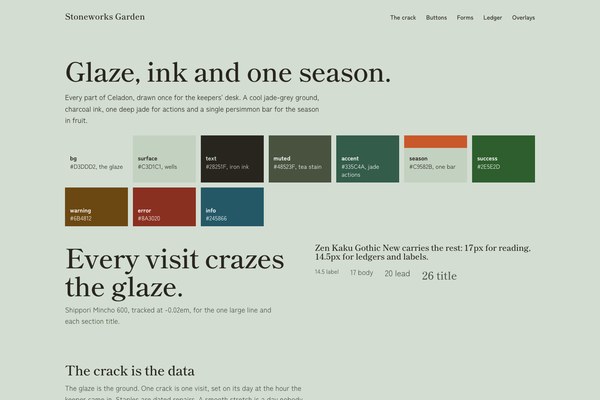
accent#335C4A
bg#D3DDD2
surface#C3D1C1
text#28251F
muted#48523F
border#B3C2B1
on accent#FFFFFF
success#2E5E2D
warning#6B4812
Celadon is a contemplative interface language for gardens, archives and other places kept slowly.
Its pictures are drawn in Celadon Glaze.
Tokens, rules and the paired art style Celadon Glaze.
Each face set in this language's own words.
Celadon
Celadon
Celadon is a contemplative interface language for gardens, archives and other places kept slowly.
Celadon is a contemplative interface language for gardens, archives and other places kept slowly.
Celadon is a contemplative interface language for gardens, archives and other places kept slowly. The glaze itself is the ground: a hand-drawn network of craze lines spreads under the first screen, and every crack is a real, logged event. The x axis is the year, the y axis the hour of the day, and one crack is one visit set on its date at the hour it happened. The smooth glaze is the part of the year still to come, a day nobody came is left smooth, and today's cracks are drawn in white. Content sits inside the field on a cool jade-grey ground in Shippori Mincho and Zen Kaku Gothic New, with deep jade for the one action and a single persimmon bar for the season in fruit.
Celadon began as a warm bisque garden of glaze pools and stepping stones. This revision is the approved texture-field take: it keeps the celadon glaze world, the jade and persimmon palette and the Stoneworks Garden keepers' pass, and replaces tiles and pools with a crazed glaze whose cracks are real visits.
Comfortable: 9px day rows, 72 to 120px between sections, 17px reading text, 14.5px table rows.
Desktop shows the year across with hours on the right edge. Tablet shortens the labels and keeps both columns. Phone turns the field upright: the future sits on top as open glaze and the crazed half-year runs down the page from today.
celadon-glaze
en-019efdd9-1129-76b2-9677-bd3f1bc46341
A glaze ground fired for the page in the Celadon Glaze technique: cool jade-grey crazed ceramic, open and calm at the left for copy, with no subject and no persimmon. The year's cracks are drawn over it as a vector layer so the raster stays quiet.
One full-bleed glaze ground per landing, driven by --hero-image, beneath the data layer; elsewhere only flat jade-grey and wells.
Subjects, scenes, pooled colour and persimmon in the ground; the data layer carries the story.
# Celadon

## Philosophy

Celadon is a contemplative interface language for gardens, archives and other places kept slowly. The glaze itself is the ground: a hand-drawn network of craze lines spreads under the first screen, and every crack is a real, logged event. The x axis is the year, the y axis the hour of the day, and one crack is one visit set on its date at the hour it happened. The smooth glaze is the part of the year still to come, a day nobody came is left smooth, and today's cracks are drawn in white. Content sits inside the field on a cool jade-grey ground in Shippori Mincho and Zen Kaku Gothic New, with deep jade for the one action and a single persimmon bar for the season in fruit.

### Values

- The ground is the data: every crack is a logged visit, every staple a dated repair, and a day nobody came is left smooth.
- Content sits inside the field. The glaze is the first screen, not a backdrop behind a card.
- One season-mark: a single persimmon bar for what is in fruit now, and nothing else warm.
- Square and quiet: radius 0 on every rectangle, no borders, no shadows except an open menu or dialog.
- Say what happened. Copy states facts (2,003 visits since April), never describes the design.

### Anti-Values

- Decoration: a crack that is not a record, a bloom, a gradient pool or a blurred wash.
- Boxing the glaze into tiles, season cards or pill tags.
- Persimmon on more than one thing at a time.
- Default fonts, drop shadows and rounded cards.
- Copy about the design system instead of the garden.

### Visual Character

- A cool jade-grey #D3DDD2 glaze with a fine network of iron-dark craze lines.
- Today's cracks in pure white, the future as smooth open glaze.
- Iron staples (a small bracket glyph) for dated repairs, as on the Bakohan bowl.
- Deep jade #335C4A for the one filled button and links; persimmon #C9582B as a 5px season bar.
- Shippori Mincho for the one large line and titles; Zen Kaku Gothic New for everything read.
- Square wells, rows without rules, and generous air around every group.

### Lineage

> Celadon began as a warm bisque garden of glaze pools and stepping stones. This revision is the approved texture-field take: it keeps the celadon glaze world, the jade and persimmon palette and the Stoneworks Garden keepers' pass, and replaces tiles and pools with a crazed glaze whose cracks are real visits.

## Tokens

### Colors

| Name | Value |
|------|-------|
| bg | `#D3DDD2` |
| surface | `#C3D1C1` |
| text | `#28251F` |
| muted | `#48523F` |
| border | `#B3C2B1` |
| accent | `#335C4A` |
| on_accent | `#FFFFFF` |
| success | `#2E5E2D` |
| warning | `#6B4812` |
| error | `#8A3020` |
| info | `#245866` |
| season | `#C9582B` |

### Derived

- **Stain**: a crack darkens with age: stroke-opacity .92 for April down to .30 for today's weight, ink #28251F on the glaze; today's cracks are #FFFFFF
- **Row Hover**: color-mix(in srgb, var(--surface) 55%, transparent)
- **Lift**: 0 1px 2px rgb(40 37 31 / .25), 0 16px 32px -14px rgb(40 37 31 / .4), only on an open menu or dialog

### Typography

- **Heading Font**: Shippori Mincho
- **Body Font**: Zen Kaku Gothic New
- **Mono Font**: none
- **Heading Weight**: 600
- **Body Weight**: 400
- **Button Weight**: 500
- **Heading Transform**: none
- **Letter Spacing**: -0.02em on display; 0 on body
- **Base Size**: 17px
- **Line Height**: 1.6
- **Scale**: ["14.5px","17px","20px","26px to 30px","40px to 64px"]
- **Google Fonts Url**: https://fonts.googleapis.com/css2?family=Shippori+Mincho:wght@500;600&family=Zen+Kaku+Gothic+New:wght@400;500;700&display=swap

### Radii

- **None**: 0px
- **Md**: 0px
- **Lg**: 0px
- **Full**: 0px

### Shadows

- **Lift**: 0 1px 2px rgb(40 37 31 / .25), 0 16px 32px -14px rgb(40 37 31 / .4), only on an open menu or dialog
- **None**: everything else is flat

### Spacing

- **Base**: 8px
- **Scale**: ["4px","8px","12px","16px","24px","32px","48px","72px","96px","120px"]

### Surfaces

- **Treatment**: glaze-field
- **Material**: The crazed glaze is the only texture and it is data: a raster ground fired for the page with the year's cracks drawn over it as a vector layer. Everything else is flat jade-grey with surface wells.
- **Card Style**: No cards. Rows, forms and the ledger sit straight on the glaze, parted by space; the keeper's pass is one surface well.
- **Wells**: Surface #C3D1C1 for inputs, the chosen tab, meter tracks and the pass.
- **Bg Pattern**: the glaze ground, only in the field; text sections are flat

### Borders

- **Default Width**: 0
- **Style**: none
- **Character**: No borders. Cracks are the only lines and each one is a record; the 1px front line marks today. Focus is a 2px jade outline at 3px offset; a focused field draws a 2px ink line under its well.

### Motion

- **Duration**: 180ms
- **Easing**: cubic-bezier(0.2, 0, 0.1, 1)
- **Crack**: 650ms ease-out quartic: a new white crack grows along its own path and stops at the older cracks
- **Philosophy**: One motion: a crack forms when a visit is logged. Everything settled renders with no JavaScript, and prefers-reduced-motion draws the crack at once.

### Controls

- **Height**: 48px (40 small, 56 large)
- **Radius**: 0px
- **Well Height**: 52px

## Rules

### Composition

- Make the first screen the glaze: the craze ground spans it edge to edge, with the copy set on open glaze beside it.
- Place every crack by data: x is the date, y is the hour; never draw a crack that is not a record.
- Keep one persimmon bar per view, under the season in fruit.
- Below the field, show the same glaze closer (by week, by month) before any other content.
- Put the pass and other actions on a single surface well; one filled jade button per view.

### Hierarchy

- One large line per view in Shippori Mincho 600 (40 to 64px) that states a fact.
- Titles in Shippori Mincho 26 to 30px; reading in Zen Kaku Gothic New 17px, labels 14.5px in muted.
- Numbers sit in tabular figures, right aligned, with a small muted unit beneath.
- Ink is for what happened, muted is for what it means.

### Density

Comfortable: 9px day rows, 72 to 120px between sections, 17px reading text, 14.5px table rows.

### Signature Patterns

- The crazed ground: a year-long strip of cracks, hours on the right edge, months along the foot.
- Log a visit: a white crack grows along its own path and the totals step up by one.
- Point to read: hovering the glaze names the day, the hour and the visit count.
- Iron staples: a small bracket glyph on every dated repair.
- The stain table: a month's cracks drawn at their age, darker with time.

## Layout

### Grid

- **Type**: texture field then ledger
- **Max Width**: 1240px, centred above 1440px
- **Gutter**: clamp(16px, 4.4vw, 56px)
- **Column Behavior**: Two-column heads and reads use minmax(0,1fr) pairs; every grid child has min-width:0.

### Whitespace

- **Section Gap**: 72 to 120px
- **Card Gap**: no cards; 9 to 12px between day rows
- **Content Padding**: content sits on the glaze at the grid edge; the pass pads 26 to 40px
- **Approach**: The glaze is the field and space does the separating.

### Density

- **Default**: comfortable
- **Comfortable**: {"button_height":"48px","input_height":"52px","row_height":"40px to 76px"}

### Responsive

Desktop shows the year across with hours on the right edge. Tablet shortens the labels and keeps both columns. Phone turns the field upright: the future sits on top as open glaze and the crazed half-year runs down the page from today.

### Breakpoints

- **Mobile**: 390px, one column, upright field
- **Phone Max**: 600px
- **Tablet**: 601px to 1199px, shorter labels
- **Desktop**: 1200px and up
- **Wide**: 1440px, content capped and centred
- **Ultrawide**: 2560px, same cap, field still full bleed

## Guidance

### Do

- Let every mark be a record and say what it records.
- Keep the glaze smooth where nothing happened.
- Use one persimmon bar for the season in fruit.
- Set copy as facts with numbers and dates.
- Style every control explicitly: square, borderless, 2px jade focus.
- Draw today's marks in white and age the rest toward iron.
- Keep text on open glaze, never on cracks.

### Don't

- Don't add decorative cracks, blooms or gradient pools.
- Don't box content into cards, tiles or pills.
- Don't use persimmon on more than one thing in a view.
- Don't round rectangles or add drop shadows.
- Don't use default fonts or tracked mono eyebrows.
- Don't describe the design system in the copy.

### Accessibility

Text colours clear AA on the glaze and on surface wells (ink 10.9:1, muted 5.9:1, jade 5.4:1, semantic inks 5.5 to 6.0:1). The field is aria-hidden with the same facts in text; hover readouts are an addition, never the only source. Reduced motion draws new cracks at once.

### Usage Context

Places kept slowly with a record that grows over time: gardens, archives, reading rooms, sanctuaries, membership schemes.

## Imagery Direction

### Pairs With

celadon-glaze

### Art Style Id

en-019efdd9-1129-76b2-9677-bd3f1bc46341

### Summary

A glaze ground fired for the page in the Celadon Glaze technique: cool jade-grey crazed ceramic, open and calm at the left for copy, with no subject and no persimmon. The year's cracks are drawn over it as a vector layer so the raster stays quiet.

### Subjects

- an empty crazed celadon glaze plate
- a glaze ground with an open pale zone at left
- a close detail of crackle with iron staining
- a plain glazed tile edge to edge

### Usage

One full-bleed glaze ground per landing, driven by --hero-image, beneath the data layer; elsewhere only flat jade-grey and wells.

### Avoid

Subjects, scenes, pooled colour and persimmon in the ground; the data layer carries the story.
---
version: "alpha"
name: "Celadon"
description: "Celadon is a contemplative interface language for gardens, archives and other places kept slowly. The glaze itself is the ground: a hand-drawn network of craze lines spreads under the first screen, and every crack is a real, logged event..."
colors:
  bg: "#D3DDD2"
  surface: "#C3D1C1"
  text: "#28251F"
  muted: "#48523F"
  border: "#B3C2B1"
  accent: "#335C4A"
  on_accent: "#FFFFFF"
  success: "#2E5E2D"
  warning: "#6B4812"
  error: "#8A3020"
  info: "#245866"
  season: "#C9582B"
typography:
  headline-lg:
    fontFamily: "Shippori Mincho"
    fontSize: "2.075rem"
    fontWeight: 700
    lineHeight: 1.1
    letterSpacing: "-0.02em"
  headline-md:
    fontFamily: "Shippori Mincho"
    fontSize: "1.66rem"
    fontWeight: 600
    lineHeight: 1.15
    letterSpacing: "-0.02em"
  body-md:
    fontFamily: "Zen Kaku Gothic New"
    fontSize: "17px"
    fontWeight: 400
    lineHeight: 1.5
    letterSpacing: "-0.02em"
  label-md:
    fontFamily: "none"
    fontSize: "0.75rem"
    fontWeight: 600
    lineHeight: 1
    letterSpacing: "0.08em"
rounded:
  none: "0px"
  md: "0px"
  lg: "0px"
  full: "0px"
spacing:
  base: "8px"
  xs: "4px"
  sm: "8px"
  md: "12px"
  lg: "16px"
  xl: "24px"
  2xl: "32px"
  3xl: "48px"
  4xl: "72px"
  step-8: "96px"
  step-9: "120px"
components:
  color-reference-bg:
    backgroundColor: "{colors.bg}"
  color-reference-surface:
    backgroundColor: "{colors.surface}"
  color-reference-text:
    backgroundColor: "{colors.text}"
  color-reference-muted:
    backgroundColor: "{colors.muted}"
  color-reference-border:
    backgroundColor: "{colors.border}"
  color-reference-accent:
    backgroundColor: "{colors.accent}"
  color-reference-on_accent:
    backgroundColor: "{colors.on_accent}"
  color-reference-success:
    backgroundColor: "{colors.success}"
  color-reference-warning:
    backgroundColor: "{colors.warning}"
  color-reference-error:
    backgroundColor: "{colors.error}"
  color-reference-info:
    backgroundColor: "{colors.info}"
  color-reference-season:
    backgroundColor: "{colors.season}"
  button-primary:
    backgroundColor: "{colors.accent}"
    textColor: "{colors.on_accent}"
    typography: "{typography.label-md}"
    rounded: "{rounded.md}"
    padding: "{spacing.md}"
  card-surface:
    backgroundColor: "{colors.surface}"
    textColor: "{colors.text}"
    rounded: "{rounded.md}"
    padding: "{spacing.md}"
  input-default:
    backgroundColor: "{colors.surface}"
    textColor: "{colors.text}"
    rounded: "{rounded.md}"
    height: "44px"
---

# Celadon

## Overview

Celadon is a contemplative interface language for gardens, archives and other places kept slowly. The glaze itself is the ground: a hand-drawn network of craze lines spreads under the first screen, and every crack is a real, logged event. The x axis is the year, the y axis the hour of the day, and one crack is one visit set on its date at the hour it happened. The smooth glaze is the part of the year still to come, a day nobody came is left smooth, and today's cracks are drawn in white. Content sits inside the field on a cool jade-grey ground in Shippori Mincho and Zen Kaku Gothic New, with deep jade for the one action and a single persimmon bar for the season in fruit.

### Values

- The ground is the data: every crack is a logged visit, every staple a dated repair, and a day nobody came is left smooth.
- Content sits inside the field. The glaze is the first screen, not a backdrop behind a card.
- One season-mark: a single persimmon bar for what is in fruit now, and nothing else warm.
- Square and quiet: radius 0 on every rectangle, no borders, no shadows except an open menu or dialog.
- Say what happened. Copy states facts (2,003 visits since April), never describes the design.

### Anti-Values

- Decoration: a crack that is not a record, a bloom, a gradient pool or a blurred wash.
- Boxing the glaze into tiles, season cards or pill tags.
- Persimmon on more than one thing at a time.
- Default fonts, drop shadows and rounded cards.
- Copy about the design system instead of the garden.

### Visual Character

- A cool jade-grey #D3DDD2 glaze with a fine network of iron-dark craze lines.
- Today's cracks in pure white, the future as smooth open glaze.
- Iron staples (a small bracket glyph) for dated repairs, as on the Bakohan bowl.
- Deep jade #335C4A for the one filled button and links; persimmon #C9582B as a 5px season bar.
- Shippori Mincho for the one large line and titles; Zen Kaku Gothic New for everything read.
- Square wells, rows without rules, and generous air around every group.

### Lineage

> Celadon began as a warm bisque garden of glaze pools and stepping stones. This revision is the approved texture-field take: it keeps the celadon glaze world, the jade and persimmon palette and the Stoneworks Garden keepers' pass, and replaces tiles and pools with a crazed glaze whose cracks are real visits.

## Colors

Use the YAML color tokens as the normative palette. The prose below names the roles agents should preserve when generating UI.

| Token | Value |
|-------|-------|
| bg | `#D3DDD2` |
| surface | `#C3D1C1` |
| text | `#28251F` |
| muted | `#48523F` |
| border | `#B3C2B1` |
| accent | `#335C4A` |
| on_accent | `#FFFFFF` |
| success | `#2E5E2D` |
| warning | `#6B4812` |
| error | `#8A3020` |
| info | `#245866` |
| season | `#C9582B` |

## Typography

Load the fonts from Google Fonts: https://fonts.googleapis.com/css2?family=Shippori+Mincho:wght@500;600&family=Zen+Kaku+Gothic+New:wght@400;500;700&display=swap

- **Headline-Lg**: Shippori Mincho, 2.075rem, weight 700, line-height 1.1.
- **Headline-Md**: Shippori Mincho, 1.66rem, weight 600, line-height 1.15.
- **Body-Md**: Zen Kaku Gothic New, 17px, weight 400, line-height 1.5.
- **Label-Md**: none, 0.75rem, weight 600, line-height 1.

## Layout

### Spacing Tokens

- **Base**: `8px`
- **Xs**: `4px`
- **Sm**: `8px`
- **Md**: `12px`
- **Lg**: `16px`
- **Xl**: `24px`
- **2xl**: `32px`
- **3xl**: `48px`
- **4xl**: `72px`
- **Step-8**: `96px`
- **Step-9**: `120px`

### Grid

- **Type**: texture field then ledger
- **Max Width**: 1240px, centred above 1440px
- **Gutter**: clamp(16px, 4.4vw, 56px)
- **Column Behavior**: Two-column heads and reads use minmax(0,1fr) pairs; every grid child has min-width:0.

### Whitespace

- **Section Gap**: 72 to 120px
- **Card Gap**: no cards; 9 to 12px between day rows
- **Content Padding**: content sits on the glaze at the grid edge; the pass pads 26 to 40px
- **Approach**: The glaze is the field and space does the separating.

### Density

- **Default**: comfortable
- **Comfortable**: {"button_height":"48px","input_height":"52px","row_height":"40px to 76px"}

### Responsive

Desktop shows the year across with hours on the right edge. Tablet shortens the labels and keeps both columns. Phone turns the field upright: the future sits on top as open glaze and the crazed half-year runs down the page from today.

### Breakpoints

- **Mobile**: 390px, one column, upright field
- **Phone Max**: 600px
- **Tablet**: 601px to 1199px, shorter labels
- **Desktop**: 1200px and up
- **Wide**: 1440px, content capped and centred
- **Ultrawide**: 2560px, same cap, field still full bleed

## Elevation & Depth

### Shadows

- **Lift**: 0 1px 2px rgb(40 37 31 / .25), 0 16px 32px -14px rgb(40 37 31 / .4), only on an open menu or dialog
- **None**: everything else is flat

## Shapes

### Rounded

- **None**: `0px`
- **Md**: `0px`
- **Lg**: `0px`
- **Full**: `0px`

### Surfaces

- **Treatment**: glaze-field
- **Material**: The crazed glaze is the only texture and it is data: a raster ground fired for the page with the year's cracks drawn over it as a vector layer. Everything else is flat jade-grey with surface wells.
- **Card Style**: No cards. Rows, forms and the ledger sit straight on the glaze, parted by space; the keeper's pass is one surface well.
- **Wells**: Surface #C3D1C1 for inputs, the chosen tab, meter tracks and the pass.
- **Bg Pattern**: the glaze ground, only in the field; text sections are flat

### Borders

- **Default Width**: 0
- **Style**: none
- **Character**: No borders. Cracks are the only lines and each one is a record; the 1px front line marks today. Focus is a 2px jade outline at 3px offset; a focused field draws a 2px ink line under its well.

## Components

### Composition

- Make the first screen the glaze: the craze ground spans it edge to edge, with the copy set on open glaze beside it.
- Place every crack by data: x is the date, y is the hour; never draw a crack that is not a record.
- Keep one persimmon bar per view, under the season in fruit.
- Below the field, show the same glaze closer (by week, by month) before any other content.
- Put the pass and other actions on a single surface well; one filled jade button per view.

### Hierarchy

- One large line per view in Shippori Mincho 600 (40 to 64px) that states a fact.
- Titles in Shippori Mincho 26 to 30px; reading in Zen Kaku Gothic New 17px, labels 14.5px in muted.
- Numbers sit in tabular figures, right aligned, with a small muted unit beneath.
- Ink is for what happened, muted is for what it means.

### Density

Comfortable: 9px day rows, 72 to 120px between sections, 17px reading text, 14.5px table rows.

### Signature Patterns

- The crazed ground: a year-long strip of cracks, hours on the right edge, months along the foot.
- Log a visit: a white crack grows along its own path and the totals step up by one.
- Point to read: hovering the glaze names the day, the hour and the visit count.
- Iron staples: a small bracket glyph on every dated repair.
- The stain table: a month's cracks drawn at their age, darker with time.

## shadcn/ui Usage

When the target app uses shadcn/ui, copy DESIGN.md with shadcn instead of the plain DESIGN.md. It contains the same Katagami design-language source plus the shadcn/ui primitives, imports, theme variables, component recipes, and preview-shot guidance.

DESIGN.md with shadcn: `/language/en-01a0fe73-eb91-7e50-9805-c020b2f9004e/DESIGN.with-shadcn.md`.

Machine-readable companions for automation: `/language/en-01a0fe73-eb91-7e50-9805-c020b2f9004e/shadcn.json` (registry theme), `/language/en-01a0fe73-eb91-7e50-9805-c020b2f9004e/shadcn-components.md` (component recipes) and `/language/en-01a0fe73-eb91-7e50-9805-c020b2f9004e/shadcn-shots.json` (preview shots). The human-facing handoff is still DESIGN.md with shadcn.

Install recommended primitives with `npx shadcn@latest add button card input textarea select dialog sheet tabs badge separator checkbox switch slider tooltip dropdown-menu table`.

Use these primitives in shadcn apps:
- button
- card
- input
- textarea
- select
- dialog
- sheet
- tabs
- badge
- separator
- checkbox
- switch
- slider
- tooltip
- dropdown-menu
- table

Implementation rule for agents: import shadcn primitives from `@/components/ui/*`, apply the generated CSS variables first, then compose the language-specific recipes from the companion MD. Katagami remains the source of truth; shadcn names are the implementation surface.

## Do's and Don'ts

- Do Let every mark be a record and say what it records.
- Do Keep the glaze smooth where nothing happened.
- Do Use one persimmon bar for the season in fruit.
- Do Set copy as facts with numbers and dates.
- Do Style every control explicitly: square, borderless, 2px jade focus.
- Do Draw today's marks in white and age the rest toward iron.
- Do Keep text on open glaze, never on cracks.
- Don't Don't add decorative cracks, blooms or gradient pools.
- Don't Don't box content into cards, tiles or pills.
- Don't Don't use persimmon on more than one thing in a view.
- Don't Don't round rectangles or add drop shadows.
- Don't Don't use default fonts or tracked mono eyebrows.
- Don't Don't describe the design system in the copy.

### Accessibility

Text colours clear AA on the glaze and on surface wells (ink 10.9:1, muted 5.9:1, jade 5.4:1, semantic inks 5.5 to 6.0:1). The field is aria-hidden with the same facts in text; hover readouts are an addition, never the only source. Reduced motion draws new cracks at once.

### Usage Context

Places kept slowly with a record that grows over time: gardens, archives, reading rooms, sanctuaries, membership schemes.

## Imagery Direction

### Pairs With

celadon-glaze

### Art Style Id

en-019efdd9-1129-76b2-9677-bd3f1bc46341

### Summary

A glaze ground fired for the page in the Celadon Glaze technique: cool jade-grey crazed ceramic, open and calm at the left for copy, with no subject and no persimmon. The year's cracks are drawn over it as a vector layer so the raster stays quiet.

### Subjects

- an empty crazed celadon glaze plate
- a glaze ground with an open pale zone at left
- a close detail of crackle with iron staining
- a plain glazed tile edge to edge

### Usage

One full-bleed glaze ground per landing, driven by --hero-image, beneath the data layer; elsewhere only flat jade-grey and wells.

### Avoid

Subjects, scenes, pooled colour and persimmon in the ground; the data layer carries the story.
```json
{
  "$schema": "https://ui.shadcn.com/schema/registry-item.json",
  "name": "celadon",
  "type": "registry:theme",
  "title": "Celadon shadcn Theme",
  "cssVars": {
    "theme": {},
    "light": {
      "background": "#D3DDD2",
      "foreground": "#28251F",
      "card": "#C3D1C1",
      "card-foreground": "#28251F",
      "popover": "#C3D1C1",
      "popover-foreground": "#28251F",
      "primary": "#28251F",
      "primary-foreground": "#ffffff",
      "secondary": "#f4f4f5",
      "secondary-foreground": "#111111",
      "muted": "#48523F",
      "muted-foreground": "#28251F",
      "accent": "#335C4A",
      "accent-foreground": "#ffffff",
      "destructive": "#8A3020",
      "border": "#B3C2B1",
      "input": "#B3C2B1",
      "ring": "#335C4A",
      "chart-1": "#28251F",
      "chart-2": "#f4f4f5",
      "chart-3": "#335C4A",
      "chart-4": "#2E5E2D",
      "chart-5": "#6B4812",
      "sidebar": "#C3D1C1",
      "sidebar-foreground": "#28251F",
      "sidebar-primary": "#28251F",
      "sidebar-primary-foreground": "#ffffff",
      "sidebar-accent": "#245866",
      "sidebar-accent-foreground": "#ffffff",
      "sidebar-border": "#B3C2B1",
      "sidebar-ring": "#335C4A",
      "radius": "0px"
    },
    "dark": {
      "background": "#0f1115",
      "foreground": "#f8fafc",
      "card": "#181b22",
      "card-foreground": "#f8fafc",
      "popover": "#181b22",
      "popover-foreground": "#f8fafc",
      "primary": "#28251F",
      "primary-foreground": "#ffffff",
      "secondary": "#252a33",
      "secondary-foreground": "#f8fafc",
      "muted": "#252a33",
      "muted-foreground": "#a1a1aa",
      "accent": "#335C4A",
      "accent-foreground": "#ffffff",
      "destructive": "#8A3020",
      "border": "#303642",
      "input": "#303642",
      "ring": "#335C4A",
      "chart-1": "#28251F",
      "chart-2": "#f4f4f5",
      "chart-3": "#335C4A",
      "chart-4": "#2E5E2D",
      "chart-5": "#6B4812",
      "sidebar": "#181b22",
      "sidebar-foreground": "#f8fafc",
      "sidebar-primary": "#28251F",
      "sidebar-primary-foreground": "#ffffff",
      "sidebar-accent": "#335C4A",
      "sidebar-accent-foreground": "#ffffff",
      "sidebar-border": "#303642",
      "sidebar-ring": "#335C4A",
      "radius": "0px"
    }
  },
  "meta": {
    "source": "katagami",
    "languageId": "en-01a0fe73-eb91-7e50-9805-c020b2f9004e",
    "slug": "celadon",
    "componentManifest": [
      "button",
      "card",
      "input",
      "textarea",
      "select",
      "dialog",
      "sheet",
      "tabs",
      "badge",
      "separator",
      "checkbox",
      "switch",
      "slider",
      "tooltip",
      "dropdown-menu",
      "table"
    ],
    "installCommand": "npx shadcn@latest add button card input textarea select dialog sheet tabs badge separator checkbox switch slider tooltip dropdown-menu table",
    "nativeTokenNames": {
      "colors": [
        "accent",
        "bg",
        "border",
        "error",
        "info",
        "muted",
        "on_accent",
        "season",
        "success",
        "surface",
        "text",
        "warning"
      ],
      "derived": [
        "lift",
        "row_hover",
        "stain"
      ],
      "typography": [
        "base_size",
        "body_font",
        "body_weight",
        "button_weight",
        "google_fonts_url",
        "heading_font",
        "heading_transform",
        "heading_weight",
        "letter_spacing",
        "line_height",
        "mono_font",
        "scale"
      ],
      "radii": [
        "full",
        "lg",
        "md",
        "none"
      ],
      "shadows": [
        "lift",
        "none"
      ],
      "spacing": [
        "base",
        "scale"
      ],
      "surfaces": [
        "bg_pattern",
        "card_style",
        "material",
        "treatment",
        "wells"
      ],
      "borders": [
        "character",
        "default_width",
        "style"
      ],
      "motion": [
        "crack",
        "duration",
        "easing",
        "philosophy"
      ],
      "controls": [
        "height",
        "radius",
        "well_height"
      ]
    }
  }
}
```The art style its pictures are drawn in and the colours its tokens carry.
The theme variables are generated from the tokens. Component recipes and preview shots have not been written for this language yet.
For an app that uses shadcn/ui: the DESIGN.md plus the install list, theme variables, component recipes, preview shots and a starter TSX file, in one Markdown file.
The same pieces as separate files: theme, CSS, TSX starter, recipes and the preview contract.
npx shadcn@latest add button card input textarea select dialog sheet tabs badge separator checkbox switch slider tooltip dropdown-menu table:root {
--background: #D3DDD2;
--foreground: #28251F;
--card: #C3D1C1;
--card-foreground: #28251F;
--popover: #C3D1C1;
--popover-foreground: #28251F;
--primary: #28251F;
--primary-foreground: #ffffff;
--secondary: #f4f4f5;
--secondary-foreground: #111111;
--muted: #48523F;
--muted-foreground: #28251F;
--accent: #335C4A;
--accent-foreground: #ffffff;
--destructive: #8A3020;
--border: #B3C2B1;
--input: #B3C2B1;
--ring: #335C4A;
--chart-1: #28251F;
--chart-2: #f4f4f5;
--chart-3: #335C4A;
--chart-4: #2E5E2D;
--chart-5: #6B4812;
--sidebar: #C3D1C1;
--sidebar-foreground: #28251F;
--sidebar-primary: #28251F;
--sidebar-primary-foreground: #ffffff;
--sidebar-accent: #245866;
--sidebar-accent-foreground: #ffffff;
--sidebar-border: #B3C2B1;
--sidebar-ring: #335C4A;
--radius: 0px;
}
.dark {
--background: #0f1115;
--foreground: #f8fafc;
--card: #181b22;
--card-foreground: #f8fafc;
--popover: #181b22;
--popover-foreground: #f8fafc;
--primary: #28251F;
--primary-foreground: #ffffff;
--secondary: #252a33;
--secondary-foreground: #f8fafc;
--muted: #252a33;
--muted-foreground: #a1a1aa;
--accent: #335C4A;
--accent-foreground: #ffffff;
--destructive: #8A3020;
--border: #303642;
--input: #303642;
--ring: #335C4A;
--chart-1: #28251F;
--chart-2: #f4f4f5;
--chart-3: #335C4A;
--chart-4: #2E5E2D;
--chart-5: #6B4812;
--sidebar: #181b22;
--sidebar-foreground: #f8fafc;
--sidebar-primary: #28251F;
--sidebar-primary-foreground: #ffffff;
--sidebar-accent: #335C4A;
--sidebar-accent-foreground: #ffffff;
--sidebar-border: #303642;
--sidebar-ring: #335C4A;
--radius: 0px;
}
import { Badge } from "@/components/ui/badge";
import { Button } from "@/components/ui/button";
import {
  Card,
  CardContent,
  CardDescription,
  CardFooter,
  CardHeader,
  CardTitle,
} from "@/components/ui/card";
import { Input } from "@/components/ui/input";
import { Tabs, TabsList, TabsTrigger } from "@/components/ui/tabs";

export function CeladonShadcnKit() {
  return (
    <section className="grid gap-4 rounded-[var(--radius)] border bg-background p-4 text-foreground">
      <div className="flex items-start justify-between gap-4">
        <div>
          <Badge variant="outline">shadcn/ui</Badge>
          <h2 className="mt-3 text-2xl font-semibold tracking-tight">Celadon</h2>
          <p className="mt-1 max-w-xl text-sm text-muted-foreground">
            Use the Katagami registry theme, then compose these shadcn primitives
            with the language-specific component recipes.
          </p>
        </div>
        <Button>Apply theme</Button>
      </div>

      <Tabs defaultValue="components">
        <TabsList>
          <TabsTrigger value="components">Components</TabsTrigger>
          <TabsTrigger value="states">States</TabsTrigger>
          <TabsTrigger value="export">Export</TabsTrigger>
        </TabsList>
      </Tabs>

      <Card>
        <CardHeader>
          <CardTitle>Component recipe</CardTitle>
          <CardDescription>
            Replace this starter content with the agent-authored product scene
            from components.md and preview-shots.json.
          </CardDescription>
        </CardHeader>
        <CardContent className="grid gap-3 sm:grid-cols-[1fr_auto]">
          <Input defaultValue="Tokenized shadcn surface" aria-label="Recipe name" />
          <Button variant="secondary">Preview state</Button>
        </CardContent>
        <CardFooter className="justify-between">
          <Badge>Ready</Badge>
          <Button variant="outline">Copy recipe</Button>
        </CardFooter>
      </Card>
    </section>
  );
}
{
  "$schema": "https://ui.shadcn.com/schema/registry-item.json",
  "name": "celadon",
  "type": "registry:theme",
  "title": "Celadon",
  "description": "Cool jade-grey glaze crazed by every logged visit: iron ink, one deep jade action, one persimmon season bar, flat, square and borderless.",
  "cssVars": {
    "theme": {
      "font-sans": "Zen Kaku Gothic New, system-ui, sans-serif",
      "font-mono": "ui-monospace, monospace",
      "font-display": "Shippori Mincho, serif",
      "radius": "0px"
    },
    "light": {
      "background": "#D3DDD2",
      "foreground": "#28251F",
      "card": "#D3DDD2",
      "card-foreground": "#28251F",
      "popover": "#D3DDD2",
      "popover-foreground": "#28251F",
      "primary": "#335C4A",
      "primary-foreground": "#FFFFFF",
      "secondary": "#C3D1C1",
      "secondary-foreground": "#28251F",
      "muted": "#C3D1C1",
      "muted-foreground": "#48523F",
      "accent": "#C3D1C1",
      "accent-foreground": "#28251F",
      "destructive": "#8A3020",
      "destructive-foreground": "#FFFFFF",
      "border": "transparent",
      "input": "transparent",
      "ring": "#335C4A",
      "chart-1": "#28251F",
      "chart-2": "#48523F",
      "chart-3": "#C9582B",
      "chart-4": "#335C4A",
      "chart-5": "#245866",
      "radius": "0px"
    },
    "dark": {
      "background": "#D3DDD2",
      "foreground": "#28251F",
      "card": "#D3DDD2",
      "card-foreground": "#28251F",
      "popover": "#D3DDD2",
      "popover-foreground": "#28251F",
      "primary": "#335C4A",
      "primary-foreground": "#FFFFFF",
      "secondary": "#C3D1C1",
      "secondary-foreground": "#28251F",
      "muted": "#C3D1C1",
      "muted-foreground": "#48523F",
      "accent": "#C3D1C1",
      "accent-foreground": "#28251F",
      "destructive": "#8A3020",
      "destructive-foreground": "#FFFFFF",
      "border": "transparent",
      "input": "transparent",
      "ring": "#335C4A",
      "chart-1": "#28251F",
      "chart-2": "#48523F",
      "chart-3": "#C9582B",
      "chart-4": "#335C4A",
      "chart-5": "#245866",
      "radius": "0px"
    }
  },
  "componentManifest": [
    "button",
    "card",
    "input",
    "textarea",
    "select",
    "dialog",
    "sheet",
    "tabs",
    "badge",
    "separator",
    "checkbox",
    "switch",
    "slider",
    "tooltip",
    "dropdown-menu",
    "table"
  ],
  "meta": {
    "nativeTokenNames": {
      "bg": "background / card / popover",
      "surface": "secondary / muted / accent (wells, the pass)",
      "text": "foreground",
      "accent": "primary / ring",
      "season": "chart-3 and the season bar (native only)",
      "error": "destructive",
      "border": "native only (tracks); --border stays transparent"
    },
    "note": "Celadon is a light, glaze-ground language; the dark scope repeats the light values. The shadcn primary is jade; persimmon is a mark, never an action.",
    "componentManifest": [
      "button",
      "card",
      "input",
      "textarea",
      "select",
      "dialog",
      "sheet",
      "tabs",
      "badge",
      "separator",
      "checkbox",
      "switch",
      "slider",
      "tooltip",
      "dropdown-menu",
      "table"
    ]
  }
}
---
artifact: component-recipes-v1
language: celadon
author: katagami-agent
primitives: 16
---

# Celadon shadcn/ui Components

Author: `katagami-agent`

## Intent

Celadon dresses shadcn/ui as the flat, quiet room around one drawn object: a crazed glaze whose cracks are logged visits. Nothing is boxed: content sits on the glaze, parted by space; the only filled surfaces are wells and the pass, all square, with no border. Jade is the action, ink is the record and persimmon is only the season in fruit.

## Required primitives

button, card, input, textarea, select, dialog, sheet, tabs, badge, separator, checkbox, switch, slider, tooltip, dropdown-menu, table. Import them from `@/components/ui/*`; do not build a second component system.

## Token cues

```css
--background:#D3DDD2;
--foreground:#28251F;
--card:#D3DDD2;
--card-foreground:#28251F;
--popover:#D3DDD2;
--popover-foreground:#28251F;
--primary:#335C4A;
--primary-foreground:#FFFFFF;
--secondary:#C3D1C1;
--secondary-foreground:#28251F;
--muted:#C3D1C1;
--muted-foreground:#48523F;
--accent:#C3D1C1;
--accent-foreground:#28251F;
--destructive:#8A3020;
--destructive-foreground:#FFFFFF;
--border:transparent;
--input:transparent;
--ring:#335C4A;
--chart-1:#28251F;
--chart-2:#48523F;
--chart-3:#C9582B;
--chart-4:#335C4A;
--chart-5:#245866;
--radius:0px;
```

Native names are kept in the theme: `bg`, `surface`, and the persimmon `season` #C9582B, which is never a shadcn primary.

## Visual character to preserve

- The crazed field is the one drawn object; build it outside shadcn.
- No borders, dividers, cards or panels. Rows separate by space; the pass is the one surface well.
- One radius degree: 0 on every rectangle; a radio is a circle.
- Persimmon only as the 5px season bar.
- Shippori Mincho for the large line and titles, Zen Kaku Gothic New 17px for reading.
- Flat everywhere; only an open menu or dialog lifts.

## ShadSync visual profile

- family: texture-field
- material: flat jade-grey glaze with a crazed data layer
- contour: default
- border: none
- underlay: False
- grain: False
- stickerBadges: False
- motion: crack grows on log
- density: comfortable
- radius: 0
- accents: jade, persimmon-season-bar

## Signature component recipes

- **button:** `h-12 rounded-none px-6 font-medium text-[17px] whitespace-nowrap border-0`. `default` is `bg-primary text-primary-foreground` (jade with a white label), one per view; it presses `translate-y-px` on active and goes ink on hover. A second action is a `link` variant word with an ink-up underline (`bg-[linear-gradient(currentColor,currentColor)] bg-no-repeat bg-[length:0_1px] hover:bg-[length:100%_1px]`). `destructive` is a word in error ink, never a solid block. Focus: `outline-2 outline-offset-[3px] outline-ring`.
- **card:** no frame around content: `bg-transparent border-0 shadow-none p-0 gap-5 rounded-none`, grouped by space under a Shippori Mincho title at 26 to 30px with `tracking-[-0.02em]`. The one surface is the pass: `bg-secondary p-8`. Never wrap the crazed field or a ledger in a Card.
- **input:** a flat well: `h-[52px] rounded-none border-0 bg-secondary px-4 text-[17px] shadow-none`; focus `shadow-[inset_0_-2px_0_var(--foreground)]` instead of a ring box; an error uses the destructive colour for the underline and the message.
- **textarea:** the input well at `min-h-[112px] py-3.5 leading-[1.6]`, vertical resize only.
- **select:** the input well with a custom 12px SVG chevron in `muted-foreground`; `SelectContent` is `bg-popover rounded-none py-2` with the lift shadow; items are square rows that tint `bg-secondary` when highlighted.
- **dialog:** `bg-popover rounded-none p-8 border-0` with the lift shadow over a 40% ink overlay; Shippori Mincho title, muted body, one jade button and a quiet word (Keep it open).
- **sheet:** a right-side `bg-popover rounded-none` panel sliding in on `cubic-bezier(.2,0,.1,1)`; a day's visits list as rows with the hour in tabular figures.
- **tabs:** `TabsList` has no tray (`bg-transparent p-0 gap-1`); triggers are 44px words in `text-muted-foreground`; the active trigger takes `bg-secondary text-foreground rounded-none`. No underline.
- **badge:** a state word, not a pill: `bg-transparent p-0 font-medium` with a 10px square mark in the semantic ink (open, slow, shut, note). The season in fruit takes a 5px persimmon bar beneath it instead.
- **separator:** do not draw one. Use spacing (9 to 12px between day rows, 48 to 72px between groups). The only line in the language is a crack, and each is a record.
- **checkbox:** `size-[22px] rounded-none border-0 bg-secondary`; checked fills `bg-primary` with a drawn white tick.
- **switch:** a square `w-12 h-[26px] rounded-none bg-secondary` track with a square muted knob; checked turns the track jade and the knob white, sliding on `cubic-bezier(.3,1.4,.5,1)`.
- **slider:** a 4px `bg-secondary` track, jade range, an 18px square jade thumb; the value prints in the label (hours a visit lasts: 2).
- **tooltip:** `bg-foreground text-background rounded-none px-3 py-2 text-[14.5px]`, no arrow.
- **dropdown-menu:** `bg-popover rounded-none py-2` with the lift shadow; rows with a muted time on the right, highlighted `bg-secondary`.
- **table:** the ledger. Rows sit on the glaze (`bg-transparent`, no dividers), figures right aligned in tabular numerals at 14.5px, names at 17px; hover tints the row `bg-secondary/55`. Hide non-essential columns below 600px.

### The crazed field and the staple (the signature, outside shadcn)

The field is not a shadcn primitive. Build it as one `svg` with `preserveAspectRatio="none"` over a `background-image: var(--hero-image)` ground: x is the date, y is the hour, and each visit is one crack path in `currentColor` iron ink with `vector-effect: non-scaling-stroke`, its `stroke-opacity` falling with age. Today's cracks are stroked `#FFFFFF`. Logging a visit appends a path with `data-d`, grows it along its own length in 650ms on an ease-out quartic and steps the totals by one; reduced motion draws it at once. The staple is a 15 by 11 bracket glyph in ink beside each dated repair. Pointing at the field reads out the day, the hour and the visit count.

## Preview shots

- `application-shell`: The keepers' year. The glaze field across the top with seasons, hours and months on its edges, the large fact line and one jade button on open glaze, then the month ledger on the glaze with state marks and a tooltip on a gate.
- `detail-editor`: Become a keeper. The pass as one surface well: name and email wells, a focused well with its ink underline, a gate select, a note textarea, a checked box, a switch, the hours slider, one jade button and a quiet word.
- `data-operations`: This week at the gates. Word tabs for By week, By month and Repairs, the gate menu open, day rows on the glaze with their figures, and a dialog asking to close the pond gate.

Each shot carries a renderable `scene` with headline, description, actions and rows or fields.

## Implementation contract

- Start from local `@/components/ui/*` shadcn primitives and apply `/katagami/shadcn/celadon/registry-theme.json`.
- Keep `--border` and `--input` transparent; wells get their tone from `bg-secondary` on the glaze.
- Set `--radius: 0px` and use it on every control.
- One `default` (jade) button per view; a second action is a word that underlines.
- No Card frames around content; show the crazed field once per page.
- Keep persimmon off every shadcn primitive; it belongs to the season bar.
- Respect `prefers-reduced-motion`: draw a new crack at once.

## Copy-paste component example

```tsx
import { Button } from "@/components/ui/button";
import { Badge } from "@/components/ui/badge";

const gates = [
  { name: "West gate", hours: "6:00 to 18:00", state: "Open" },
  { name: "Pond gate", hours: "7:00 to 18:00", state: "Slow" },
  { name: "Moss terrace", hours: "closed Monday", state: "Shut" },
];

export function Gates() {
  return (
    <section className="flex flex-col gap-6">
      <h2 className="font-[Shippori_Mincho] text-[30px] font-semibold tracking-[-0.02em]">
        Every visit crazes the glaze.
      </h2>
      <p className="max-w-[34em] text-[17px] leading-[1.6]">
        2,003 visits since 1 April.{" "}
        <span className="text-muted-foreground">The smooth glaze is the year still to come.</span>
      </p>
      <div className="flex flex-col">
        {gates.map((g) => (
          <div key={g.name} className="grid grid-cols-[1fr_auto_auto] items-center gap-6 py-3 hover:bg-secondary/55">
            <span className="font-medium">{g.name}</span>
            <span className="text-[14.5px] tabular-nums">{g.hours}</span>
            <Badge variant="outline" className="border-0 bg-transparent p-0">{g.state}</Badge>
          </div>
        ))}
      </div>
      <Button className="w-fit rounded-none">Log today's visit</Button>
    </section>
  );
}
```
{
  "artifact": "katagami:shadcn-preview-shots",
  "version": "preview-shots-v1",
  "schema": "katagami:shadcn-preview-shots/renderable-v1",
  "renderable": true,
  "author": "katagami-agent",
  "requiresVisualProfile": true,
  "language": {
    "id": "en-019efdd9-8a27-7f23-a206-ed48cae66ca2",
    "name": "Celadon",
    "slug": "celadon"
  },
  "installCommand": "npx shadcn@latest add button card input textarea select dialog sheet tabs badge separator checkbox switch slider tooltip dropdown-menu table",
  "primitives": [
    "button",
    "card",
    "input",
    "textarea",
    "select",
    "dialog",
    "sheet",
    "tabs",
    "badge",
    "separator",
    "checkbox",
    "switch",
    "slider",
    "tooltip",
    "dropdown-menu",
    "table"
  ],
  "identityNotes": [
    "Every crack is a logged visit; every staple a dated repair; a day nobody came stays smooth.",
    "No borders, dividers, cards or panels; content sits on the glaze with wells as the only fill.",
    "Jade is the action; persimmon is only the season in fruit.",
    "Shippori Mincho for the large line and titles, Zen Kaku Gothic New for reading."
  ],
  "visualProfile": {
    "family": "texture-field",
    "material": "flat jade-grey glaze with a crazed data layer",
    "contour": "default",
    "border": "none",
    "underlay": false,
    "grain": false,
    "stickerBadges": false,
    "motion": "crack grows on log",
    "density": "comfortable",
    "radius": [
      0
    ],
    "accents": [
      "jade",
      "persimmon-season-bar"
    ]
  },
  "componentRecipes": [
    {
      "primitive": "button",
      "intent": "`h-12 rounded-none px-6 font-medium text-[17px] whitespace-nowrap border-0`. `default` is `bg-primary text-primary-foreground` (jade with a white label), one per view; it presses `translate-y-px` on active and goes ink on hover. A second action is a `link` variant word with an ink-up underline (`bg-[linear-gradient(currentColor,currentColor)] bg-no-repeat bg-[length:0_1px] hover:bg-[length:100%_1px]`). `destructive` is a word in error ink, never a solid block. Focus: `outline-2 outline-offset-[3px] outline-ring`.",
      "recipe": "`h-12 rounded-none px-6 font-medium text-[17px] whitespace-nowrap border-0`. `default` is `bg-primary text-primary-foreground` (jade with a white label), one per view; it presses `translate-y-px` on active and goes ink on hover. A second action is a `link` variant word with an ink-up underline (`bg-[linear-gradient(currentColor,currentColor)] bg-no-repeat bg-[length:0_1px] hover:bg-[length:100%_1px]`). `destructive` is a word in error ink, never a solid block. Focus: `outline-2 outline-offset-[3px] outline-ring`."
    },
    {
      "primitive": "card",
      "intent": "no frame around content: `bg-transparent border-0 shadow-none p-0 gap-5 rounded-none`, grouped by space under a Shippori Mincho title at 26 to 30px with `tracking-[-0.02em]`. The one surface is the pass: `bg-secondary p-8`. Never wrap the crazed field or a ledger in a Card.",
      "recipe": "no frame around content: `bg-transparent border-0 shadow-none p-0 gap-5 rounded-none`, grouped by space under a Shippori Mincho title at 26 to 30px with `tracking-[-0.02em]`. The one surface is the pass: `bg-secondary p-8`. Never wrap the crazed field or a ledger in a Card."
    },
    {
      "primitive": "input",
      "intent": "a flat well: `h-[52px] rounded-none border-0 bg-secondary px-4 text-[17px] shadow-none`; focus `shadow-[inset_0_-2px_0_var(--foreground)]` instead of a ring box; an error uses the destructive colour for the underline and the message.",
      "recipe": "a flat well: `h-[52px] rounded-none border-0 bg-secondary px-4 text-[17px] shadow-none`; focus `shadow-[inset_0_-2px_0_var(--foreground)]` instead of a ring box; an error uses the destructive colour for the underline and the message."
    },
    {
      "primitive": "textarea",
      "intent": "the input well at `min-h-[112px] py-3.5 leading-[1.6]`, vertical resize only.",
      "recipe": "the input well at `min-h-[112px] py-3.5 leading-[1.6]`, vertical resize only."
    },
    {
      "primitive": "select",
      "intent": "the input well with a custom 12px SVG chevron in `muted-foreground`; `SelectContent` is `bg-popover rounded-none py-2` with the lift shadow; items are square rows that tint `bg-secondary` when highlighted.",
      "recipe": "the input well with a custom 12px SVG chevron in `muted-foreground`; `SelectContent` is `bg-popover rounded-none py-2` with the lift shadow; items are square rows that tint `bg-secondary` when highlighted."
    },
    {
      "primitive": "dialog",
      "intent": "`bg-popover rounded-none p-8 border-0` with the lift shadow over a 40% ink overlay; Shippori Mincho title, muted body, one jade button and a quiet word (Keep it open).",
      "recipe": "`bg-popover rounded-none p-8 border-0` with the lift shadow over a 40% ink overlay; Shippori Mincho title, muted body, one jade button and a quiet word (Keep it open)."
    },
    {
      "primitive": "sheet",
      "intent": "a right-side `bg-popover rounded-none` panel sliding in on `cubic-bezier(.2,0,.1,1)`; a day's visits list as rows with the hour in tabular figures.",
      "recipe": "a right-side `bg-popover rounded-none` panel sliding in on `cubic-bezier(.2,0,.1,1)`; a day's visits list as rows with the hour in tabular figures."
    },
    {
      "primitive": "tabs",
      "intent": "`TabsList` has no tray (`bg-transparent p-0 gap-1`); triggers are 44px words in `text-muted-foreground`; the active trigger takes `bg-secondary text-foreground rounded-none`. No underline.",
      "recipe": "`TabsList` has no tray (`bg-transparent p-0 gap-1`); triggers are 44px words in `text-muted-foreground`; the active trigger takes `bg-secondary text-foreground rounded-none`. No underline."
    },
    {
      "primitive": "badge",
      "intent": "a state word, not a pill: `bg-transparent p-0 font-medium` with a 10px square mark in the semantic ink (open, slow, shut, note). The season in fruit takes a 5px persimmon bar beneath it instead.",
      "recipe": "a state word, not a pill: `bg-transparent p-0 font-medium` with a 10px square mark in the semantic ink (open, slow, shut, note). The season in fruit takes a 5px persimmon bar beneath it instead."
    },
    {
      "primitive": "separator",
      "intent": "do not draw one. Use spacing (9 to 12px between day rows, 48 to 72px between groups). The only line in the language is a crack, and each is a record.",
      "recipe": "do not draw one. Use spacing (9 to 12px between day rows, 48 to 72px between groups). The only line in the language is a crack, and each is a record."
    },
    {
      "primitive": "checkbox",
      "intent": "`size-[22px] rounded-none border-0 bg-secondary`; checked fills `bg-primary` with a drawn white tick.",
      "recipe": "`size-[22px] rounded-none border-0 bg-secondary`; checked fills `bg-primary` with a drawn white tick."
    },
    {
      "primitive": "switch",
      "intent": "a square `w-12 h-[26px] rounded-none bg-secondary` track with a square muted knob; checked turns the track jade and the knob white, sliding on `cubic-bezier(.3,1.4,.5,1)`.",
      "recipe": "a square `w-12 h-[26px] rounded-none bg-secondary` track with a square muted knob; checked turns the track jade and the knob white, sliding on `cubic-bezier(.3,1.4,.5,1)`."
    },
    {
      "primitive": "slider",
      "intent": "a 4px `bg-secondary` track, jade range, an 18px square jade thumb; the value prints in the label (hours a visit lasts: 2).",
      "recipe": "a 4px `bg-secondary` track, jade range, an 18px square jade thumb; the value prints in the label (hours a visit lasts: 2)."
    },
    {
      "primitive": "tooltip",
      "intent": "`bg-foreground text-background rounded-none px-3 py-2 text-[14.5px]`, no arrow.",
      "recipe": "`bg-foreground text-background rounded-none px-3 py-2 text-[14.5px]`, no arrow."
    },
    {
      "primitive": "dropdown-menu",
      "intent": "`bg-popover rounded-none py-2` with the lift shadow; rows with a muted time on the right, highlighted `bg-secondary`.",
      "recipe": "`bg-popover rounded-none py-2` with the lift shadow; rows with a muted time on the right, highlighted `bg-secondary`."
    },
    {
      "primitive": "table",
      "intent": "the ledger. Rows sit on the glaze (`bg-transparent`, no dividers), figures right aligned in tabular numerals at 14.5px, names at 17px; hover tints the row `bg-secondary/55`. Hide non-essential columns below 600px.",
      "recipe": "the ledger. Rows sit on the glaze (`bg-transparent`, no dividers), figures right aligned in tabular numerals at 14.5px, names at 17px; hover tints the row `bg-secondary/55`. Hide non-essential columns below 600px."
    }
  ],
  "shots": [
    {
      "id": "application-shell",
      "title": "The keepers' year",
      "viewport": "desktop",
      "primitives": [
        "button",
        "card",
        "badge",
        "table",
        "separator",
        "tooltip"
      ],
      "composition": "The glaze field across the top with seasons, hours and months on its edges, the large fact line and one jade button on open glaze, then the month ledger on the glaze with state marks and a tooltip on a gate.",
      "mustShow": [
        "crazed ground with hours on the right edge",
        "white cracks for today",
        "one jade button Log today's visit",
        "persimmon bar under the season in fruit"
      ],
      "avoid": [
        "borders or cards",
        "persimmon on more than one thing",
        "decorative cracks",
        "drop shadows"
      ],
      "mustShowStates": [
        "primary jade button",
        "state marks in semantic ink",
        "row hover on surface",
        "tooltip on a gate"
      ],
      "avoidRules": [
        "no borders",
        "no second warm accent",
        "no rounded corners",
        "no emoji on buttons"
      ],
      "scene": {
        "eyebrow": "Stoneworks Garden",
        "headline": "Every visit crazes the glaze.",
        "description": "2,003 visits by 286 keepers since 1 April. Each one is a crack, set at the hour the keeper came through the gate.",
        "primaryAction": "Log today's visit",
        "secondaryAction": "Read the repairs",
        "rows": [
          {
            "label": "April",
            "value": "335 visits",
            "status": "Settled"
          },
          {
            "label": "May",
            "value": "422 visits",
            "status": "Settled"
          },
          {
            "label": "July",
            "value": "295 visits",
            "status": "Settled"
          },
          {
            "label": "Pond gate",
            "value": "7:00 to 18:00",
            "status": "Open"
          }
        ],
        "statuses": [
          "Open",
          "Slow",
          "Shut"
        ]
      }
    },
    {
      "id": "detail-editor",
      "title": "Become a keeper",
      "viewport": "desktop",
      "primitives": [
        "card",
        "input",
        "select",
        "textarea",
        "checkbox",
        "switch",
        "slider",
        "button",
        "badge"
      ],
      "composition": "The pass as one surface well: name and email wells, a focused well with its ink underline, a gate select, a note textarea, a checked box, a switch, the hours slider, one jade button and a quiet word.",
      "mustShow": [
        "focused well with an ink underline",
        "custom select chevron",
        "checked jade checkbox",
        "switch on in jade",
        "error in error ink"
      ],
      "avoid": [
        "browser default controls",
        "outlined inputs",
        "rounded corners"
      ],
      "mustShowStates": [
        "focus underline",
        "checked",
        "switch on",
        "error",
        "primary button"
      ],
      "avoidRules": [
        "no borders",
        "no nested cards"
      ],
      "scene": {
        "eyebrow": "A keeper's pass, 48 pounds a year",
        "headline": "Become a keeper",
        "description": "The year runs from 1 April. Join in October and your first cracks go on the smooth side.",
        "primaryAction": "Save my pass",
        "secondaryAction": "Keep it open",
        "fields": [
          {
            "label": "Name",
            "value": "Hazuki Mori",
            "type": "text"
          },
          {
            "label": "Gate you use most",
            "value": "Pond gate",
            "type": "select"
          },
          {
            "label": "Email",
            "value": "hazuki@",
            "type": "text"
          },
          {
            "label": "Hours a visit lasts",
            "value": "2",
            "type": "range"
          }
        ],
        "statuses": [
          "Focus",
          "Checked",
          "Held"
        ]
      }
    },
    {
      "id": "data-operations",
      "title": "This week at the gates",
      "viewport": "desktop",
      "primitives": [
        "tabs",
        "dropdown-menu",
        "table",
        "badge",
        "dialog",
        "sheet",
        "button",
        "separator"
      ],
      "composition": "Word tabs for By week, By month and Repairs, the gate menu open, day rows on the glaze with their figures, and a dialog asking to close the pond gate.",
      "mustShow": [
        "active tab on surface",
        "open gate menu",
        "Shut in error ink",
        "Close the pond gate dialog"
      ],
      "avoid": [
        "row dividers",
        "solid red buttons",
        "pill tags"
      ],
      "mustShowStates": [
        "active tab",
        "menu open",
        "row hover",
        "destructive word"
      ],
      "avoidRules": [
        "no dividers",
        "no second accent"
      ],
      "scene": {
        "eyebrow": "Tuesday 29 September, 14:10",
        "headline": "This week at the gates",
        "description": "Eleven keepers in so far today. Thursday, in rain, had nobody; the gates were open.",
        "primaryAction": "Close it",
        "secondaryAction": "Keep it open",
        "rows": [
          {
            "label": "Wed 23 Sep · persimmon grove, second day in fruit",
            "value": "41",
            "status": "Open"
          },
          {
            "label": "Thu 24 Sep · rain all day",
            "value": "0",
            "status": "Quiet"
          },
          {
            "label": "Fri 25 Sep · moon-viewing, lanterns until 21:00",
            "value": "38",
            "status": "Open"
          },
          {
            "label": "Mon 28 Sep · moss terrace raked",
            "value": "22",
            "status": "Shut until 9:00"
          }
        ],
        "statuses": [
          "Open",
          "Quiet",
          "Shut"
        ]
      }
    }
  ],
  "qualityRules": {
    "do": [
      "Let every crack be a record",
      "Separate with space and type value",
      "One jade action per view; a second action is a word that underlines",
      "One persimmon bar for the season in fruit"
    ],
    "dont": [
      "No borders, hairlines or dividers",
      "No cards or panels around content",
      "No persimmon on more than one thing",
      "No rounded rectangles",
      "No emoji on buttons"
    ]
  }
}
Keep Celadon and swap a palette and an art style onto it. The landing recolors live.
 Celadon