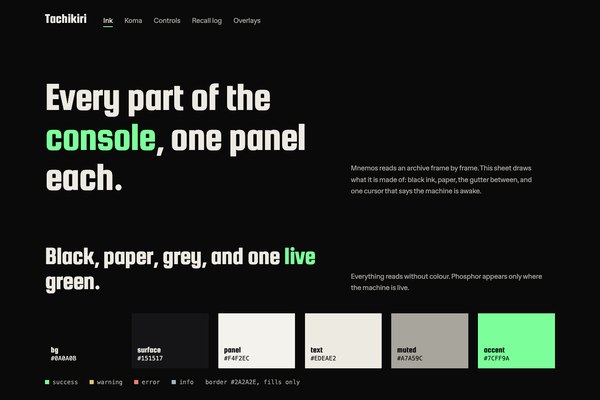
accent#7CFF9A
bg#0A0A0B
surface#151517
text#EDEAE2
muted#A7A59C
border#2A2A2E
panel#F4F2EC
on panel#0A0A0B
on accent#06140A
Tachikiri is a koma-noir interface language for systems that feel observed rather than operated.
Its pictures are drawn in Phosphor Ledger.
Tokens, rules and the paired art style Phosphor Ledger.
Each face set in this language's own words.
Tachikiri
Tachikiri
Tachikiri is a koma-noir interface language for systems that feel observed rather than operated.
Tachikiri is a koma-noir interface language for systems that feel observed rather than operated.
Tachikiri is a koma-noir interface language for systems that feel observed rather than operated. A page is staged like a manga spread: one full-bleed ink drawing with its type on the empty black wall, then koma panels of unequal width, a gutter that does the pacing, and a terminal slab that goes live with one phosphor cursor. Black, paper and grey are the real palette, and green marks only what the machine is doing now.
Revised in place from the approved Inspora specimen tachikiri-i (round 8, 2026-10-07). Kept: the name, the black ground, the paper koma, phosphor green on live signal only, the page order and the Mnemos copy, and the unequal koma spread. Changed: the hero is one full-strength drawing with a calm black wall and the type on it, with no scrim; Anton, Noto Sans and Kode Mono became Squada One, Hedvig Letters Sans and the system mono; the semantic colours were retinted; the stamps, eyebrows, outlines, offset shadows, three step cards and colophon were removed; the steps became one typed slab and a rules section was added.
Alternate dense terminal slabs with large unoccupied black or paper fields. Gutters run from 12px between koma to 128px between sections.
Phones (390px) stack the koma to one column, switch to the tall hero drawing and shrink the title to 56 to 70px. The tablet band (601 to 1199px) keeps a 12-column spread with 12 and 7/5 spans and the tall hero. From 1441px the hero text stays at 6vw from the edge and the content caps and centres.
phosphor-ledger
High-contrast black-ink screentone illustration: hard inked contours, halftone dot tones modelling volume, pure-black shadow masses against paper-white highlights, and a single tiny phosphor-green glint as the only colour. The hero is drawn with a calm solid black wall on one side, so the title stands on the drawing's own emptiness.
One full-bleed landing hero in the ink-screentone technique, painted with var(--hero-image): the lit CRT lower right on a desk, the wall left as a flat black field for the type, and a tall version with the wall on top for phones. No scrim over it. Never illustration behind body text or on the thumbnail.
en-019ef80f-d766-7c82-96ba-c5e48af24a83
# Tachikiri

## Philosophy

Tachikiri is a koma-noir interface language for systems that feel observed rather than operated. A page is staged like a manga spread: one full-bleed ink drawing with its type on the empty black wall, then koma panels of unequal width, a gutter that does the pacing, and a terminal slab that goes live with one phosphor cursor. Black, paper and grey are the real palette, and green marks only what the machine is doing now.

### Values

- Restraint before atmosphere: noir is made by omission, hard contrast and visible silence.
- Panels as interface logic: unequal koma and the gutter between them set order, grouping and pace.
- Typed evidence over ornament: commands, paths and counts carry the references, with nothing laid over them.
- One live signal: phosphor green appears for the cursor, the confirmed recall, the one action and focus.
- Recognizable without colour: the identity survives in scale, gutter and type.

### Anti-Values

- Gradient scrims, dot overlays and glow over the drawing.
- Invented stamps, tracked uppercase eyebrow labels and decorative codes.
- Outlines, hard offset shadows and rounded cards.
- Three equal step cards or an equal-weight analytics grid.
- Over-used display faces and a default green, amber, red and blue status set.

### Visual Character

- Ground #0A0A0B with surface #151517 slabs and paper #F4F2EC koma, all flat and square.
- One full-strength screentone drawing as the hero, with a calm solid black wall for the type.
- Squada One headings, Hedvig Letters Sans prose and system mono evidence.
- One phosphor green #7CFF9A, spent only on live signal.
- Semantic colours retinted to the palette so status reads as a word and a mark, never a rainbow.

### Lineage

> Revised in place from the approved Inspora specimen tachikiri-i (round 8, 2026-10-07). Kept: the name, the black ground, the paper koma, phosphor green on live signal only, the page order and the Mnemos copy, and the unequal koma spread. Changed: the hero is one full-strength drawing with a calm black wall and the type on it, with no scrim; Anton, Noto Sans and Kode Mono became Squada One, Hedvig Letters Sans and the system mono; the semantic colours were retinted; the stamps, eyebrows, outlines, offset shadows, three step cards and colophon were removed; the steps became one typed slab and a rules section was added.

## Tokens

### Colors

| Name | Value |
|------|-------|
| bg | `#0A0A0B` |
| surface | `#151517` |
| panel | `#F4F2EC` |
| on_panel | `#0A0A0B` |
| text | `#EDEAE2` |
| muted | `#A7A59C` |
| border | `#2A2A2E` |
| accent | `#7CFF9A` |
| on_accent | `#06140A` |
| success | `#7CFF9A` |
| warning | `#E6C36A` |
| error | `#FF7A6B` |
| info | `#9DB8C4` |

### Typography

- **Heading Font**: Squada One
- **Body Font**: Hedvig Letters Sans
- **Mono Font**: ui-monospace
- **Heading Weight**: 400
- **Body Weight**: 400
- **Button Weight**: 400
- **Heading Transform**: none
- **Base Size**: 17px
- **Line Height**: 1.6
- **Letter Spacing**: -0.02em on display and body; 0 on mono
- **Scale**: ["14.5px","17px","20px","26px","36px","60px","96px","150px"]
- **Google Fonts Url**: https://fonts.googleapis.com/css2?family=Hedvig+Letters+Sans&family=Squada+One&display=swap

### Radii

- **None**: 0px
- **Sm**: 0px
- **Md**: 0px
- **Lg**: 0px
- **Full**: 0px

### Shadows

- **None**: everything is flat; depth comes from ink against paper and from the gutter

### Spacing

- **Base**: 8px
- **Scale**: ["4px","8px","12px","16px","24px","32px","48px","64px","96px","128px"]

### Surfaces

- **Treatment**: black room with paper-white koma
- **Card Style**: No cards. Koma are flat fills of surface or paper in unequal widths, parted by a gutter of the ground.
- **Bg Pattern**: none; the hero drawing carries the only texture

### Borders

- **Default Width**: 0
- **Style**: none
- **Character**: No borders, outlines or hairlines. Panels are fills; a 2px outline appears only as the focus ring.

### Motion

- **Duration**: 180ms
- **Easing**: cubic-bezier(0.2,0,0,1)
- **Philosophy**: A blinking phosphor cursor and a quiet hover. The settled page is the default, renders with no JavaScript, and prefers-reduced-motion stops the blink.

### Controls

- **Height**: 54px button, 44px small, 52px field
- **Radius**: 0px

## Rules

### Composition

- Stage a screen as an asymmetric koma spread: one dominant panel, then smaller ones of different widths, parted by a gutter of the black ground.
- Put the hero title on the empty black wall of one full-bleed ink drawing, with no top bar, no scrim and nothing laid over the drawing.
- Show one live terminal slab per view: surface fill, mono output, one phosphor cursor.
- Never use cards, outlines or equal rows; every cluster takes its own width.

### Hierarchy

- Headings in Squada One 400 at -0.02em: 150px at most for the hero, 60 to 88px for sections, 26 to 44px inside koma.
- Prose in Hedvig Letters Sans 400 at 17px, in two tones: text and muted.
- The system mono prints evidence: commands, paths, counts and steps, at 14.5px or larger.
- Importance is scale and order; the widest koma reads first.

### Density

Alternate dense terminal slabs with large unoccupied black or paper fields. Gutters run from 12px between koma to 128px between sections.

### Signature Patterns

- Koma spread: four or five panels in a 12-column grid with unequal spans, paper and surface fills, the gutter as the only structure.
- Terminal inversion: a live panel turns to a surface slab with mono output and a single blinking phosphor cursor.
- Phosphor signal: green is spent only on the cursor, the confirmed recall, the one button that acts and the focus ring.
- Ink wall hero: one full-bleed black and white screentone drawing with a calm solid black wall on which the type stands.
- Typed evidence: the process is told as one slab of mono lines, each verb in green, and nothing decorative is added.

## Layout

### Grid

- **Type**: asymmetric koma spread under a full-bleed hero
- **Max Width**: 1320px content, centred above 1440px; the hero spans the viewport
- **Gutter**: 48px desktop, 20px phone, 12 to 24px between koma
- **Column Behavior**: A 12-column grid with unequal spans (7 and 5, 4 and 8); every child has min-width:0 and uses minmax(0,1fr).

### Whitespace

- **Section Gap**: 128px desktop, 64px phone
- **Card Gap**: no cards; gutters of 12 to 24px between koma
- **Content Padding**: koma pad 24 to 44px; the hero title sits 100px below the wordmark
- **Approach**: The black ground is the table. Space and scale separate, and large unoccupied fields stay unoccupied.

### Density

- **Default**: medium-low with pockets of terminal density
- **Comfortable**: {"button_height":"54px","input_height":"52px","row_height":"44 to 56px"}

### Responsive

Phones (390px) stack the koma to one column, switch to the tall hero drawing and shrink the title to 56 to 70px. The tablet band (601 to 1199px) keeps a 12-column spread with 12 and 7/5 spans and the tall hero. From 1441px the hero text stays at 6vw from the edge and the content caps and centres.

### Breakpoints

- **Mobile**: 390px
- **Tablet**: 601 to 1199px
- **Desktop**: 1280px
- **Ultrawide**: 2560px

## Guidance

### Do

- Put the title on the empty black wall of the hero drawing and keep the wall empty.
- Vary koma widths: one dominant, one dense slab, one quiet paper beat.
- Write real interface language: commands, paths, frame counts and steps.
- Spend green only on the live cursor, the confirmed state, the one button and focus.
- Keep every corner square, every fill flat and every line gone.
- Pair each status colour with a word and a mark.
- Keep the page readable with no JavaScript.

### Don't

- Don't lay a scrim, dot field or grain over the hero drawing.
- Don't add timestamps, scene stamps or reel codes as decoration.
- Don't draw outlines, hairlines or offset shadows around panels.
- Don't build three equal cards or an equal-weight dashboard grid.
- Don't set tracked uppercase eyebrow or tab labels.
- Don't use green as a field, a gradient or a decoration.
- Don't round corners or add glow.

### Accessibility

Text on ink is #EDEAE2 on #0A0A0B and ink on paper is #0A0A0B on #F4F2EC, both far above AA. Muted #A7A59C passes AA on the ground and the surface. Green is supplemental and always paired with a word. Focus is a visible 2px outline, touch targets are at least 44px, and prefers-reduced-motion stops the cursor.

### Usage Context

Best for AI memory consoles, forensic archive tools, security review interfaces and developer products that want mystery without noise.

## Imagery Direction

### Pairs With

phosphor-ledger

### Summary

High-contrast black-ink screentone illustration: hard inked contours, halftone dot tones modelling volume, pure-black shadow masses against paper-white highlights, and a single tiny phosphor-green glint as the only colour. The hero is drawn with a calm solid black wall on one side, so the title stands on the drawing's own emptiness.

### Subjects

- a lone CRT terminal in a dark operations room
- forensic archive interiors and empty consoles
- post-human writing systems and memory machines
- objects and figures treated as inked screentone plates

### Usage

One full-bleed landing hero in the ink-screentone technique, painted with var(--hero-image): the lit CRT lower right on a desk, the wall left as a flat black field for the type, and a tall version with the wall on top for phones. No scrim over it. Never illustration behind body text or on the thumbnail.

### Art Style Id

en-019ef80f-d766-7c82-96ba-c5e48af24a83
---
version: "alpha"
name: "Tachikiri"
description: "Tachikiri is a koma-noir interface language for systems that feel observed rather than operated. A page is staged like a manga spread: one full-bleed ink drawing with its type on the empty black wall, then koma panels of unequal width, a..."
colors:
  bg: "#0A0A0B"
  surface: "#151517"
  panel: "#F4F2EC"
  on_panel: "#0A0A0B"
  text: "#EDEAE2"
  muted: "#A7A59C"
  border: "#2A2A2E"
  accent: "#7CFF9A"
  on_accent: "#06140A"
  success: "#7CFF9A"
  warning: "#E6C36A"
  error: "#FF7A6B"
  info: "#9DB8C4"
typography:
  headline-lg:
    fontFamily: "Squada One"
    fontSize: "2.075rem"
    fontWeight: 700
    lineHeight: 1.1
    letterSpacing: "-0.02em"
  headline-md:
    fontFamily: "Squada One"
    fontSize: "1.66rem"
    fontWeight: 600
    lineHeight: 1.15
    letterSpacing: "-0.02em"
  body-md:
    fontFamily: "Hedvig Letters Sans"
    fontSize: "17px"
    fontWeight: 400
    lineHeight: 1.5
    letterSpacing: "-0.02em"
  label-md:
    fontFamily: "ui-monospace"
    fontSize: "0.75rem"
    fontWeight: 600
    lineHeight: 1
    letterSpacing: "0.08em"
rounded:
  none: "0px"
  sm: "0px"
  md: "0px"
  lg: "0px"
  full: "0px"
spacing:
  base: "8px"
  xs: "4px"
  sm: "8px"
  md: "12px"
  lg: "16px"
  xl: "24px"
  2xl: "32px"
  3xl: "48px"
  4xl: "64px"
  step-8: "96px"
  step-9: "128px"
components:
  color-reference-bg:
    backgroundColor: "{colors.bg}"
  color-reference-surface:
    backgroundColor: "{colors.surface}"
  color-reference-panel:
    backgroundColor: "{colors.panel}"
  color-reference-on_panel:
    backgroundColor: "{colors.on_panel}"
  color-reference-text:
    backgroundColor: "{colors.text}"
  color-reference-muted:
    backgroundColor: "{colors.muted}"
  color-reference-border:
    backgroundColor: "{colors.border}"
  color-reference-accent:
    backgroundColor: "{colors.accent}"
  color-reference-on_accent:
    backgroundColor: "{colors.on_accent}"
  color-reference-success:
    backgroundColor: "{colors.success}"
  color-reference-warning:
    backgroundColor: "{colors.warning}"
  color-reference-error:
    backgroundColor: "{colors.error}"
  color-reference-info:
    backgroundColor: "{colors.info}"
  button-primary:
    backgroundColor: "{colors.accent}"
    textColor: "{colors.on_accent}"
    typography: "{typography.label-md}"
    rounded: "{rounded.md}"
    padding: "{spacing.md}"
  card-surface:
    backgroundColor: "{colors.surface}"
    textColor: "{colors.text}"
    rounded: "{rounded.md}"
    padding: "{spacing.md}"
  input-default:
    backgroundColor: "{colors.surface}"
    textColor: "{colors.text}"
    rounded: "{rounded.md}"
    height: "44px"
---

# Tachikiri

## Overview

Tachikiri is a koma-noir interface language for systems that feel observed rather than operated. A page is staged like a manga spread: one full-bleed ink drawing with its type on the empty black wall, then koma panels of unequal width, a gutter that does the pacing, and a terminal slab that goes live with one phosphor cursor. Black, paper and grey are the real palette, and green marks only what the machine is doing now.

### Values

- Restraint before atmosphere: noir is made by omission, hard contrast and visible silence.
- Panels as interface logic: unequal koma and the gutter between them set order, grouping and pace.
- Typed evidence over ornament: commands, paths and counts carry the references, with nothing laid over them.
- One live signal: phosphor green appears for the cursor, the confirmed recall, the one action and focus.
- Recognizable without colour: the identity survives in scale, gutter and type.

### Anti-Values

- Gradient scrims, dot overlays and glow over the drawing.
- Invented stamps, tracked uppercase eyebrow labels and decorative codes.
- Outlines, hard offset shadows and rounded cards.
- Three equal step cards or an equal-weight analytics grid.
- Over-used display faces and a default green, amber, red and blue status set.

### Visual Character

- Ground #0A0A0B with surface #151517 slabs and paper #F4F2EC koma, all flat and square.
- One full-strength screentone drawing as the hero, with a calm solid black wall for the type.
- Squada One headings, Hedvig Letters Sans prose and system mono evidence.
- One phosphor green #7CFF9A, spent only on live signal.
- Semantic colours retinted to the palette so status reads as a word and a mark, never a rainbow.

### Lineage

> Revised in place from the approved Inspora specimen tachikiri-i (round 8, 2026-10-07). Kept: the name, the black ground, the paper koma, phosphor green on live signal only, the page order and the Mnemos copy, and the unequal koma spread. Changed: the hero is one full-strength drawing with a calm black wall and the type on it, with no scrim; Anton, Noto Sans and Kode Mono became Squada One, Hedvig Letters Sans and the system mono; the semantic colours were retinted; the stamps, eyebrows, outlines, offset shadows, three step cards and colophon were removed; the steps became one typed slab and a rules section was added.

## Colors

Use the YAML color tokens as the normative palette. The prose below names the roles agents should preserve when generating UI.

| Token | Value |
|-------|-------|
| bg | `#0A0A0B` |
| surface | `#151517` |
| panel | `#F4F2EC` |
| on_panel | `#0A0A0B` |
| text | `#EDEAE2` |
| muted | `#A7A59C` |
| border | `#2A2A2E` |
| accent | `#7CFF9A` |
| on_accent | `#06140A` |
| success | `#7CFF9A` |
| warning | `#E6C36A` |
| error | `#FF7A6B` |
| info | `#9DB8C4` |

## Typography

Load the fonts from Google Fonts: https://fonts.googleapis.com/css2?family=Hedvig+Letters+Sans&family=Squada+One&display=swap

- **Headline-Lg**: Squada One, 2.075rem, weight 700, line-height 1.1.
- **Headline-Md**: Squada One, 1.66rem, weight 600, line-height 1.15.
- **Body-Md**: Hedvig Letters Sans, 17px, weight 400, line-height 1.5.
- **Label-Md**: ui-monospace, 0.75rem, weight 600, line-height 1.

## Layout

### Spacing Tokens

- **Base**: `8px`
- **Xs**: `4px`
- **Sm**: `8px`
- **Md**: `12px`
- **Lg**: `16px`
- **Xl**: `24px`
- **2xl**: `32px`
- **3xl**: `48px`
- **4xl**: `64px`
- **Step-8**: `96px`
- **Step-9**: `128px`

### Grid

- **Type**: asymmetric koma spread under a full-bleed hero
- **Max Width**: 1320px content, centred above 1440px; the hero spans the viewport
- **Gutter**: 48px desktop, 20px phone, 12 to 24px between koma
- **Column Behavior**: A 12-column grid with unequal spans (7 and 5, 4 and 8); every child has min-width:0 and uses minmax(0,1fr).

### Whitespace

- **Section Gap**: 128px desktop, 64px phone
- **Card Gap**: no cards; gutters of 12 to 24px between koma
- **Content Padding**: koma pad 24 to 44px; the hero title sits 100px below the wordmark
- **Approach**: The black ground is the table. Space and scale separate, and large unoccupied fields stay unoccupied.

### Density

- **Default**: medium-low with pockets of terminal density
- **Comfortable**: {"button_height":"54px","input_height":"52px","row_height":"44 to 56px"}

### Responsive

Phones (390px) stack the koma to one column, switch to the tall hero drawing and shrink the title to 56 to 70px. The tablet band (601 to 1199px) keeps a 12-column spread with 12 and 7/5 spans and the tall hero. From 1441px the hero text stays at 6vw from the edge and the content caps and centres.

### Breakpoints

- **Mobile**: 390px
- **Tablet**: 601 to 1199px
- **Desktop**: 1280px
- **Ultrawide**: 2560px

## Elevation & Depth

### Shadows

- **None**: everything is flat; depth comes from ink against paper and from the gutter

## Shapes

### Rounded

- **None**: `0px`
- **Sm**: `0px`
- **Md**: `0px`
- **Lg**: `0px`
- **Full**: `0px`

### Surfaces

- **Treatment**: black room with paper-white koma
- **Card Style**: No cards. Koma are flat fills of surface or paper in unequal widths, parted by a gutter of the ground.
- **Bg Pattern**: none; the hero drawing carries the only texture

### Borders

- **Default Width**: 0
- **Style**: none
- **Character**: No borders, outlines or hairlines. Panels are fills; a 2px outline appears only as the focus ring.

## Components

### Composition

- Stage a screen as an asymmetric koma spread: one dominant panel, then smaller ones of different widths, parted by a gutter of the black ground.
- Put the hero title on the empty black wall of one full-bleed ink drawing, with no top bar, no scrim and nothing laid over the drawing.
- Show one live terminal slab per view: surface fill, mono output, one phosphor cursor.
- Never use cards, outlines or equal rows; every cluster takes its own width.

### Hierarchy

- Headings in Squada One 400 at -0.02em: 150px at most for the hero, 60 to 88px for sections, 26 to 44px inside koma.
- Prose in Hedvig Letters Sans 400 at 17px, in two tones: text and muted.
- The system mono prints evidence: commands, paths, counts and steps, at 14.5px or larger.
- Importance is scale and order; the widest koma reads first.

### Density

Alternate dense terminal slabs with large unoccupied black or paper fields. Gutters run from 12px between koma to 128px between sections.

### Signature Patterns

- Koma spread: four or five panels in a 12-column grid with unequal spans, paper and surface fills, the gutter as the only structure.
- Terminal inversion: a live panel turns to a surface slab with mono output and a single blinking phosphor cursor.
- Phosphor signal: green is spent only on the cursor, the confirmed recall, the one button that acts and the focus ring.
- Ink wall hero: one full-bleed black and white screentone drawing with a calm solid black wall on which the type stands.
- Typed evidence: the process is told as one slab of mono lines, each verb in green, and nothing decorative is added.

## shadcn/ui Usage

When the target app uses shadcn/ui, copy DESIGN.md with shadcn instead of the plain DESIGN.md. It contains the same Katagami design-language source plus the shadcn/ui primitives, imports, theme variables, component recipes, and preview-shot guidance.

DESIGN.md with shadcn: `/language/en-01a11415-7241-7cd1-bcaf-bc989ee93a8c/DESIGN.with-shadcn.md`.

Machine-readable companions for automation: `/language/en-01a11415-7241-7cd1-bcaf-bc989ee93a8c/shadcn.json` (registry theme), `/language/en-01a11415-7241-7cd1-bcaf-bc989ee93a8c/shadcn-components.md` (component recipes) and `/language/en-01a11415-7241-7cd1-bcaf-bc989ee93a8c/shadcn-shots.json` (preview shots). The human-facing handoff is still DESIGN.md with shadcn.

Install recommended primitives with `npx shadcn@latest add button card input textarea select dialog sheet tabs badge separator checkbox switch slider tooltip dropdown-menu table`.

Use these primitives in shadcn apps:
- button
- card
- input
- textarea
- select
- dialog
- sheet
- tabs
- badge
- separator
- checkbox
- switch
- slider
- tooltip
- dropdown-menu
- table

Implementation rule for agents: import shadcn primitives from `@/components/ui/*`, apply the generated CSS variables first, then compose the language-specific recipes from the companion MD. Katagami remains the source of truth; shadcn names are the implementation surface.

## Do's and Don'ts

- Do Put the title on the empty black wall of the hero drawing and keep the wall empty.
- Do Vary koma widths: one dominant, one dense slab, one quiet paper beat.
- Do Write real interface language: commands, paths, frame counts and steps.
- Do Spend green only on the live cursor, the confirmed state, the one button and focus.
- Do Keep every corner square, every fill flat and every line gone.
- Do Pair each status colour with a word and a mark.
- Do Keep the page readable with no JavaScript.
- Don't Don't lay a scrim, dot field or grain over the hero drawing.
- Don't Don't add timestamps, scene stamps or reel codes as decoration.
- Don't Don't draw outlines, hairlines or offset shadows around panels.
- Don't Don't build three equal cards or an equal-weight dashboard grid.
- Don't Don't set tracked uppercase eyebrow or tab labels.
- Don't Don't use green as a field, a gradient or a decoration.
- Don't Don't round corners or add glow.

### Accessibility

Text on ink is #EDEAE2 on #0A0A0B and ink on paper is #0A0A0B on #F4F2EC, both far above AA. Muted #A7A59C passes AA on the ground and the surface. Green is supplemental and always paired with a word. Focus is a visible 2px outline, touch targets are at least 44px, and prefers-reduced-motion stops the cursor.

### Usage Context

Best for AI memory consoles, forensic archive tools, security review interfaces and developer products that want mystery without noise.

## Imagery Direction

### Pairs With

phosphor-ledger

### Summary

High-contrast black-ink screentone illustration: hard inked contours, halftone dot tones modelling volume, pure-black shadow masses against paper-white highlights, and a single tiny phosphor-green glint as the only colour. The hero is drawn with a calm solid black wall on one side, so the title stands on the drawing's own emptiness.

### Subjects

- a lone CRT terminal in a dark operations room
- forensic archive interiors and empty consoles
- post-human writing systems and memory machines
- objects and figures treated as inked screentone plates

### Usage

One full-bleed landing hero in the ink-screentone technique, painted with var(--hero-image): the lit CRT lower right on a desk, the wall left as a flat black field for the type, and a tall version with the wall on top for phones. No scrim over it. Never illustration behind body text or on the thumbnail.

### Art Style Id

en-019ef80f-d766-7c82-96ba-c5e48af24a83
```json
{
  "$schema": "https://ui.shadcn.com/schema/registry-item.json",
  "name": "tachikiri",
  "type": "registry:theme",
  "title": "Tachikiri shadcn Theme",
  "cssVars": {
    "theme": {},
    "light": {
      "background": "#0A0A0B",
      "foreground": "#EDEAE2",
      "card": "#151517",
      "card-foreground": "#EDEAE2",
      "popover": "#151517",
      "popover-foreground": "#EDEAE2",
      "primary": "#EDEAE2",
      "primary-foreground": "#111111",
      "secondary": "#f4f4f5",
      "secondary-foreground": "#111111",
      "muted": "#A7A59C",
      "muted-foreground": "#EDEAE2",
      "accent": "#7CFF9A",
      "accent-foreground": "#111111",
      "destructive": "#FF7A6B",
      "border": "#2A2A2E",
      "input": "#2A2A2E",
      "ring": "#7CFF9A",
      "chart-1": "#EDEAE2",
      "chart-2": "#f4f4f5",
      "chart-3": "#7CFF9A",
      "chart-4": "#7CFF9A",
      "chart-5": "#E6C36A",
      "sidebar": "#151517",
      "sidebar-foreground": "#EDEAE2",
      "sidebar-primary": "#EDEAE2",
      "sidebar-primary-foreground": "#111111",
      "sidebar-accent": "#9DB8C4",
      "sidebar-accent-foreground": "#ffffff",
      "sidebar-border": "#2A2A2E",
      "sidebar-ring": "#7CFF9A",
      "radius": "0px"
    },
    "dark": {
      "background": "#0f1115",
      "foreground": "#f8fafc",
      "card": "#181b22",
      "card-foreground": "#f8fafc",
      "popover": "#181b22",
      "popover-foreground": "#f8fafc",
      "primary": "#EDEAE2",
      "primary-foreground": "#111111",
      "secondary": "#252a33",
      "secondary-foreground": "#f8fafc",
      "muted": "#252a33",
      "muted-foreground": "#a1a1aa",
      "accent": "#7CFF9A",
      "accent-foreground": "#111111",
      "destructive": "#FF7A6B",
      "border": "#303642",
      "input": "#303642",
      "ring": "#7CFF9A",
      "chart-1": "#EDEAE2",
      "chart-2": "#f4f4f5",
      "chart-3": "#7CFF9A",
      "chart-4": "#7CFF9A",
      "chart-5": "#E6C36A",
      "sidebar": "#181b22",
      "sidebar-foreground": "#f8fafc",
      "sidebar-primary": "#EDEAE2",
      "sidebar-primary-foreground": "#111111",
      "sidebar-accent": "#7CFF9A",
      "sidebar-accent-foreground": "#111111",
      "sidebar-border": "#303642",
      "sidebar-ring": "#7CFF9A",
      "radius": "0px"
    }
  },
  "meta": {
    "source": "katagami",
    "languageId": "en-01a11415-7241-7cd1-bcaf-bc989ee93a8c",
    "slug": "tachikiri",
    "componentManifest": [
      "button",
      "card",
      "input",
      "textarea",
      "select",
      "dialog",
      "sheet",
      "tabs",
      "badge",
      "separator",
      "checkbox",
      "switch",
      "slider",
      "tooltip",
      "dropdown-menu",
      "table"
    ],
    "installCommand": "npx shadcn@latest add button card input textarea select dialog sheet tabs badge separator checkbox switch slider tooltip dropdown-menu table",
    "nativeTokenNames": {
      "colors": [
        "accent",
        "bg",
        "border",
        "error",
        "info",
        "muted",
        "on_accent",
        "on_panel",
        "panel",
        "success",
        "surface",
        "text",
        "warning"
      ],
      "typography": [
        "base_size",
        "body_font",
        "body_weight",
        "button_weight",
        "google_fonts_url",
        "heading_font",
        "heading_transform",
        "heading_weight",
        "letter_spacing",
        "line_height",
        "mono_font",
        "scale"
      ],
      "radii": [
        "full",
        "lg",
        "md",
        "none",
        "sm"
      ],
      "shadows": [
        "none"
      ],
      "spacing": [
        "base",
        "scale"
      ],
      "surfaces": [
        "bg_pattern",
        "card_style",
        "treatment"
      ],
      "borders": [
        "character",
        "default_width",
        "style"
      ],
      "motion": [
        "duration",
        "easing",
        "philosophy"
      ],
      "controls": [
        "height",
        "radius"
      ]
    }
  }
}
```The art style its pictures are drawn in and the colours its tokens carry.
The theme variables are generated from the tokens. Component recipes and preview shots have not been written for this language yet.
For an app that uses shadcn/ui: the DESIGN.md plus the install list, theme variables, component recipes, preview shots and a starter TSX file, in one Markdown file.
The same pieces as separate files: theme, CSS, TSX starter, recipes and the preview contract.
npx shadcn@latest add button card input textarea select dialog sheet tabs badge separator checkbox switch slider tooltip dropdown-menu table:root {
--background: #0A0A0B;
--foreground: #EDEAE2;
--card: #151517;
--card-foreground: #EDEAE2;
--popover: #151517;
--popover-foreground: #EDEAE2;
--primary: #EDEAE2;
--primary-foreground: #111111;
--secondary: #f4f4f5;
--secondary-foreground: #111111;
--muted: #A7A59C;
--muted-foreground: #EDEAE2;
--accent: #7CFF9A;
--accent-foreground: #111111;
--destructive: #FF7A6B;
--border: #2A2A2E;
--input: #2A2A2E;
--ring: #7CFF9A;
--chart-1: #EDEAE2;
--chart-2: #f4f4f5;
--chart-3: #7CFF9A;
--chart-4: #7CFF9A;
--chart-5: #E6C36A;
--sidebar: #151517;
--sidebar-foreground: #EDEAE2;
--sidebar-primary: #EDEAE2;
--sidebar-primary-foreground: #111111;
--sidebar-accent: #9DB8C4;
--sidebar-accent-foreground: #ffffff;
--sidebar-border: #2A2A2E;
--sidebar-ring: #7CFF9A;
--radius: 0px;
}
.dark {
--background: #0f1115;
--foreground: #f8fafc;
--card: #181b22;
--card-foreground: #f8fafc;
--popover: #181b22;
--popover-foreground: #f8fafc;
--primary: #EDEAE2;
--primary-foreground: #111111;
--secondary: #252a33;
--secondary-foreground: #f8fafc;
--muted: #252a33;
--muted-foreground: #a1a1aa;
--accent: #7CFF9A;
--accent-foreground: #111111;
--destructive: #FF7A6B;
--border: #303642;
--input: #303642;
--ring: #7CFF9A;
--chart-1: #EDEAE2;
--chart-2: #f4f4f5;
--chart-3: #7CFF9A;
--chart-4: #7CFF9A;
--chart-5: #E6C36A;
--sidebar: #181b22;
--sidebar-foreground: #f8fafc;
--sidebar-primary: #EDEAE2;
--sidebar-primary-foreground: #111111;
--sidebar-accent: #7CFF9A;
--sidebar-accent-foreground: #111111;
--sidebar-border: #303642;
--sidebar-ring: #7CFF9A;
--radius: 0px;
}
import { Badge } from "@/components/ui/badge";
import { Button } from "@/components/ui/button";
import {
  Card,
  CardContent,
  CardDescription,
  CardFooter,
  CardHeader,
  CardTitle,
} from "@/components/ui/card";
import { Input } from "@/components/ui/input";
import { Tabs, TabsList, TabsTrigger } from "@/components/ui/tabs";

export function TachikiriShadcnKit() {
  return (
    <section className="grid gap-4 rounded-[var(--radius)] border bg-background p-4 text-foreground">
      <div className="flex items-start justify-between gap-4">
        <div>
          <Badge variant="outline">shadcn/ui</Badge>
          <h2 className="mt-3 text-2xl font-semibold tracking-tight">Tachikiri</h2>
          <p className="mt-1 max-w-xl text-sm text-muted-foreground">
            Use the Katagami registry theme, then compose these shadcn primitives
            with the language-specific component recipes.
          </p>
        </div>
        <Button>Apply theme</Button>
      </div>

      <Tabs defaultValue="components">
        <TabsList>
          <TabsTrigger value="components">Components</TabsTrigger>
          <TabsTrigger value="states">States</TabsTrigger>
          <TabsTrigger value="export">Export</TabsTrigger>
        </TabsList>
      </Tabs>

      <Card>
        <CardHeader>
          <CardTitle>Component recipe</CardTitle>
          <CardDescription>
            Replace this starter content with the agent-authored product scene
            from components.md and preview-shots.json.
          </CardDescription>
        </CardHeader>
        <CardContent className="grid gap-3 sm:grid-cols-[1fr_auto]">
          <Input defaultValue="Tokenized shadcn surface" aria-label="Recipe name" />
          <Button variant="secondary">Preview state</Button>
        </CardContent>
        <CardFooter className="justify-between">
          <Badge>Ready</Badge>
          <Button variant="outline">Copy recipe</Button>
        </CardFooter>
      </Card>
    </section>
  );
}
{
  "$schema": "https://ui.shadcn.com/schema/registry-item.json",
  "name": "tachikiri",
  "type": "registry:theme",
  "title": "Tachikiri",
  "description": "Black ground, paper koma and one phosphor green: flat, square, borderless, one green button, a terminal slab with a blinking cursor.",
  "cssVars": {
    "theme": {
      "font-sans": "Hedvig Letters Sans, system-ui, sans-serif",
      "font-mono": "ui-monospace, SF Mono, Menlo, monospace",
      "font-display": "Squada One, system-ui, sans-serif",
      "radius": "0px"
    },
    "light": {
      "background": "#0A0A0B",
      "foreground": "#EDEAE2",
      "card": "#151517",
      "card-foreground": "#EDEAE2",
      "popover": "#F4F2EC",
      "popover-foreground": "#0A0A0B",
      "primary": "#7CFF9A",
      "primary-foreground": "#06140A",
      "secondary": "#151517",
      "secondary-foreground": "#EDEAE2",
      "muted": "#151517",
      "muted-foreground": "#A7A59C",
      "accent": "#2A2A2E",
      "accent-foreground": "#EDEAE2",
      "destructive": "#FF7A6B",
      "destructive-foreground": "#0A0A0B",
      "border": "transparent",
      "input": "transparent",
      "ring": "#7CFF9A",
      "chart-1": "#7CFF9A",
      "chart-2": "#EDEAE2",
      "chart-3": "#A7A59C",
      "chart-4": "#E6C36A",
      "chart-5": "#9DB8C4",
      "radius": "0px"
    },
    "dark": {
      "background": "#0A0A0B",
      "foreground": "#EDEAE2",
      "card": "#151517",
      "card-foreground": "#EDEAE2",
      "popover": "#F4F2EC",
      "popover-foreground": "#0A0A0B",
      "primary": "#7CFF9A",
      "primary-foreground": "#06140A",
      "secondary": "#151517",
      "secondary-foreground": "#EDEAE2",
      "muted": "#151517",
      "muted-foreground": "#A7A59C",
      "accent": "#2A2A2E",
      "accent-foreground": "#EDEAE2",
      "destructive": "#FF7A6B",
      "destructive-foreground": "#0A0A0B",
      "border": "transparent",
      "input": "transparent",
      "ring": "#7CFF9A",
      "chart-1": "#7CFF9A",
      "chart-2": "#EDEAE2",
      "chart-3": "#A7A59C",
      "chart-4": "#E6C36A",
      "chart-5": "#9DB8C4",
      "radius": "0px"
    }
  },
  "componentManifest": [
    "button",
    "card",
    "input",
    "textarea",
    "select",
    "dialog",
    "sheet",
    "tabs",
    "badge",
    "separator",
    "checkbox",
    "switch",
    "slider",
    "tooltip",
    "dropdown-menu",
    "table"
  ],
  "meta": {
    "nativeTokenNames": {
      "bg": "background",
      "surface": "card / secondary / muted",
      "panel": "popover (the paper koma, menus and dialogs)",
      "on_panel": "popover-foreground",
      "text": "foreground",
      "muted": "muted-foreground",
      "accent": "primary / ring / chart-1",
      "on_accent": "primary-foreground",
      "error": "destructive",
      "success": "chart-1 (native)",
      "warning": "chart-4",
      "info": "chart-5",
      "border": "native only (tracks and disabled fills); --border stays transparent"
    },
    "note": "Tachikiri is a dark, black-ground language; the dark scope repeats the light values. The shadcn primary is phosphor, spent on the one action per view, the focus ring and the live cursor.",
    "componentManifest": [
      "button",
      "card",
      "input",
      "textarea",
      "select",
      "dialog",
      "sheet",
      "tabs",
      "badge",
      "separator",
      "checkbox",
      "switch",
      "slider",
      "tooltip",
      "dropdown-menu",
      "table"
    ]
  }
}
---
artifact: component-recipes-v1
language: tachikiri
author: katagami-agent
primitives: 16
---

# Tachikiri shadcn/ui Components

Author: `katagami-agent`

## Intent

Tachikiri dresses shadcn/ui as a manga spread: black ground, unequal paper and surface koma parted by a gutter, a terminal slab with one phosphor cursor, and one phosphor green button per view.

## Required primitives

button, card, input, textarea, select, dialog, sheet, tabs, badge, separator, checkbox, switch, slider, tooltip, dropdown-menu, table. Import them from `@/components/ui/*`; do not build a second component system.

## Token cues

```css
--background:#0A0A0B;
--foreground:#EDEAE2;
--card:#151517;
--card-foreground:#EDEAE2;
--popover:#F4F2EC;
--popover-foreground:#0A0A0B;
--primary:#7CFF9A;
--primary-foreground:#06140A;
--secondary:#151517;
--secondary-foreground:#EDEAE2;
--muted:#151517;
--muted-foreground:#A7A59C;
--accent:#2A2A2E;
--accent-foreground:#EDEAE2;
--destructive:#FF7A6B;
--destructive-foreground:#0A0A0B;
--border:transparent;
--input:transparent;
--ring:#7CFF9A;
--chart-1:#7CFF9A;
--chart-2:#EDEAE2;
--chart-3:#A7A59C;
--chart-4:#E6C36A;
--chart-5:#9DB8C4;
--radius:0px;
```

Native names are kept in the theme: `bg`, `surface`, `panel`, `on_panel` and the phosphor `accent` `#7CFF9A`, which is the shadcn primary.

## Visual character to preserve

- Koma, not cards: unequal widths on a 12-column grid, parted by a gutter of the black ground.
- No borders, outlines, dividers or shadows. Fills and the gutter separate.
- One radius degree: 0 on every control, koma and overlay.
- Phosphor green only on the live cursor, the one action, the confirmed state and focus.
- Squada One for headings and buttons, Hedvig Letters Sans 17px for prose, system mono for evidence.
- Overlays are solid paper slabs with ink text, with no scrim or blur.

## ShadSync visual profile

- family: koma-terminal
- material: flat black ground with paper and surface koma
- contour: default
- border: none
- underlay: False
- grain: False
- stickerBadges: False
- motion: blinking cursor and quiet hover
- density: medium-low
- radius: 0
- accents: phosphor-green

## Signature component recipes

- **button:** `h-[54px] rounded-none px-7 font-[Squada_One] text-2xl whitespace-nowrap border-0`. `default` is `bg-primary text-primary-foreground` (phosphor with an ink label), one per view; hover turns it `bg-foreground`, active presses `translate-y-px`, disabled is `bg-accent text-muted-foreground`. A second action is `variant=link`: an underlined Squada One word with a 2px underline.
- **card:** a koma, not a card: `rounded-none border-0 shadow-none p-8 gap-3` on `bg-card` (or `bg-popover text-popover-foreground` for the paper beat), in unequal widths on a 12-column grid with a 12 to 24px gutter of the ground. Never nest one and never make three equal.
- **input:** a flat well: `h-[52px] rounded-none border-0 bg-background px-4 font-mono text-[17px] shadow-none`; focus `shadow-[inset_0_-2px_0_var(--ring)]` with no ring box; an error draws the underline and the mono message in `text-destructive`.
- **textarea:** the input well at `min-h-[112px] py-3 font-mono leading-[1.6]`, vertical resize only.
- **select:** the input well with a custom 14px SVG chevron in `muted-foreground`; `SelectContent` is `bg-popover text-popover-foreground rounded-none py-2`, items are 44px square rows that invert to `bg-popover-foreground text-popover` when highlighted.
- **dialog:** `bg-popover text-popover-foreground rounded-none p-10 border-0 shadow-none` on a solid ground overlay with no blur; Squada One title, a muted-ink body, one ink-on-paper button and a quiet word (Keep reading).
- **sheet:** a right-side `bg-card rounded-none p-10 border-0` panel, no overlay blur, that slides in on `cubic-bezier(.2,0,0,1)`; recall output prints in mono with one blinking phosphor cursor at the end.
- **tabs:** `TabsList` is `bg-transparent p-0 gap-1`; triggers are 48px Squada One words in `text-muted-foreground`; the active trigger is `bg-popover text-popover-foreground rounded-none`. No underline.
- **badge:** a state word with a square mark, not a pill: `bg-transparent p-0 font-mono text-[14.5px]` with a 10px square dot in the status colour before it, never colour alone.
- **separator:** do not draw one. Separate with the gutter (12 to 24px between koma) and 64 to 128px between sections.
- **checkbox:** `size-[22px] rounded-none border-0 bg-background`; checked fills `bg-primary` with a drawn ink tick; focus is a 2px `ring` outline at 3px offset.
- **switch:** a square `w-12 h-[26px] rounded-none bg-background` track with a square muted knob; checked turns the track phosphor and the knob ink, sliding 180ms.
- **slider:** a 4px `bg-accent` track, phosphor range, an 18 by 28px square paper thumb; the reading prints in mono beside the label (96px).
- **tooltip:** `bg-foreground text-background rounded-none px-3 py-2 font-mono text-[14.5px]`, no arrow.
- **dropdown-menu:** `bg-popover text-popover-foreground rounded-none py-2` with no shadow; 44px rows with a mono shortcut on the right, the highlighted row inverts to ink with a paper label.
- **table:** the recall log: rows are `bg-card` slabs parted by a 6px gap of the ground (no dividers), mono at 14.5px, a muted first column and a status word with a square mark; hover lifts a row to `bg-accent`. Hide the frames column below 700px.

### The koma spread and the terminal slab (the signature, outside shadcn)

Build the spread as a 12-column grid (`grid-cols-12 gap-3 lg:gap-6`) of `rounded-none border-0` fills with unequal spans (7 and 5, then 4 and 8): one dominant paper koma, a `bg-card` terminal slab, a narrow gutter koma and a paper beat. The terminal slab prints mono lines (`font-mono text-[14.5px]`), a muted comment line and one cursor: a `0.55em` by `0.9em` `bg-primary` block with `steps(2,start)` blink at 1.1s, stopped under `prefers-reduced-motion`. The hero is one ink drawing on `var(--hero-image)` with the title on its empty black wall and no scrim.

## Preview shots

- `application-shell`: Mnemos, reading reel 09. The hero drawing on the left wall with the title on its black, then a koma spread: a wide paper koma, a terminal slab with the recall command and one phosphor cursor, a narrow gutter koma, and a quiet table of recalls with state words.
- `detail-editor`: Open a case. A case form on a surface koma: a path field, a focused scene field with its green underline, a reader field in error, a frame range select, a note textarea, checkboxes, a lock switch, the hold slider and one phosphor button with a quiet word.
- `data-operations`: The recall log. Word tabs for Today, This week and Locked, a paper menu open over the log, the recall rows as slabs with state words, and a paper dialog asking to lock a recall, with a sheet of output beside it.

Each shot carries a renderable `scene` with headline, description, actions and rows or fields.

## Implementation contract

- Start from local `@/components/ui/*` shadcn primitives and apply `/katagami/shadcn/tachikiri/registry-theme.json`.
- Keep `--border` and `--input` transparent; fields get their tone from `bg-background` on a `bg-card` koma.
- Set `--radius: 0px` and use it on every control.
- One `default` (phosphor) button per view; a second action is an underlined word.
- No Card frames of equal weight; vary the koma widths.
- Keep phosphor off decoration; it marks live signal, the one action and focus.
- Respect `prefers-reduced-motion`: stop the cursor blink.

## Copy-paste component example

```tsx
import { Button } from "@/components/ui/button";
import { Card, CardContent, CardHeader, CardTitle } from "@/components/ui/card";
import { Badge } from "@/components/ui/badge";

const recalls = [
  { path: "/archive/reel-09", frames: "1,204", state: "Locked", live: true },
  { path: "/archive/reel-08", frames: "986", state: "Reading", live: false },
];

export function Console() {
  return (
    <div className="grid grid-cols-12 gap-3 lg:gap-6">
      <Card className="col-span-12 rounded-none border-0 bg-popover p-8 text-popover-foreground shadow-none lg:col-span-7">
        <CardHeader className="p-0">
          <CardTitle className="font-[Squada_One] text-[44px] font-normal tracking-[-0.02em]">
            The screen reads you back.
          </CardTitle>
        </CardHeader>
        <CardContent className="p-0 pt-3 text-[17px]">Recalls land as koma. One cursor is alive.</CardContent>
      </Card>
      <Card className="col-span-12 rounded-none border-0 bg-card p-8 shadow-none lg:col-span-5">
        <CardContent className="flex flex-col gap-2 p-0 font-mono text-[14.5px]">
          {recalls.map((r) => (
            <div key={r.path} className="flex items-center justify-between">
              <span>{r.path}</span>
              <Badge className="bg-transparent p-0 font-mono text-[14.5px] text-foreground">{r.state}</Badge>
            </div>
          ))}
          <Button className="mt-6 h-[54px] self-start rounded-none px-7 font-[Squada_One] text-2xl">Open the console</Button>
        </CardContent>
      </Card>
    </div>
  );
}
```
{
  "artifact": "katagami:shadcn-preview-shots",
  "version": "preview-shots-v1",
  "schema": "katagami:shadcn-preview-shots/renderable-v1",
  "renderable": true,
  "author": "katagami-agent",
  "requiresVisualProfile": true,
  "language": {
    "id": "en-019ef820-29bb-7941-9720-bb01d0378e82",
    "name": "Tachikiri",
    "slug": "tachikiri"
  },
  "installCommand": "npx shadcn@latest add button card input textarea select dialog sheet tabs badge separator checkbox switch slider tooltip dropdown-menu table",
  "primitives": [
    "button",
    "card",
    "input",
    "textarea",
    "select",
    "dialog",
    "sheet",
    "tabs",
    "badge",
    "separator",
    "checkbox",
    "switch",
    "slider",
    "tooltip",
    "dropdown-menu",
    "table"
  ],
  "identityNotes": [
    "Koma of unequal width on a black ground, parted by the gutter.",
    "No borders, outlines, cards of equal weight or shadows.",
    "The phosphor button acts; every second action is an underlined word.",
    "Green is live signal only: cursor, confirmed state, the one action, focus."
  ],
  "visualProfile": {
    "family": "koma-terminal",
    "material": "flat black ground with paper and surface koma",
    "contour": "default",
    "border": "none",
    "underlay": false,
    "grain": false,
    "stickerBadges": false,
    "motion": "blinking cursor and quiet hover",
    "density": "medium-low",
    "radius": [
      0
    ],
    "accents": [
      "phosphor-green"
    ]
  },
  "componentRecipes": [
    {
      "primitive": "button",
      "intent": "`h-[54px] rounded-none px-7 font-[Squada_One] text-2xl whitespace-nowrap border-0`. `default` is `bg-primary text-primary-foreground` (phosphor with an ink label), one per view; hover turns it `bg-foreground`, active presses `translate-y-px`, disabled is `bg-accent text-muted-foreground`. A second action is `variant=link`: an underlined Squada One word with a 2px underline.",
      "recipe": "`h-[54px] rounded-none px-7 font-[Squada_One] text-2xl whitespace-nowrap border-0`. `default` is `bg-primary text-primary-foreground` (phosphor with an ink label), one per view; hover turns it `bg-foreground`, active presses `translate-y-px`, disabled is `bg-accent text-muted-foreground`. A second action is `variant=link`: an underlined Squada One word with a 2px underline."
    },
    {
      "primitive": "card",
      "intent": "a koma, not a card: `rounded-none border-0 shadow-none p-8 gap-3` on `bg-card` (or `bg-popover text-popover-foreground` for the paper beat), in unequal widths on a 12-column grid with a 12 to 24px gutter of the ground. Never nest one and never make three equal.",
      "recipe": "a koma, not a card: `rounded-none border-0 shadow-none p-8 gap-3` on `bg-card` (or `bg-popover text-popover-foreground` for the paper beat), in unequal widths on a 12-column grid with a 12 to 24px gutter of the ground. Never nest one and never make three equal."
    },
    {
      "primitive": "input",
      "intent": "a flat well: `h-[52px] rounded-none border-0 bg-background px-4 font-mono text-[17px] shadow-none`; focus `shadow-[inset_0_-2px_0_var(--ring)]` with no ring box; an error draws the underline and the mono message in `text-destructive`.",
      "recipe": "a flat well: `h-[52px] rounded-none border-0 bg-background px-4 font-mono text-[17px] shadow-none`; focus `shadow-[inset_0_-2px_0_var(--ring)]` with no ring box; an error draws the underline and the mono message in `text-destructive`."
    },
    {
      "primitive": "textarea",
      "intent": "the input well at `min-h-[112px] py-3 font-mono leading-[1.6]`, vertical resize only.",
      "recipe": "the input well at `min-h-[112px] py-3 font-mono leading-[1.6]`, vertical resize only."
    },
    {
      "primitive": "select",
      "intent": "the input well with a custom 14px SVG chevron in `muted-foreground`; `SelectContent` is `bg-popover text-popover-foreground rounded-none py-2`, items are 44px square rows that invert to `bg-popover-foreground text-popover` when highlighted.",
      "recipe": "the input well with a custom 14px SVG chevron in `muted-foreground`; `SelectContent` is `bg-popover text-popover-foreground rounded-none py-2`, items are 44px square rows that invert to `bg-popover-foreground text-popover` when highlighted."
    },
    {
      "primitive": "dialog",
      "intent": "`bg-popover text-popover-foreground rounded-none p-10 border-0 shadow-none` on a solid ground overlay with no blur; Squada One title, a muted-ink body, one ink-on-paper button and a quiet word (Keep reading).",
      "recipe": "`bg-popover text-popover-foreground rounded-none p-10 border-0 shadow-none` on a solid ground overlay with no blur; Squada One title, a muted-ink body, one ink-on-paper button and a quiet word (Keep reading)."
    },
    {
      "primitive": "sheet",
      "intent": "a right-side `bg-card rounded-none p-10 border-0` panel, no overlay blur, that slides in on `cubic-bezier(.2,0,0,1)`; recall output prints in mono with one blinking phosphor cursor at the end.",
      "recipe": "a right-side `bg-card rounded-none p-10 border-0` panel, no overlay blur, that slides in on `cubic-bezier(.2,0,0,1)`; recall output prints in mono with one blinking phosphor cursor at the end."
    },
    {
      "primitive": "tabs",
      "intent": "`TabsList` is `bg-transparent p-0 gap-1`; triggers are 48px Squada One words in `text-muted-foreground`; the active trigger is `bg-popover text-popover-foreground rounded-none`. No underline.",
      "recipe": "`TabsList` is `bg-transparent p-0 gap-1`; triggers are 48px Squada One words in `text-muted-foreground`; the active trigger is `bg-popover text-popover-foreground rounded-none`. No underline."
    },
    {
      "primitive": "badge",
      "intent": "a state word with a square mark, not a pill: `bg-transparent p-0 font-mono text-[14.5px]` with a 10px square dot in the status colour before it, never colour alone.",
      "recipe": "a state word with a square mark, not a pill: `bg-transparent p-0 font-mono text-[14.5px]` with a 10px square dot in the status colour before it, never colour alone."
    },
    {
      "primitive": "separator",
      "intent": "do not draw one. Separate with the gutter (12 to 24px between koma) and 64 to 128px between sections.",
      "recipe": "do not draw one. Separate with the gutter (12 to 24px between koma) and 64 to 128px between sections."
    },
    {
      "primitive": "checkbox",
      "intent": "`size-[22px] rounded-none border-0 bg-background`; checked fills `bg-primary` with a drawn ink tick; focus is a 2px `ring` outline at 3px offset.",
      "recipe": "`size-[22px] rounded-none border-0 bg-background`; checked fills `bg-primary` with a drawn ink tick; focus is a 2px `ring` outline at 3px offset."
    },
    {
      "primitive": "switch",
      "intent": "a square `w-12 h-[26px] rounded-none bg-background` track with a square muted knob; checked turns the track phosphor and the knob ink, sliding 180ms.",
      "recipe": "a square `w-12 h-[26px] rounded-none bg-background` track with a square muted knob; checked turns the track phosphor and the knob ink, sliding 180ms."
    },
    {
      "primitive": "slider",
      "intent": "a 4px `bg-accent` track, phosphor range, an 18 by 28px square paper thumb; the reading prints in mono beside the label (96px).",
      "recipe": "a 4px `bg-accent` track, phosphor range, an 18 by 28px square paper thumb; the reading prints in mono beside the label (96px)."
    },
    {
      "primitive": "tooltip",
      "intent": "`bg-foreground text-background rounded-none px-3 py-2 font-mono text-[14.5px]`, no arrow.",
      "recipe": "`bg-foreground text-background rounded-none px-3 py-2 font-mono text-[14.5px]`, no arrow."
    },
    {
      "primitive": "dropdown-menu",
      "intent": "`bg-popover text-popover-foreground rounded-none py-2` with no shadow; 44px rows with a mono shortcut on the right, the highlighted row inverts to ink with a paper label.",
      "recipe": "`bg-popover text-popover-foreground rounded-none py-2` with no shadow; 44px rows with a mono shortcut on the right, the highlighted row inverts to ink with a paper label."
    },
    {
      "primitive": "table",
      "intent": "the recall log: rows are `bg-card` slabs parted by a 6px gap of the ground (no dividers), mono at 14.5px, a muted first column and a status word with a square mark; hover lifts a row to `bg-accent`. Hide the frames column below 700px.",
      "recipe": "the recall log: rows are `bg-card` slabs parted by a 6px gap of the ground (no dividers), mono at 14.5px, a muted first column and a status word with a square mark; hover lifts a row to `bg-accent`. Hide the frames column below 700px."
    }
  ],
  "shots": [
    {
      "id": "application-shell",
      "title": "Mnemos, reading reel 09",
      "viewport": "desktop",
      "primitives": [
        "button",
        "card",
        "badge",
        "table",
        "separator",
        "tooltip"
      ],
      "composition": "The hero drawing on the left wall with the title on its black, then a koma spread: a wide paper koma, a terminal slab with the recall command and one phosphor cursor, a narrow gutter koma, and a quiet table of recalls with state words.",
      "mustShow": [
        "the title on the empty black wall",
        "one phosphor button",
        "a terminal slab with one blinking cursor",
        "koma of unequal width"
      ],
      "avoid": [
        "a scrim over the drawing",
        "outlines or hairlines",
        "three equal cards",
        "stamps or eyebrow labels"
      ],
      "mustShowStates": [
        "primary phosphor button",
        "live state with cursor",
        "row hover",
        "status word with a mark"
      ],
      "avoidRules": [
        "no borders",
        "no gradients",
        "no equal card rows"
      ],
      "scene": {
        "eyebrow": "Archive review",
        "headline": "The screen reads you back.",
        "description": "Mnemos reads an archive frame by frame and stages each recall as a koma. One cursor is the only thing alive in the room.",
        "primaryAction": "Open the console",
        "secondaryAction": "Watch it recall",
        "rows": [
          {
            "label": "/archive/reel-09",
            "value": "1,204 frames",
            "status": "Locked"
          },
          {
            "label": "/archive/reel-08",
            "value": "986 frames",
            "status": "Reading"
          },
          {
            "label": "/archive/reel-07",
            "value": "1,310 frames",
            "status": "Slow disk"
          },
          {
            "label": "/archive/reel-06",
            "value": "702 frames",
            "status": "Gap at 412"
          }
        ]
      }
    },
    {
      "id": "detail-editor",
      "title": "Open a case",
      "viewport": "desktop",
      "primitives": [
        "card",
        "input",
        "select",
        "textarea",
        "checkbox",
        "switch",
        "slider",
        "button",
        "badge"
      ],
      "composition": "A case form on a surface koma: a path field, a focused scene field with its green underline, a reader field in error, a frame range select, a note textarea, checkboxes, a lock switch, the hold slider and one phosphor button with a quiet word.",
      "mustShow": [
        "focused field with a green underline",
        "custom select chevron",
        "checked phosphor checkbox",
        "switch on in phosphor",
        "error in coral words"
      ],
      "avoid": [
        "browser default controls",
        "outlined inputs",
        "rounded corners"
      ],
      "mustShowStates": [
        "focus underline",
        "checked",
        "switch on",
        "error",
        "primary button"
      ],
      "avoidRules": [
        "no borders",
        "no nested cards"
      ],
      "scene": {
        "eyebrow": "Case 0914",
        "headline": "Open a case",
        "description": "Point Mnemos at an archive, choose how much to read, and say what the log should remember.",
        "primaryAction": "Start the read",
        "secondaryAction": "Save for later",
        "fields": [
          {
            "label": "Archive path",
            "value": "/archive/reel-09",
            "type": "text"
          },
          {
            "label": "Scene",
            "value": "C",
            "type": "text"
          },
          {
            "label": "Frame range",
            "value": "Every frame",
            "type": "select"
          },
          {
            "label": "Hold between koma",
            "value": "96px",
            "type": "range"
          }
        ],
        "statuses": [
          "Focus",
          "Checked",
          "Locked"
        ]
      }
    },
    {
      "id": "data-operations",
      "title": "The recall log",
      "viewport": "desktop",
      "primitives": [
        "tabs",
        "dropdown-menu",
        "table",
        "badge",
        "dialog",
        "sheet",
        "button",
        "separator"
      ],
      "composition": "Word tabs for Today, This week and Locked, a paper menu open over the log, the recall rows as slabs with state words, and a paper dialog asking to lock a recall, with a sheet of output beside it.",
      "mustShow": [
        "active tab as a paper block",
        "open menu with an inverted row",
        "Wants a look in coral",
        "dialog with one ink button"
      ],
      "avoid": [
        "row dividers",
        "a scrim or blur",
        "green as a field"
      ],
      "mustShowStates": [
        "active tab",
        "menu open",
        "row hover",
        "dialog open"
      ],
      "avoidRules": [
        "no dividers",
        "no second accent"
      ],
      "scene": {
        "eyebrow": "Reel 09 · Tuesday",
        "headline": "Lock this recall?",
        "description": "Locking pins 1,204 frames to scene C. The cursor confirms it and the read cannot be reopened.",
        "primaryAction": "Lock it",
        "secondaryAction": "Keep reading",
        "rows": [
          {
            "label": "03:14 · /archive/reel-09",
            "value": "1,204",
            "status": "Locked"
          },
          {
            "label": "03:02 · /archive/reel-08",
            "value": "986",
            "status": "Reading"
          },
          {
            "label": "02:47 · /archive/reel-07",
            "value": "1,310",
            "status": "Slow disk"
          },
          {
            "label": "02:31 · /archive/reel-06",
            "value": "702",
            "status": "Wants a look"
          }
        ],
        "statuses": [
          "Locked",
          "Reading",
          "Slow disk",
          "Wants a look"
        ]
      }
    }
  ],
  "qualityRules": {
    "do": [
      "Vary koma widths: one dominant, one dense slab, one quiet paper beat",
      "Put the title on the empty wall of the drawing",
      "One phosphor button per view; a second action is an underlined word",
      "Print evidence in mono"
    ],
    "dont": [
      "No borders, outlines or shadows",
      "No scrim or dots over the drawing",
      "No three equal cards",
      "No rounded corners",
      "No emoji on buttons"
    ]
  }
}
Keep Tachikiri and swap a palette and an art style onto it. The landing recolors live.
 Tachikiri