accent#7E4B1B
bg#EEE8DD
surface#F7F3EC
text#231D17
muted#645A4D
border#B9AE9E
copy#554C41
on accent#FBF6EE
success#56633A
Andon is a cedar and Mino washi lantern used as an interface, and the lantern is the lighting schedule.
Tokens and rules, ready for an agent to follow.
Each face set in this language's own words.
Andon
Andon
Andon is a cedar and Mino washi lantern used as an interface, and the lantern is the lighting schedule.
Andon is a cedar and Mino washi lantern used as an interface, and the lantern is the lighting schedule.
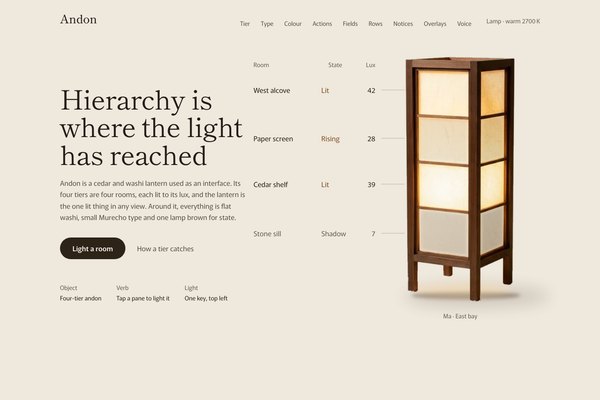
Andon is a cedar and Mino washi lantern used as an interface, and the lantern is the lighting schedule. It stands on a pale washi table; its four tiers are four rooms, each lit to its lux, so West alcove and Cedar shelf glow, Paper screen is half lit and rising, and Stone sill is dark paper. The schedule sits beside it with each row level with its tier and a hairline running to the post. Touch a pane, its row or Light a room and that tier catches and glows. Everything around the lantern is flat and precise: small Murecho type, one light Shippori Mincho headline, and lamp brown only on the words Lit and Rising.
An in-place revision of Andon (generation 2), rebuilt the Inspora way from the elevated specimen arni approved on 2026-09-28. It keeps the lamplight concept, light as hierarchy, the ma interval as the dark stone sill, the washi and cedar world, Shippori Mincho and the room schedule, and drops the lampfall gradients, the amber seam, the shadow gutter, the grain, the chips and IBM Plex.
Calm and edited: one object and a short headline per view, 136 to 152px between sections on desktop and 104px on phones, 52px controls, rows parted by 12 to 17px of padding, prose held to about 34em.
Phones (390px) stack to one column: headline, copy and the action, then the schedule and a 360px lantern side by side with 8px hairlines; nav links and non-essential table columns hide. Tablets (768 to 1080px) put the copy above a centred lantern group and keep two-column forms. Ultra-wide caps and centres the content, keeps the lantern at 740px at most, and lets only the hero image span the full width.
umbra
Studio product photographs of the andon and its parts on a pale washi table: oiled Kiso cedar with square joinery, Mino kozo washi lit from inside at 2700 K with the fibres showing, one key light from the top left, brown-tinted shadows falling to the lower right, and a warm pool of lamplight at the foot. One object, photographed as a catalogue piece.
The landing hero is the empty washi sweep, photographed with a soft top-left key, with the live cut-out lantern standing on it and the headline beside it on the ground. Later views use parts of the lantern (a lit pane close up, one tier in four states) rather than the whole lantern again. No text, no people, no props, no vignette, no lens flare. From Umbra this direction keeps the single light from the upper left, matte opaque material, warm highlights and one cast shadow in one direction; it softens Umbra's hard low sun into a studio key so the washi reads as lit from inside, and keeps the shade warm brown rather than indigo.
# Andon

## Philosophy

Andon is a cedar and Mino washi lantern used as an interface, and the lantern is the lighting schedule. It stands on a pale washi table; its four tiers are four rooms, each lit to its lux, so West alcove and Cedar shelf glow, Paper screen is half lit and rising, and Stone sill is dark paper. The schedule sits beside it with each row level with its tier and a hairline running to the post. Touch a pane, its row or Light a room and that tier catches and glows. Everything around the lantern is flat and precise: small Murecho type, one light Shippori Mincho headline, and lamp brown only on the words Lit and Rising.

### Values

- {"name":"Light as hierarchy","explanation":"Priority is how much light a room has. The lantern shows it as lit paper; the schedule shows it as lux; nothing else competes."}
- {"name":"One lit thing","explanation":"The lantern is the only lit or raised object in a view. The page around it is flat washi, so the paper reads as light."}
- {"name":"Active emptiness","explanation":"The dark stone sill is the ma interval: a room left dark on purpose, named in the schedule and kept dark by a setting."}
- {"name":"Material, not effect","explanation":"Washi, cedar and a 2700 K filament are photographed, not simulated. The unlit state is the same paper photographed dark, never a grey overlay or a gradient."}
- {"name":"Depth is a verb","explanation":"A tier catches only when you touch it: a short flicker, then it settles lit. At rest nothing moves."}
- {"name":"Domestic words","explanation":"Rooms, times, lux and warmth. West alcove, lit until ten. No product-speak and no borrowed Japanism."}

### Anti-Values

- {"name":"Lamplight sprayed on everything","explanation":"The old top glow, the directional gradient on every plane and the grain over the ground are gone. Light belongs to the lantern."}
- {"name":"The amber seam","explanation":"No luminous edge on the active element; state is a word in lamp brown."}
- {"name":"Boxes and chips","explanation":"No cards, bordered panels, zebra rows or status pills. Rows sit on the table, parted by space."}
- {"name":"Ornamental Japanism","explanation":"No cherry blossoms, red suns, faux brush calligraphy or motif wallpaper."}
- {"name":"Glow as decoration","explanation":"No glow on buttons or text. The cedar button is flat because the lantern is the lamp."}

### Visual Character

- One cut-out product render of a four-tier cedar and washi andon stands on the #EEE8DD washi table with table on every side, a blurred brown contact shadow falling a little right of its foot, a soft wide ambient shadow to the lower right and a #FFDEB0 pool of lamplight between its legs.
- Each tier's light is image data: a second transparent render of the same washi, unlit, is clipped to each tier with opacity 0 (Lit), 0.07 (Low), 0.44 (Rising) or 0.9 (Shadow).
- The schedule sits to the lantern's left with each row level with the middle of its tier and a 1px #B9AE9E hairline running from the lux figure to the post, like a callout on a product drawing.
- Type is small and quiet around one big light element: a Shippori Mincho 400 headline at 64px with -0.02em tracking, everything else Murecho at 14.5 to 21px with tabular lux figures.
- Lamp brown #7E4B1B appears only on the state words Lit and Rising, focus rings and meter lines; the single action is a flat cedar pill (#2E2218) with no seam and no shadow.
- Nothing is boxed: rows, forms and lists sit straight on the table, and at most one flat #F7F3EC plane appears in a view, square-cornered like the lantern's panes.

### Lineage

> An in-place revision of Andon (generation 2), rebuilt the Inspora way from the elevated specimen arni approved on 2026-09-28. It keeps the lamplight concept, light as hierarchy, the ma interval as the dark stone sill, the washi and cedar world, Shippori Mincho and the room schedule, and drops the lampfall gradients, the amber seam, the shadow gutter, the grain, the chips and IBM Plex.

## Tokens

### Colors

| Name | Value |
|------|-------|
| bg | `#EEE8DD` |
| surface | `#F7F3EC` |
| text | `#231D17` |
| copy | `#554C41` |
| muted | `#645A4D` |
| border | `#B9AE9E` |
| accent | `#7E4B1B` |
| on_accent | `#FBF6EE` |
| success | `#56633A` |
| warning | `#80561A` |
| error | `#8C3A2B` |
| info | `#456068` |
| cedar | `#2E2218` |
| well | `#E4DED3` |
| glow | `#FFDEB0` |
| shade | `#3C2A18` |

### Derived

- **Copy**: color-mix(in srgb, var(--muted) 77%, var(--text))
- **Cedar**: color-mix(in srgb, var(--text) 88%, var(--accent))
- **Well**: color-mix(in srgb, var(--bg) 93%, var(--muted))
- **Shade**: color-mix(in srgb, var(--text) 72%, var(--accent))
- **Note**: Past the eleven role colours only glow (#FFDEB0, the lamplight pool) is literal; copy, cedar, well and shade are mixed from the roles in CSS, so a palette swap carries the button, the wells and the shadows with it.

### Typography

- **Heading Font**: Shippori Mincho
- **Body Font**: Murecho
- **Mono Font**: none
- **Heading Weight**: 400
- **Wordmark Weight**: 500
- **Body Weight**: 400
- **Label Weight**: 500
- **Heading Transform**: none
- **Letter Spacing**: -0.02em on Shippori Mincho display; 0 on Murecho
- **Line Height**: 1.6
- **Base Size**: 17px
- **Scale**: ["14.5px","17px","21px","28px","40px","64px"]
- **Roles**: {"display":"Shippori Mincho 400: the one big light word in a view (64px headline, 40px section titles, 28px quotes); 500 only for the wordmark","body":"Murecho 400 at 17px for copy, rows and controls; 500 for button labels, the lead line and a selected row","label":"Murecho 400 at 14.5px in the quiet ink for labels, captions and table heads; sentence case, never tracked caps"}
- **Numerals**: lining tabular figures for lux, times and counts
- **Google Fonts Url**: https://fonts.googleapis.com/css2?family=Murecho:wght@400;500&family=Shippori+Mincho:wght@400;500&display=swap

### Radii

- **None**: 0px
- **Md**: 0px
- **Lg**: 0px
- **Full**: 9999px

### Shadows

- **Contact**: a solid --shade ellipse under the lantern's foot, 3% of its height, blurred 4px at 42% opacity, offset a little right of centre
- **Ambient**: a wide --shade ellipse, 9% of the lantern's height, blurred 18px at 16%, running out to the lower right
- **Pool**: a --glow ellipse between the legs, blurred 10px at 55%, rising to 100% when the lowest tier lights
- **Lift**: 0 1px 2px color-mix(in srgb, var(--shade) 22%, transparent), 10px 18px 40px -14px color-mix(in srgb, var(--shade) 34%, transparent)
- **Note**: One key light from the top left. The lantern throws the contact and ambient pair; an open dialog borrows the same two layers as its lift. Nothing else has a shadow, and no shadow is grey.

### Spacing

- **Base**: 8px
- **Scale**: ["4px","8px","12px","16px","24px","32px","48px","64px","96px","152px"]

### Surfaces

- **Treatment**: one-lantern-on-a-washi-table
- **Material**: The lantern is the only material object: oiled Kiso cedar with square mortise joints and four tiers of Mino kozo washi, lit from inside at 2700 K, photographed on a washi sweep and cut out. Its unlit state is a second photograph of the same washi, warm grey, laid over each tier. Everything else is flat colour.
- **Card Style**: No cards. Content sits straight on the washi table, grouped by space and a Shippori Mincho title. The flat --surface plane (one value lighter than the table) appears once per view at most: the current row, a selected table row, an open menu or dialog, or the foot band.
- **Table**: The page ground --bg is the table the lantern stands on. On the landing the hero image is the same washi sweep, photographed empty with a soft top-left key, and the live lantern stands on it.
- **Tiers**: Tier darkness is the opacity of the unlit sheet clipped to that tier: 0 for Lit, 0.07 for Low, 0.44 for Rising, 0.9 for Shadow.

### Borders

- **Default Width**: 0
- **Style**: none
- **Character**: No borders, rules, dividers or outlined boxes. The only lines are 1px --border callout hairlines that run from a schedule row to the lantern's post, like a product drawing, and the 1px leader line a link draws on hover. Focus is a 2px --accent outline.

### Motion

- **Duration**: 700ms catch, 1100ms fade back
- **Easing**: linear keyframes for the catch; cubic-bezier(.4,0,.2,1) to fade back; cubic-bezier(.2,.7,.2,1) for reveals; cubic-bezier(.34,1.3,.5,1) for the switch knob
- **Catch**: keyframes on the unlit sheet: d, 45% of d at 14%, 82% at 24%, 18% at 46%, 30% at 62%, then 0
- **Pool**: brightens over 900ms, 180ms after the lowest tier lights
- **Reveal**: sections rise 16 to 18px over 800 to 900ms as they enter, once, staggered 100 to 120ms
- **Philosophy**: Motion is a physical verb: the paper catches the lamp, dips and settles lit. The settled state is the default and renders with no JavaScript; an inline script adds .anim to <html> only when prefers-reduced-motion is not set, and a 4s fallback settles anything the observer misses. Under reduced motion a tier changes in 0.15s with no flicker.

### Controls

- **Height**: 52px
- **Compact Height**: 44px
- **Button Radius**: 9999px
- **Well Radius**: 0px
- **Wells**: --well on the table, --surface on focus with a 2px --accent ring

## Rules

### Composition

- Give each view one object moment: the lantern whole with its schedule, or one part of it (a single tier, a lit pane close up). Everything else in the view stays flat.
- Stand the lantern on the table with air on every side and the headline, copy and one action on the ground beside it; never put a panel or scrim over it.
- Show the whole lantern once per page. Later views take a part or a moment of it: one tier in four states, the lowest pane close up, the plan of the rooms it lights.
- Line each schedule row up with the middle of its tier and run a 1px hairline from the lux figure to the lantern's post.
- Separate by space and value, never by boxes: rows, lists, forms and specimens sit on the table; one flat --surface plane per view at most.
- One action per view as a flat cedar pill; any second action is a leader-line text link.

### Hierarchy

- The one big element in a view is a light word: Shippori Mincho 400 at 64px for the headline, 40px for section titles, 28px for a quote.
- Everything else is Murecho: 17px body and rows, 21px for a lead line, 14.5px labels in the quiet ink, sentence case.
- State is a word, not a chip: Lit and Rising in lamp brown, Shadow in the quiet ink with the rest of its row.
- Lux, times and counts use lining tabular figures and sit right-aligned.
- Semantic status is an 8px dot and a word in its earth colour, then a plain sentence.

### Density

Calm and edited: one object and a short headline per view, 136 to 152px between sections on desktop and 104px on phones, 52px controls, rows parted by 12 to 17px of padding, prose held to about 34em.

### Signature Patterns

- The lantern schedule: a cut-out four-tier cedar and washi andon (assets/lantern.webp) standing on the washi table beside the room schedule, each row level with its tier and joined to the post by a 1px hairline.
- Tier light as data: a transparent unlit render of the same washi (assets/lantern-unlit.webp) clipped to each tier, its opacity the room's darkness (0, 0.07, 0.44, 0.9).
- Catch: hovering or focusing a tier, its row or Light a room runs a 0.7s flicker on that tier's unlit sheet and settles it lit; the pool of lamplight brightens when the lowest tier lights, and the row's state turns to Lit.
- The dark sill: one room is left in shadow on purpose as the ma interval, named in the schedule and kept dark by a setting.
- Leader-line links: a link draws an 18px lamp-brown hairline before its word on hover and focus, the same line as the schedule callouts.
- The flat cedar pill: the one action per view, 52px, no seam and no shadow, because the lantern is the lamp.

## Layout

### Grid

- **Type**: object-first product page
- **Max Width**: 1180px content on the landing, 1240px on the embodiment, 1320 to 1400px from 1800px wide
- **Gutter**: 40 to 44px desktop, 32px tablet, 16px phone
- **Column Behavior**: The hero is copy (minmax(0,1fr)) beside the lantern group (schedule up to 320px plus the lantern at min(66svh, 740px) tall). Below it, two-column rows use minmax(0,5fr) minmax(0,7fr); every track is minmax(0,...) and every grid child min-width:0.

### Whitespace

- **Section Gap**: 136 to 152px desktop, 104px phone
- **Card Gap**: no cards; 12 to 17px row padding, 28 to 56px between groups
- **Content Padding**: content sits on the table, aligned to the grid edge; the dialog pads 36px
- **Approach**: The table is empty space by design: the lantern needs air on every side, the headline aligns with its top rim and the action with its foot line.

### Density

- **Default**: comfortable
- **Comfortable**: {"button_height":"52px","input_height":"52px","row_height":"50 to 58px rows parted by space"}

### Responsive

Phones (390px) stack to one column: headline, copy and the action, then the schedule and a 360px lantern side by side with 8px hairlines; nav links and non-essential table columns hide. Tablets (768 to 1080px) put the copy above a centred lantern group and keep two-column forms. Ultra-wide caps and centres the content, keeps the lantern at 740px at most, and lets only the hero image span the full width.

### Breakpoints

- **Mobile**: 390px
- **Phone Max**: 640px
- **Tablet**: 768 to 1080px
- **Desktop**: 1280px
- **Wide**: 1440px
- **Ultrawide**: 1800px and 2560px

## Guidance

### Do

- Stand the lantern on the washi table in the first view with its schedule beside it and air all round.
- Read the rooms off the lantern: a lit tier is a lit room; keep every other figure as quiet flat text.
- Leave one room dark on purpose and say so.
- Spend lamp brown on Lit and Rising, focus and meters only; make the action a flat cedar pill.
- Separate rows by space and value, and keep at most one flat plane in a view.
- Write in the house's words: West alcove, lit until ten. Sunset 17:36. Keep the stone sill dark.
- Style every control explicitly: square wells one value below the table, pill buttons and segments, round switches.

### Don't

- Don't show the whole lantern twice on one page; use one tier or a close-up for later moments.
- Don't put a scrim, panel or card over or around the lantern.
- Don't add glow, gradients or grain to the page, buttons or text.
- Don't draw borders, dividers or an accent edge; the only lines are callout hairlines and link leaders.
- Don't use chips or pills for state, or a stat band of big numbers.
- Don't pair a secondary button with the cedar one.
- Don't decorate with Japanese motifs or put emoji or symbol glyphs on buttons.

### Usage Context

Calm tools where one physical thing carries the state: lighting and home control, reading and archive desks, schedules for a house, an inn or a gallery, material catalogues.

### Accessibility

WCAG AA and better on the washi table #EEE8DD: ink #231D17 is 13.7:1, copy #554C41 is 6.9:1, quiet #645A4D is 5.5:1, lamp brown #7E4B1B is 5.9:1, and the cedar button label #F7F3EC on #2E2218 is 14.0:1. Semantic colours clear 4.5:1 on the table and on the plane. Status is a dot plus a word, never colour alone. Tiers, rows and the button are keyboard reachable with role button, and focus shows the lit state with a 2px lamp-brown ring. prefers-reduced-motion drops the flicker and reveals; the state still changes.

## Imagery Direction

### Pairs With

umbra

### Summary

Studio product photographs of the andon and its parts on a pale washi table: oiled Kiso cedar with square joinery, Mino kozo washi lit from inside at 2700 K with the fibres showing, one key light from the top left, brown-tinted shadows falling to the lower right, and a warm pool of lamplight at the foot. One object, photographed as a catalogue piece.

### Subjects

- the four-tier cedar and washi andon
- one lit washi pane in its cedar frame, close
- a cedar mortise joint
- the washi sweep the lantern stands on
- the pool of lamplight on the table

### Usage

The landing hero is the empty washi sweep, photographed with a soft top-left key, with the live cut-out lantern standing on it and the headline beside it on the ground. Later views use parts of the lantern (a lit pane close up, one tier in four states) rather than the whole lantern again. No text, no people, no props, no vignette, no lens flare. From Umbra this direction keeps the single light from the upper left, matte opaque material, warm highlights and one cast shadow in one direction; it softens Umbra's hard low sun into a studio key so the washi reads as lit from inside, and keeps the shade warm brown rather than indigo.
---
version: "alpha"
name: "Andon"
description: "Andon is a cedar and Mino washi lantern used as an interface, and the lantern is the lighting schedule. It stands on a pale washi table; its four tiers are four rooms, each lit to its lux, so West alcove and Cedar shelf glow, Paper scree..."
colors:
  bg: "#EEE8DD"
  surface: "#F7F3EC"
  text: "#231D17"
  copy: "#554C41"
  muted: "#645A4D"
  border: "#B9AE9E"
  accent: "#7E4B1B"
  on_accent: "#FBF6EE"
  success: "#56633A"
  warning: "#80561A"
  error: "#8C3A2B"
  info: "#456068"
  cedar: "#2E2218"
  well: "#E4DED3"
  glow: "#FFDEB0"
  shade: "#3C2A18"
typography:
  headline-lg:
    fontFamily: "Shippori Mincho"
    fontSize: "2.075rem"
    fontWeight: 700
    lineHeight: 1.1
    letterSpacing: "-0.02em"
  headline-md:
    fontFamily: "Shippori Mincho"
    fontSize: "1.66rem"
    fontWeight: 600
    lineHeight: 1.15
    letterSpacing: "-0.02em"
  body-md:
    fontFamily: "Murecho"
    fontSize: "17px"
    fontWeight: 400
    lineHeight: 1.6
    letterSpacing: "-0.02em"
  label-md:
    fontFamily: "none"
    fontSize: "0.75rem"
    fontWeight: 600
    lineHeight: 1
    letterSpacing: "0.08em"
rounded:
  none: "0px"
  md: "0px"
  lg: "0px"
  full: "9999px"
spacing:
  base: "8px"
  xs: "4px"
  sm: "8px"
  md: "12px"
  lg: "16px"
  xl: "24px"
  2xl: "32px"
  3xl: "48px"
  4xl: "64px"
  step-8: "96px"
  step-9: "152px"
components:
  color-reference-bg:
    backgroundColor: "{colors.bg}"
  color-reference-surface:
    backgroundColor: "{colors.surface}"
  color-reference-text:
    backgroundColor: "{colors.text}"
  color-reference-copy:
    backgroundColor: "{colors.copy}"
  color-reference-muted:
    backgroundColor: "{colors.muted}"
  color-reference-border:
    backgroundColor: "{colors.border}"
  color-reference-accent:
    backgroundColor: "{colors.accent}"
  color-reference-on_accent:
    backgroundColor: "{colors.on_accent}"
  color-reference-success:
    backgroundColor: "{colors.success}"
  color-reference-warning:
    backgroundColor: "{colors.warning}"
  color-reference-error:
    backgroundColor: "{colors.error}"
  color-reference-info:
    backgroundColor: "{colors.info}"
  color-reference-cedar:
    backgroundColor: "{colors.cedar}"
  color-reference-well:
    backgroundColor: "{colors.well}"
  color-reference-glow:
    backgroundColor: "{colors.glow}"
  color-reference-shade:
    backgroundColor: "{colors.shade}"
  button-primary:
    backgroundColor: "{colors.accent}"
    textColor: "{colors.on_accent}"
    typography: "{typography.label-md}"
    rounded: "{rounded.md}"
    padding: "{spacing.md}"
  card-surface:
    backgroundColor: "{colors.surface}"
    textColor: "{colors.text}"
    rounded: "{rounded.md}"
    padding: "{spacing.md}"
  input-default:
    backgroundColor: "{colors.surface}"
    textColor: "{colors.text}"
    rounded: "{rounded.md}"
    height: "44px"
---

# Andon

## Overview

Andon is a cedar and Mino washi lantern used as an interface, and the lantern is the lighting schedule. It stands on a pale washi table; its four tiers are four rooms, each lit to its lux, so West alcove and Cedar shelf glow, Paper screen is half lit and rising, and Stone sill is dark paper. The schedule sits beside it with each row level with its tier and a hairline running to the post. Touch a pane, its row or Light a room and that tier catches and glows. Everything around the lantern is flat and precise: small Murecho type, one light Shippori Mincho headline, and lamp brown only on the words Lit and Rising.

### Values

- {"name":"Light as hierarchy","explanation":"Priority is how much light a room has. The lantern shows it as lit paper; the schedule shows it as lux; nothing else competes."}
- {"name":"One lit thing","explanation":"The lantern is the only lit or raised object in a view. The page around it is flat washi, so the paper reads as light."}
- {"name":"Active emptiness","explanation":"The dark stone sill is the ma interval: a room left dark on purpose, named in the schedule and kept dark by a setting."}
- {"name":"Material, not effect","explanation":"Washi, cedar and a 2700 K filament are photographed, not simulated. The unlit state is the same paper photographed dark, never a grey overlay or a gradient."}
- {"name":"Depth is a verb","explanation":"A tier catches only when you touch it: a short flicker, then it settles lit. At rest nothing moves."}
- {"name":"Domestic words","explanation":"Rooms, times, lux and warmth. West alcove, lit until ten. No product-speak and no borrowed Japanism."}

### Anti-Values

- {"name":"Lamplight sprayed on everything","explanation":"The old top glow, the directional gradient on every plane and the grain over the ground are gone. Light belongs to the lantern."}
- {"name":"The amber seam","explanation":"No luminous edge on the active element; state is a word in lamp brown."}
- {"name":"Boxes and chips","explanation":"No cards, bordered panels, zebra rows or status pills. Rows sit on the table, parted by space."}
- {"name":"Ornamental Japanism","explanation":"No cherry blossoms, red suns, faux brush calligraphy or motif wallpaper."}
- {"name":"Glow as decoration","explanation":"No glow on buttons or text. The cedar button is flat because the lantern is the lamp."}

### Visual Character

- One cut-out product render of a four-tier cedar and washi andon stands on the #EEE8DD washi table with table on every side, a blurred brown contact shadow falling a little right of its foot, a soft wide ambient shadow to the lower right and a #FFDEB0 pool of lamplight between its legs.
- Each tier's light is image data: a second transparent render of the same washi, unlit, is clipped to each tier with opacity 0 (Lit), 0.07 (Low), 0.44 (Rising) or 0.9 (Shadow).
- The schedule sits to the lantern's left with each row level with the middle of its tier and a 1px #B9AE9E hairline running from the lux figure to the post, like a callout on a product drawing.
- Type is small and quiet around one big light element: a Shippori Mincho 400 headline at 64px with -0.02em tracking, everything else Murecho at 14.5 to 21px with tabular lux figures.
- Lamp brown #7E4B1B appears only on the state words Lit and Rising, focus rings and meter lines; the single action is a flat cedar pill (#2E2218) with no seam and no shadow.
- Nothing is boxed: rows, forms and lists sit straight on the table, and at most one flat #F7F3EC plane appears in a view, square-cornered like the lantern's panes.

### Lineage

> An in-place revision of Andon (generation 2), rebuilt the Inspora way from the elevated specimen arni approved on 2026-09-28. It keeps the lamplight concept, light as hierarchy, the ma interval as the dark stone sill, the washi and cedar world, Shippori Mincho and the room schedule, and drops the lampfall gradients, the amber seam, the shadow gutter, the grain, the chips and IBM Plex.

## Colors

Use the YAML color tokens as the normative palette. The prose below names the roles agents should preserve when generating UI.

| Token | Value |
|-------|-------|
| bg | `#EEE8DD` |
| surface | `#F7F3EC` |
| text | `#231D17` |
| copy | `#554C41` |
| muted | `#645A4D` |
| border | `#B9AE9E` |
| accent | `#7E4B1B` |
| on_accent | `#FBF6EE` |
| success | `#56633A` |
| warning | `#80561A` |
| error | `#8C3A2B` |
| info | `#456068` |
| cedar | `#2E2218` |
| well | `#E4DED3` |
| glow | `#FFDEB0` |
| shade | `#3C2A18` |

## Typography

Load the fonts from Google Fonts: https://fonts.googleapis.com/css2?family=Murecho:wght@400;500&family=Shippori+Mincho:wght@400;500&display=swap

- **Headline-Lg**: Shippori Mincho, 2.075rem, weight 700, line-height 1.1.
- **Headline-Md**: Shippori Mincho, 1.66rem, weight 600, line-height 1.15.
- **Body-Md**: Murecho, 17px, weight 400, line-height 1.6.
- **Label-Md**: none, 0.75rem, weight 600, line-height 1.

## Layout

### Spacing Tokens

- **Base**: `8px`
- **Xs**: `4px`
- **Sm**: `8px`
- **Md**: `12px`
- **Lg**: `16px`
- **Xl**: `24px`
- **2xl**: `32px`
- **3xl**: `48px`
- **4xl**: `64px`
- **Step-8**: `96px`
- **Step-9**: `152px`

### Grid

- **Type**: object-first product page
- **Max Width**: 1180px content on the landing, 1240px on the embodiment, 1320 to 1400px from 1800px wide
- **Gutter**: 40 to 44px desktop, 32px tablet, 16px phone
- **Column Behavior**: The hero is copy (minmax(0,1fr)) beside the lantern group (schedule up to 320px plus the lantern at min(66svh, 740px) tall). Below it, two-column rows use minmax(0,5fr) minmax(0,7fr); every track is minmax(0,...) and every grid child min-width:0.

### Whitespace

- **Section Gap**: 136 to 152px desktop, 104px phone
- **Card Gap**: no cards; 12 to 17px row padding, 28 to 56px between groups
- **Content Padding**: content sits on the table, aligned to the grid edge; the dialog pads 36px
- **Approach**: The table is empty space by design: the lantern needs air on every side, the headline aligns with its top rim and the action with its foot line.

### Density

- **Default**: comfortable
- **Comfortable**: {"button_height":"52px","input_height":"52px","row_height":"50 to 58px rows parted by space"}

### Responsive

Phones (390px) stack to one column: headline, copy and the action, then the schedule and a 360px lantern side by side with 8px hairlines; nav links and non-essential table columns hide. Tablets (768 to 1080px) put the copy above a centred lantern group and keep two-column forms. Ultra-wide caps and centres the content, keeps the lantern at 740px at most, and lets only the hero image span the full width.

### Breakpoints

- **Mobile**: 390px
- **Phone Max**: 640px
- **Tablet**: 768 to 1080px
- **Desktop**: 1280px
- **Wide**: 1440px
- **Ultrawide**: 1800px and 2560px

## Elevation & Depth

### Shadows

- **Contact**: a solid --shade ellipse under the lantern's foot, 3% of its height, blurred 4px at 42% opacity, offset a little right of centre
- **Ambient**: a wide --shade ellipse, 9% of the lantern's height, blurred 18px at 16%, running out to the lower right
- **Pool**: a --glow ellipse between the legs, blurred 10px at 55%, rising to 100% when the lowest tier lights
- **Lift**: 0 1px 2px color-mix(in srgb, var(--shade) 22%, transparent), 10px 18px 40px -14px color-mix(in srgb, var(--shade) 34%, transparent)
- **Note**: One key light from the top left. The lantern throws the contact and ambient pair; an open dialog borrows the same two layers as its lift. Nothing else has a shadow, and no shadow is grey.

## Shapes

### Rounded

- **None**: `0px`
- **Md**: `0px`
- **Lg**: `0px`
- **Full**: `9999px`

### Surfaces

- **Treatment**: one-lantern-on-a-washi-table
- **Material**: The lantern is the only material object: oiled Kiso cedar with square mortise joints and four tiers of Mino kozo washi, lit from inside at 2700 K, photographed on a washi sweep and cut out. Its unlit state is a second photograph of the same washi, warm grey, laid over each tier. Everything else is flat colour.
- **Card Style**: No cards. Content sits straight on the washi table, grouped by space and a Shippori Mincho title. The flat --surface plane (one value lighter than the table) appears once per view at most: the current row, a selected table row, an open menu or dialog, or the foot band.
- **Table**: The page ground --bg is the table the lantern stands on. On the landing the hero image is the same washi sweep, photographed empty with a soft top-left key, and the live lantern stands on it.
- **Tiers**: Tier darkness is the opacity of the unlit sheet clipped to that tier: 0 for Lit, 0.07 for Low, 0.44 for Rising, 0.9 for Shadow.

### Borders

- **Default Width**: 0
- **Style**: none
- **Character**: No borders, rules, dividers or outlined boxes. The only lines are 1px --border callout hairlines that run from a schedule row to the lantern's post, like a product drawing, and the 1px leader line a link draws on hover. Focus is a 2px --accent outline.

## Components

### Composition

- Give each view one object moment: the lantern whole with its schedule, or one part of it (a single tier, a lit pane close up). Everything else in the view stays flat.
- Stand the lantern on the table with air on every side and the headline, copy and one action on the ground beside it; never put a panel or scrim over it.
- Show the whole lantern once per page. Later views take a part or a moment of it: one tier in four states, the lowest pane close up, the plan of the rooms it lights.
- Line each schedule row up with the middle of its tier and run a 1px hairline from the lux figure to the lantern's post.
- Separate by space and value, never by boxes: rows, lists, forms and specimens sit on the table; one flat --surface plane per view at most.
- One action per view as a flat cedar pill; any second action is a leader-line text link.

### Hierarchy

- The one big element in a view is a light word: Shippori Mincho 400 at 64px for the headline, 40px for section titles, 28px for a quote.
- Everything else is Murecho: 17px body and rows, 21px for a lead line, 14.5px labels in the quiet ink, sentence case.
- State is a word, not a chip: Lit and Rising in lamp brown, Shadow in the quiet ink with the rest of its row.
- Lux, times and counts use lining tabular figures and sit right-aligned.
- Semantic status is an 8px dot and a word in its earth colour, then a plain sentence.

### Density

Calm and edited: one object and a short headline per view, 136 to 152px between sections on desktop and 104px on phones, 52px controls, rows parted by 12 to 17px of padding, prose held to about 34em.

### Signature Patterns

- The lantern schedule: a cut-out four-tier cedar and washi andon (assets/lantern.webp) standing on the washi table beside the room schedule, each row level with its tier and joined to the post by a 1px hairline.
- Tier light as data: a transparent unlit render of the same washi (assets/lantern-unlit.webp) clipped to each tier, its opacity the room's darkness (0, 0.07, 0.44, 0.9).
- Catch: hovering or focusing a tier, its row or Light a room runs a 0.7s flicker on that tier's unlit sheet and settles it lit; the pool of lamplight brightens when the lowest tier lights, and the row's state turns to Lit.
- The dark sill: one room is left in shadow on purpose as the ma interval, named in the schedule and kept dark by a setting.
- Leader-line links: a link draws an 18px lamp-brown hairline before its word on hover and focus, the same line as the schedule callouts.
- The flat cedar pill: the one action per view, 52px, no seam and no shadow, because the lantern is the lamp.

## shadcn/ui Usage

When the target app uses shadcn/ui, copy DESIGN.md with shadcn instead of the plain DESIGN.md. It contains the same Katagami design-language source plus the shadcn/ui primitives, imports, theme variables, component recipes, and preview-shot guidance.

DESIGN.md with shadcn: `/language/en-01a0ecb1-11c3-78a0-8200-1bdcee09a5f9/DESIGN.with-shadcn.md`.

Machine-readable companions for automation: `/language/en-01a0ecb1-11c3-78a0-8200-1bdcee09a5f9/shadcn.json` (registry theme), `/language/en-01a0ecb1-11c3-78a0-8200-1bdcee09a5f9/shadcn-components.md` (component recipes) and `/language/en-01a0ecb1-11c3-78a0-8200-1bdcee09a5f9/shadcn-shots.json` (preview shots). The human-facing handoff is still DESIGN.md with shadcn.

Install recommended primitives with `npx shadcn@latest add button card input textarea select dialog sheet tabs badge separator checkbox switch slider tooltip dropdown-menu table`.

Use these primitives in shadcn apps:
- button
- card
- input
- textarea
- select
- dialog
- sheet
- tabs
- badge
- separator
- checkbox
- switch
- slider
- tooltip
- dropdown-menu
- table

Implementation rule for agents: import shadcn primitives from `@/components/ui/*`, apply the generated CSS variables first, then compose the language-specific recipes from the companion MD. Katagami remains the source of truth; shadcn names are the implementation surface.

## Do's and Don'ts

- Do Stand the lantern on the washi table in the first view with its schedule beside it and air all round.
- Do Read the rooms off the lantern: a lit tier is a lit room; keep every other figure as quiet flat text.
- Do Leave one room dark on purpose and say so.
- Do Spend lamp brown on Lit and Rising, focus and meters only; make the action a flat cedar pill.
- Do Separate rows by space and value, and keep at most one flat plane in a view.
- Do Write in the house's words: West alcove, lit until ten. Sunset 17:36. Keep the stone sill dark.
- Do Style every control explicitly: square wells one value below the table, pill buttons and segments, round switches.
- Don't Don't show the whole lantern twice on one page; use one tier or a close-up for later moments.
- Don't Don't put a scrim, panel or card over or around the lantern.
- Don't Don't add glow, gradients or grain to the page, buttons or text.
- Don't Don't draw borders, dividers or an accent edge; the only lines are callout hairlines and link leaders.
- Don't Don't use chips or pills for state, or a stat band of big numbers.
- Don't Don't pair a secondary button with the cedar one.
- Don't Don't decorate with Japanese motifs or put emoji or symbol glyphs on buttons.

### Usage Context

Calm tools where one physical thing carries the state: lighting and home control, reading and archive desks, schedules for a house, an inn or a gallery, material catalogues.

### Accessibility

WCAG AA and better on the washi table #EEE8DD: ink #231D17 is 13.7:1, copy #554C41 is 6.9:1, quiet #645A4D is 5.5:1, lamp brown #7E4B1B is 5.9:1, and the cedar button label #F7F3EC on #2E2218 is 14.0:1. Semantic colours clear 4.5:1 on the table and on the plane. Status is a dot plus a word, never colour alone. Tiers, rows and the button are keyboard reachable with role button, and focus shows the lit state with a 2px lamp-brown ring. prefers-reduced-motion drops the flicker and reveals; the state still changes.

## Imagery Direction

### Pairs With

umbra

### Summary

Studio product photographs of the andon and its parts on a pale washi table: oiled Kiso cedar with square joinery, Mino kozo washi lit from inside at 2700 K with the fibres showing, one key light from the top left, brown-tinted shadows falling to the lower right, and a warm pool of lamplight at the foot. One object, photographed as a catalogue piece.

### Subjects

- the four-tier cedar and washi andon
- one lit washi pane in its cedar frame, close
- a cedar mortise joint
- the washi sweep the lantern stands on
- the pool of lamplight on the table

### Usage

The landing hero is the empty washi sweep, photographed with a soft top-left key, with the live cut-out lantern standing on it and the headline beside it on the ground. Later views use parts of the lantern (a lit pane close up, one tier in four states) rather than the whole lantern again. No text, no people, no props, no vignette, no lens flare. From Umbra this direction keeps the single light from the upper left, matte opaque material, warm highlights and one cast shadow in one direction; it softens Umbra's hard low sun into a studio key so the washi reads as lit from inside, and keeps the shade warm brown rather than indigo.
```json
{
  "$schema": "https://ui.shadcn.com/schema/registry-item.json",
  "name": "andon",
  "type": "registry:theme",
  "title": "Andon shadcn Theme",
  "cssVars": {
    "theme": {},
    "light": {
      "background": "#EEE8DD",
      "foreground": "#231D17",
      "card": "#F7F3EC",
      "card-foreground": "#231D17",
      "popover": "#F7F3EC",
      "popover-foreground": "#231D17",
      "primary": "#231D17",
      "primary-foreground": "#ffffff",
      "secondary": "#f4f4f5",
      "secondary-foreground": "#111111",
      "muted": "#645A4D",
      "muted-foreground": "#231D17",
      "accent": "#7E4B1B",
      "accent-foreground": "#ffffff",
      "destructive": "#8C3A2B",
      "border": "#B9AE9E",
      "input": "#B9AE9E",
      "ring": "#7E4B1B",
      "chart-1": "#231D17",
      "chart-2": "#f4f4f5",
      "chart-3": "#7E4B1B",
      "chart-4": "#56633A",
      "chart-5": "#80561A",
      "sidebar": "#F7F3EC",
      "sidebar-foreground": "#231D17",
      "sidebar-primary": "#231D17",
      "sidebar-primary-foreground": "#ffffff",
      "sidebar-accent": "#456068",
      "sidebar-accent-foreground": "#ffffff",
      "sidebar-border": "#B9AE9E",
      "sidebar-ring": "#7E4B1B",
      "radius": "0px"
    },
    "dark": {
      "background": "#0f1115",
      "foreground": "#f8fafc",
      "card": "#181b22",
      "card-foreground": "#f8fafc",
      "popover": "#181b22",
      "popover-foreground": "#f8fafc",
      "primary": "#231D17",
      "primary-foreground": "#ffffff",
      "secondary": "#252a33",
      "secondary-foreground": "#f8fafc",
      "muted": "#252a33",
      "muted-foreground": "#a1a1aa",
      "accent": "#7E4B1B",
      "accent-foreground": "#ffffff",
      "destructive": "#8C3A2B",
      "border": "#303642",
      "input": "#303642",
      "ring": "#7E4B1B",
      "chart-1": "#231D17",
      "chart-2": "#f4f4f5",
      "chart-3": "#7E4B1B",
      "chart-4": "#56633A",
      "chart-5": "#80561A",
      "sidebar": "#181b22",
      "sidebar-foreground": "#f8fafc",
      "sidebar-primary": "#231D17",
      "sidebar-primary-foreground": "#ffffff",
      "sidebar-accent": "#7E4B1B",
      "sidebar-accent-foreground": "#ffffff",
      "sidebar-border": "#303642",
      "sidebar-ring": "#7E4B1B",
      "radius": "0px"
    }
  },
  "meta": {
    "source": "katagami",
    "languageId": "en-01a0ecb1-11c3-78a0-8200-1bdcee09a5f9",
    "slug": "andon",
    "componentManifest": [
      "button",
      "card",
      "input",
      "textarea",
      "select",
      "dialog",
      "sheet",
      "tabs",
      "badge",
      "separator",
      "checkbox",
      "switch",
      "slider",
      "tooltip",
      "dropdown-menu",
      "table"
    ],
    "installCommand": "npx shadcn@latest add button card input textarea select dialog sheet tabs badge separator checkbox switch slider tooltip dropdown-menu table",
    "nativeTokenNames": {
      "colors": [
        "accent",
        "bg",
        "border",
        "cedar",
        "copy",
        "error",
        "glow",
        "info",
        "muted",
        "on_accent",
        "shade",
        "success",
        "surface",
        "text",
        "warning",
        "well"
      ],
      "derived": [
        "cedar",
        "copy",
        "note",
        "shade",
        "well"
      ],
      "typography": [
        "base_size",
        "body_font",
        "body_weight",
        "google_fonts_url",
        "heading_font",
        "heading_transform",
        "heading_weight",
        "label_weight",
        "letter_spacing",
        "line_height",
        "mono_font",
        "numerals",
        "roles",
        "scale",
        "wordmark_weight"
      ],
      "radii": [
        "full",
        "lg",
        "md",
        "none"
      ],
      "shadows": [
        "ambient",
        "contact",
        "lift",
        "note",
        "pool"
      ],
      "spacing": [
        "base",
        "scale"
      ],
      "surfaces": [
        "card_style",
        "material",
        "table",
        "tiers",
        "treatment"
      ],
      "borders": [
        "character",
        "default_width",
        "style"
      ],
      "motion": [
        "catch",
        "duration",
        "easing",
        "philosophy",
        "pool",
        "reveal"
      ],
      "controls": [
        "button_radius",
        "compact_height",
        "height",
        "well_radius",
        "wells"
      ]
    }
  }
}
```The art style its pictures are drawn in and the colours its tokens carry.
The theme variables are generated from the tokens. Component recipes and preview shots have not been written for this language yet.
For an app that uses shadcn/ui: the DESIGN.md plus the install list, theme variables, component recipes, preview shots and a starter TSX file, in one Markdown file.
The same pieces as separate files: theme, CSS, TSX starter, recipes and the preview contract.
npx shadcn@latest add button card input textarea select dialog sheet tabs badge separator checkbox switch slider tooltip dropdown-menu table:root {
--background: #EEE8DD;
--foreground: #231D17;
--card: #F7F3EC;
--card-foreground: #231D17;
--popover: #F7F3EC;
--popover-foreground: #231D17;
--primary: #231D17;
--primary-foreground: #ffffff;
--secondary: #f4f4f5;
--secondary-foreground: #111111;
--muted: #645A4D;
--muted-foreground: #231D17;
--accent: #7E4B1B;
--accent-foreground: #ffffff;
--destructive: #8C3A2B;
--border: #B9AE9E;
--input: #B9AE9E;
--ring: #7E4B1B;
--chart-1: #231D17;
--chart-2: #f4f4f5;
--chart-3: #7E4B1B;
--chart-4: #56633A;
--chart-5: #80561A;
--sidebar: #F7F3EC;
--sidebar-foreground: #231D17;
--sidebar-primary: #231D17;
--sidebar-primary-foreground: #ffffff;
--sidebar-accent: #456068;
--sidebar-accent-foreground: #ffffff;
--sidebar-border: #B9AE9E;
--sidebar-ring: #7E4B1B;
--radius: 0px;
}
.dark {
--background: #0f1115;
--foreground: #f8fafc;
--card: #181b22;
--card-foreground: #f8fafc;
--popover: #181b22;
--popover-foreground: #f8fafc;
--primary: #231D17;
--primary-foreground: #ffffff;
--secondary: #252a33;
--secondary-foreground: #f8fafc;
--muted: #252a33;
--muted-foreground: #a1a1aa;
--accent: #7E4B1B;
--accent-foreground: #ffffff;
--destructive: #8C3A2B;
--border: #303642;
--input: #303642;
--ring: #7E4B1B;
--chart-1: #231D17;
--chart-2: #f4f4f5;
--chart-3: #7E4B1B;
--chart-4: #56633A;
--chart-5: #80561A;
--sidebar: #181b22;
--sidebar-foreground: #f8fafc;
--sidebar-primary: #231D17;
--sidebar-primary-foreground: #ffffff;
--sidebar-accent: #7E4B1B;
--sidebar-accent-foreground: #ffffff;
--sidebar-border: #303642;
--sidebar-ring: #7E4B1B;
--radius: 0px;
}
import { Badge } from "@/components/ui/badge";
import { Button } from "@/components/ui/button";
import {
  Card,
  CardContent,
  CardDescription,
  CardFooter,
  CardHeader,
  CardTitle,
} from "@/components/ui/card";
import { Input } from "@/components/ui/input";
import { Tabs, TabsList, TabsTrigger } from "@/components/ui/tabs";

export function AndonShadcnKit() {
  return (
    <section className="grid gap-4 rounded-[var(--radius)] border bg-background p-4 text-foreground">
      <div className="flex items-start justify-between gap-4">
        <div>
          <Badge variant="outline">shadcn/ui</Badge>
          <h2 className="mt-3 text-2xl font-semibold tracking-tight">Andon</h2>
          <p className="mt-1 max-w-xl text-sm text-muted-foreground">
            Use the Katagami registry theme, then compose these shadcn primitives
            with the language-specific component recipes.
          </p>
        </div>
        <Button>Apply theme</Button>
      </div>

      <Tabs defaultValue="components">
        <TabsList>
          <TabsTrigger value="components">Components</TabsTrigger>
          <TabsTrigger value="states">States</TabsTrigger>
          <TabsTrigger value="export">Export</TabsTrigger>
        </TabsList>
      </Tabs>

      <Card>
        <CardHeader>
          <CardTitle>Component recipe</CardTitle>
          <CardDescription>
            Replace this starter content with the agent-authored product scene
            from components.md and preview-shots.json.
          </CardDescription>
        </CardHeader>
        <CardContent className="grid gap-3 sm:grid-cols-[1fr_auto]">
          <Input defaultValue="Tokenized shadcn surface" aria-label="Recipe name" />
          <Button variant="secondary">Preview state</Button>
        </CardContent>
        <CardFooter className="justify-between">
          <Badge>Ready</Badge>
          <Button variant="outline">Copy recipe</Button>
        </CardFooter>
      </Card>
    </section>
  );
}
{
  "$schema": "https://ui.shadcn.com/schema/registry-item.json",
  "name": "andon",
  "type": "registry:theme",
  "title": "Andon",
  "description": "A cedar and washi lantern whose tiers are the rooms: a flat washi table, square wells, no borders, one flat cedar pill and lamp brown for state.",
  "cssVars": {
    "theme": {
      "font-sans": "Murecho, system-ui, sans-serif",
      "font-display": "Shippori Mincho, Georgia, serif",
      "radius": "0px"
    },
    "light": {
      "background": "#EEE8DD",
      "foreground": "#231D17",
      "card": "#F7F3EC",
      "card-foreground": "#231D17",
      "popover": "#F7F3EC",
      "popover-foreground": "#231D17",
      "primary": "#2E2218",
      "primary-foreground": "#F7F3EC",
      "secondary": "#E4DED3",
      "secondary-foreground": "#231D17",
      "muted": "#E4DED3",
      "muted-foreground": "#645A4D",
      "accent": "#E4DED3",
      "accent-foreground": "#231D17",
      "destructive": "#8C3A2B",
      "destructive-foreground": "#FBF6EE",
      "border": "transparent",
      "input": "transparent",
      "ring": "#7E4B1B",
      "chart-1": "#7E4B1B",
      "chart-2": "#2E2218",
      "chart-3": "#645A4D",
      "chart-4": "#56633A",
      "chart-5": "#456068",
      "radius": "0px"
    },
    "dark": {
      "background": "#EEE8DD",
      "foreground": "#231D17",
      "card": "#F7F3EC",
      "card-foreground": "#231D17",
      "popover": "#F7F3EC",
      "popover-foreground": "#231D17",
      "primary": "#2E2218",
      "primary-foreground": "#F7F3EC",
      "secondary": "#E4DED3",
      "secondary-foreground": "#231D17",
      "muted": "#E4DED3",
      "muted-foreground": "#645A4D",
      "accent": "#E4DED3",
      "accent-foreground": "#231D17",
      "destructive": "#8C3A2B",
      "destructive-foreground": "#FBF6EE",
      "border": "transparent",
      "input": "transparent",
      "ring": "#7E4B1B",
      "chart-1": "#7E4B1B",
      "chart-2": "#2E2218",
      "chart-3": "#645A4D",
      "chart-4": "#56633A",
      "chart-5": "#456068",
      "radius": "0px"
    }
  },
  "componentManifest": [
    "button",
    "card",
    "input",
    "textarea",
    "select",
    "dialog",
    "sheet",
    "tabs",
    "badge",
    "separator",
    "checkbox",
    "switch",
    "slider",
    "tooltip",
    "dropdown-menu",
    "table"
  ],
  "meta": {
    "nativeTokenNames": {
      "bg": "background",
      "surface": "card / popover",
      "well": "secondary / muted / accent",
      "text": "foreground",
      "muted": "muted-foreground",
      "cedar": "primary",
      "accent": "ring (lamp brown)",
      "error": "destructive",
      "copy": "native only",
      "glow": "native only",
      "shade": "native only",
      "border": "native only (callout hairlines)"
    },
    "note": "Andon is a light-ground language by concept; the dark scope repeats the light values. Buttons are pills (rounded-full) over a 0px radius for every rectangle.",
    "componentManifest": [
      "button",
      "card",
      "input",
      "textarea",
      "select",
      "dialog",
      "sheet",
      "tabs",
      "badge",
      "separator",
      "checkbox",
      "switch",
      "slider",
      "tooltip",
      "dropdown-menu",
      "table"
    ]
  }
}
---
artifact: component-recipes-v1
language: andon
author: katagami-agent
primitives: 16
---

# Andon shadcn/ui Components

Author: `katagami-agent`

## Intent

Andon dresses shadcn/ui as the flat, precise interface around one real object: a cedar and Mino washi andon whose four tiers are four rooms, each lit to its lux. The lantern is the only lit or raised thing in a view and appears whole once per page. Nothing else is boxed: content sits straight on the washi table, parted by space; the only filled surfaces are square wells, one selected row and an open overlay. The one action is a flat cedar pill; lamp brown marks the state words Lit and Rising.

## Required primitives

button, card, input, textarea, select, dialog, sheet, tabs, badge, separator, checkbox, switch, slider, tooltip, dropdown-menu, table. Import them from `@/components/ui/*`; do not build a second component system.

## Token cues

```css
--background:#EEE8DD;
--foreground:#231D17;
--card:#F7F3EC;
--card-foreground:#231D17;
--popover:#F7F3EC;
--popover-foreground:#231D17;
--primary:#2E2218;
--primary-foreground:#F7F3EC;
--secondary:#E4DED3;
--secondary-foreground:#231D17;
--muted:#E4DED3;
--muted-foreground:#645A4D;
--accent:#E4DED3;
--accent-foreground:#231D17;
--destructive:#8C3A2B;
--destructive-foreground:#FBF6EE;
--border:transparent;
--input:transparent;
--ring:#7E4B1B;
--chart-1:#7E4B1B;
--chart-2:#2E2218;
--chart-3:#645A4D;
--chart-4:#56633A;
--chart-5:#456068;
--radius:0px;
--font-sans:Murecho; --font-display:"Shippori Mincho";
```

Native names are kept in the theme: `bg`, `surface`, `well`, `cedar`, `copy`, `glow`, `shade`, `border` (callout hairlines only).

## Visual character to preserve

- One object per view: the lantern with its schedule, or one part of it. Never put it in a Card.
- No borders, dividers, cards or chips. Rows and groups separate by space and type value; at most one flat plane per view.
- Rectangles are square (0px) like the lantern's panes; buttons, segments, switches and dots are round (9999px).
- Lamp brown only on Lit and Rising, focus rings, meters and link leaders.
- Shippori Mincho 400 for the one big light word; Murecho for everything else, sentence case.
- No glow, gradients or grain. Only the lantern and an open dialog cast the two-layer brown shadow from a top-left key.

## ShadSync visual profile

- family: lantern-object
- material: flat washi planes around one lit cedar and washi lantern
- contour: default, radius 0 with pill buttons
- border: none
- underlay: false
- grain: false
- stickerBadges: false
- motion: tier catches with a flicker and settles lit
- density: comfortable
- accents: lamp-brown

## Signature component recipes

- **button:** 52px, rounded-full, Murecho 500 at 17px, no border, no shadow, never wraps. Default is the flat cedar pill (primary), one per view; hover deepens it to ink, active presses 1px. A second action is a ghost link that draws an 18px lamp-brown leader line before its word. Destructive is earth-red link text with the same leader, never a filled red button. Focus is a 2px lamp-brown outline.
- **card:** No frame around content: transparent, no border, no shadow, no padding, grouped by space under a Shippori Mincho title. bg-card (the flat washi plane) is kept for one selected row, an open menu or dialog, at 0px radius.
- **input:** A flat square 52px well of the secondary washi tone on the page, no border, 18px side padding; on focus it lifts to bg-card with a 2px lamp-brown ring.
- **textarea:** The input well at 120px, 14px vertical padding, line-height 1.6, vertical resize only.
- **select:** The input well with a drawn 12px SVG chevron in ink; the content opens as the flat washi plane, square, with rows that tint the well tone when highlighted and a muted lux figure on the right.
- **dialog:** The one raised plane: bg-card, square, 36px padding, with the lantern's two-layer brown shadow; Shippori Mincho 28px title, Murecho body, a compact cedar pill beside an earth-red leader link; drawn SVG close in a 44px hit area.
- **sheet:** A right-side flat washi plane, square, sliding in on cubic-bezier(.2,.7,.2,1); it lists a room's evening as rows on the plane, parted by space.
- **tabs:** No tray: 44px Murecho triggers in the quiet ink; the active trigger turns ink and draws the 18px lamp-brown leader line before its word. No underline, no pill.
- **badge:** A state word, not a pill: bg-transparent, no padding, Murecho 17px. Lit and Rising in lamp brown, Shadow in the quiet ink; semantic status adds an 8px round dot in its earth colour.
- **separator:** Not drawn. Rows part by 12 to 17px padding and groups by 28 to 56px; render transparent if a primitive needs one.
- **checkbox:** 22px square well that fills cedar with a drawn washi-coloured tick when checked; focus is the lamp-brown ring.
- **switch:** 48 by 28px round track in the hairline tone with a washi knob; on fills the track cedar and slides the knob on cubic-bezier(.34,1.3,.5,1).
- **slider:** A 2px hairline track, a lamp-brown range and a 22px round cedar thumb; the value prints in Murecho between Shadow and Full labels.
- **tooltip:** Ink rectangle with washi text at 14.5px, square, no arrow, placed beside its trigger.
- **dropdown-menu:** Opens in place as the flat washi plane, square, no shadow; Murecho rows with a muted detail on the right, highlighted with the well tone.
- **table:** Rows straight on the table, no dividers, 16px cell padding, tabular figures right-aligned; the header is 14.5px quiet ink; the selected row takes the flat washi plane and a 500 room name; hover is a faint wash of it. Hide Warmth and Until below 640px.

### The lantern schedule (the signature, outside shadcn)

The lantern is not a shadcn primitive. Build it once: the cut-out render (`lantern.webp`, 320 by 712) at a fixed height, four tier layers of `lantern-unlit.webp` clipped to each tier with `opacity` 0, 0.07, 0.44 and 0.9, and four transparent hit areas with `role="button"`. Beside it, the schedule rows sit at 14.3%, 33.8%, 52.3% and 72% of its height with a 1px hairline to the post. Hover or focus on a tier, its row or Light a room runs the 0.7s catch on that tier and settles it at 0; the pool brightens when the lowest tier lights.

## Preview shots

- `application-shell`: tonight in the East bay. The lantern schedule with one cedar action, then the evening's timetable with the current row on the plane.
- `detail-editor`: set the alcove for tomorrow. Square wells, a room select, the brightness slider, warmth segments, a switch, a checkbox and one cedar save.
- `data-operations`: rooms tonight. Tabs with a leader line, a menu open in place, the rooms table with state words, notices as dots and words, and the raised dialog.

Each shot carries a renderable `scene` with headline, description, actions and rows or fields.

## Implementation contract

- Start from local `@/components/ui/*` shadcn primitives and apply `/katagami/shadcn/andon/registry-theme.json`.
- Keep `--border` and `--input` transparent; wells take their tone from `bg-secondary`.
- Set `--radius: 0px`; give Button, Switch and segment items `rounded-full`.
- One `default` (cedar) button per view; a second action is a ghost link with the leader line.
- No Card frames around content; show the whole lantern once per page.
- Respect `prefers-reduced-motion`: drop the flicker and reveals, keep the state change.

## Copy-paste component example

```tsx
import { Button } from "@/components/ui/button";
import { Card, CardContent, CardHeader, CardTitle } from "@/components/ui/card";
import { Badge } from "@/components/ui/badge";

const rooms = [
  { room: "West alcove", state: "Lit", lux: 42 },
  { room: "Paper screen", state: "Rising", lux: 28 },
  { room: "Cedar shelf", state: "Lit", lux: 39 },
  { room: "Stone sill", state: "Shadow", lux: 7 },
];

export function Tonight() {
  return (
    <Card className="gap-5 border-0 bg-transparent p-0 shadow-none">
      <CardHeader className="p-0">
        <CardTitle className="font-[Shippori_Mincho] text-[40px] font-normal leading-[1.12] tracking-[-0.02em]">West alcove, lit until ten</CardTitle>
      </CardHeader>
      <CardContent className="flex flex-col p-0 text-[17px] tabular-nums">
        {rooms.map((r) => (
          <div key={r.room} className="grid grid-cols-[1fr_5em_2.4em] items-baseline gap-3.5 py-3">
            <span className={r.state === "Shadow" ? "text-muted-foreground" : ""}>{r.room}</span>
            <Badge className={"h-auto bg-transparent p-0 text-[17px] font-normal " + (r.state === "Shadow" ? "text-muted-foreground" : "text-ring")}>{r.state}</Badge>
            <span className="text-right">{r.lux}</span>
          </div>
        ))}
        <Button className="mt-6 h-[52px] self-start rounded-full px-[30px] text-[17px] font-medium">Light a room</Button>
      </CardContent>
    </Card>
  );
}
```
{
  "artifact": "katagami:shadcn-preview-shots",
  "version": "preview-shots-v1",
  "schema": "katagami:shadcn-preview-shots/renderable-v1",
  "renderable": true,
  "author": "katagami-agent",
  "requiresVisualProfile": true,
  "language": {
    "id": "en-019f8af8-d1d6-7501-8b46-e22c51f016bd",
    "name": "Andon",
    "slug": "andon"
  },
  "installCommand": "npx shadcn@latest add button card input textarea select dialog sheet tabs badge separator checkbox switch slider tooltip dropdown-menu table",
  "primitives": [
    "button",
    "card",
    "input",
    "textarea",
    "select",
    "dialog",
    "sheet",
    "tabs",
    "badge",
    "separator",
    "checkbox",
    "switch",
    "slider",
    "tooltip",
    "dropdown-menu",
    "table"
  ],
  "identityNotes": [
    "One object per view: the cedar and washi andon whose four tiers are the rooms, standing on the flat washi table.",
    "No borders, dividers, cards or chips; content sits on the table, parted by space, with at most one flat plane per view.",
    "Lamp brown only on the state words Lit and Rising, focus and meters; the one action is a flat cedar pill.",
    "Shippori Mincho 400 for the one big light word, Murecho for everything else."
  ],
  "visualProfile": {
    "family": "lantern-object",
    "material": "flat washi planes around one lit cedar and washi lantern",
    "contour": "default",
    "border": "none",
    "underlay": false,
    "grain": false,
    "stickerBadges": false,
    "motion": "tier catches with a flicker and settles lit",
    "density": "comfortable",
    "radius": [
      0,
      9999
    ],
    "accents": [
      "lamp-brown"
    ]
  },
  "componentRecipes": [
    {
      "primitive": "button",
      "intent": "52px, rounded-full, Murecho 500 at 17px, no border, no shadow, never wraps. Default is the flat cedar pill (primary), one per view; hover deepens it to ink, active presses 1px. A second action is a ghost link that draws an 18px lamp-brown leader line before its word. Destructive is earth-red link text with the same leader, never a filled red button. Focus is a 2px lamp-brown outline.",
      "recipe": "52px, rounded-full, Murecho 500 at 17px, no border, no shadow, never wraps. Default is the flat cedar pill (primary), one per view; hover deepens it to ink, active presses 1px. A second action is a ghost link that draws an 18px lamp-brown leader line before its word. Destructive is earth-red link text with the same leader, never a filled red button. Focus is a 2px lamp-brown outline."
    },
    {
      "primitive": "card",
      "intent": "No frame around content: transparent, no border, no shadow, no padding, grouped by space under a Shippori Mincho title. bg-card (the flat washi plane) is kept for one selected row, an open menu or dialog, at 0px radius.",
      "recipe": "No frame around content: transparent, no border, no shadow, no padding, grouped by space under a Shippori Mincho title. bg-card (the flat washi plane) is kept for one selected row, an open menu or dialog, at 0px radius."
    },
    {
      "primitive": "input",
      "intent": "A flat square 52px well of the secondary washi tone on the page, no border, 18px side padding; on focus it lifts to bg-card with a 2px lamp-brown ring.",
      "recipe": "A flat square 52px well of the secondary washi tone on the page, no border, 18px side padding; on focus it lifts to bg-card with a 2px lamp-brown ring."
    },
    {
      "primitive": "textarea",
      "intent": "The input well at 120px, 14px vertical padding, line-height 1.6, vertical resize only.",
      "recipe": "The input well at 120px, 14px vertical padding, line-height 1.6, vertical resize only."
    },
    {
      "primitive": "select",
      "intent": "The input well with a drawn 12px SVG chevron in ink; the content opens as the flat washi plane, square, with rows that tint the well tone when highlighted and a muted lux figure on the right.",
      "recipe": "The input well with a drawn 12px SVG chevron in ink; the content opens as the flat washi plane, square, with rows that tint the well tone when highlighted and a muted lux figure on the right."
    },
    {
      "primitive": "dialog",
      "intent": "The one raised plane: bg-card, square, 36px padding, with the lantern's two-layer brown shadow; Shippori Mincho 28px title, Murecho body, a compact cedar pill beside an earth-red leader link; drawn SVG close in a 44px hit area.",
      "recipe": "The one raised plane: bg-card, square, 36px padding, with the lantern's two-layer brown shadow; Shippori Mincho 28px title, Murecho body, a compact cedar pill beside an earth-red leader link; drawn SVG close in a 44px hit area."
    },
    {
      "primitive": "sheet",
      "intent": "A right-side flat washi plane, square, sliding in on cubic-bezier(.2,.7,.2,1); it lists a room's evening as rows on the plane, parted by space.",
      "recipe": "A right-side flat washi plane, square, sliding in on cubic-bezier(.2,.7,.2,1); it lists a room's evening as rows on the plane, parted by space."
    },
    {
      "primitive": "tabs",
      "intent": "No tray: 44px Murecho triggers in the quiet ink; the active trigger turns ink and draws the 18px lamp-brown leader line before its word. No underline, no pill.",
      "recipe": "No tray: 44px Murecho triggers in the quiet ink; the active trigger turns ink and draws the 18px lamp-brown leader line before its word. No underline, no pill."
    },
    {
      "primitive": "badge",
      "intent": "A state word, not a pill: bg-transparent, no padding, Murecho 17px. Lit and Rising in lamp brown, Shadow in the quiet ink; semantic status adds an 8px round dot in its earth colour.",
      "recipe": "A state word, not a pill: bg-transparent, no padding, Murecho 17px. Lit and Rising in lamp brown, Shadow in the quiet ink; semantic status adds an 8px round dot in its earth colour."
    },
    {
      "primitive": "separator",
      "intent": "Not drawn. Rows part by 12 to 17px padding and groups by 28 to 56px; render transparent if a primitive needs one.",
      "recipe": "Not drawn. Rows part by 12 to 17px padding and groups by 28 to 56px; render transparent if a primitive needs one."
    },
    {
      "primitive": "checkbox",
      "intent": "22px square well that fills cedar with a drawn washi-coloured tick when checked; focus is the lamp-brown ring.",
      "recipe": "22px square well that fills cedar with a drawn washi-coloured tick when checked; focus is the lamp-brown ring."
    },
    {
      "primitive": "switch",
      "intent": "48 by 28px round track in the hairline tone with a washi knob; on fills the track cedar and slides the knob on cubic-bezier(.34,1.3,.5,1).",
      "recipe": "48 by 28px round track in the hairline tone with a washi knob; on fills the track cedar and slides the knob on cubic-bezier(.34,1.3,.5,1)."
    },
    {
      "primitive": "slider",
      "intent": "A 2px hairline track, a lamp-brown range and a 22px round cedar thumb; the value prints in Murecho between Shadow and Full labels.",
      "recipe": "A 2px hairline track, a lamp-brown range and a 22px round cedar thumb; the value prints in Murecho between Shadow and Full labels."
    },
    {
      "primitive": "tooltip",
      "intent": "Ink rectangle with washi text at 14.5px, square, no arrow, placed beside its trigger.",
      "recipe": "Ink rectangle with washi text at 14.5px, square, no arrow, placed beside its trigger."
    },
    {
      "primitive": "dropdown-menu",
      "intent": "Opens in place as the flat washi plane, square, no shadow; Murecho rows with a muted detail on the right, highlighted with the well tone.",
      "recipe": "Opens in place as the flat washi plane, square, no shadow; Murecho rows with a muted detail on the right, highlighted with the well tone."
    },
    {
      "primitive": "table",
      "intent": "Rows straight on the table, no dividers, 16px cell padding, tabular figures right-aligned; the header is 14.5px quiet ink; the selected row takes the flat washi plane and a 500 room name; hover is a faint wash of it. Hide Warmth and Until below 640px.",
      "recipe": "Rows straight on the table, no dividers, 16px cell padding, tabular figures right-aligned; the header is 14.5px quiet ink; the selected row takes the flat washi plane and a 500 room name; hover is a faint wash of it. Hide Warmth and Until below 640px."
    }
  ],
  "shots": [
    {
      "id": "application-shell",
      "title": "Tonight in the East bay",
      "viewport": "desktop",
      "primitives": [
        "button",
        "card",
        "badge",
        "table",
        "tabs",
        "tooltip"
      ],
      "composition": "The lantern schedule: headline and one cedar action on the left, the room rows level with the lantern's tiers and joined to its post by hairlines, the lantern on the washi table as the one lit object, then the evening's timetable on the table with the current row on the flat plane.",
      "mustShow": [
        "the lantern with three lit tiers and a dark lowest tier",
        "rows level with the tiers with hairlines",
        "Lit and Rising in lamp brown",
        "one cedar Light a room pill"
      ],
      "avoid": [
        "borders or dividers",
        "cards or chips around rows",
        "glow on the button",
        "a stat band"
      ],
      "mustShowStates": [
        "hovered tier lit",
        "selected row on the plane",
        "focus ring in lamp brown"
      ],
      "avoidRules": [
        "no borders",
        "no gradients",
        "no emoji on buttons"
      ],
      "scene": {
        "eyebrow": "East bay · Tue 29 Sep · sunset 17:36",
        "headline": "West alcove, lit until ten",
        "description": "Three rooms are lit. The stone sill stays dark as the interval.",
        "primaryAction": "Light a room",
        "secondaryAction": "Copy last night",
        "rows": [
          {
            "label": "West alcove",
            "value": "42 lux",
            "status": "Lit"
          },
          {
            "label": "Paper screen",
            "value": "28 lux",
            "status": "Rising"
          },
          {
            "label": "Cedar shelf",
            "value": "39 lux",
            "status": "Lit"
          },
          {
            "label": "Stone sill",
            "value": "7 lux",
            "status": "Shadow"
          }
        ]
      }
    },
    {
      "id": "detail-editor",
      "title": "Set the alcove for tomorrow",
      "viewport": "desktop",
      "primitives": [
        "card",
        "input",
        "select",
        "textarea",
        "checkbox",
        "switch",
        "slider",
        "button",
        "badge"
      ],
      "composition": "A form straight on the table: room select, Lit until well, brightness slider, warmth segments, a sunset switch, the keep-the-sill-dark checkbox, one cedar save and a leader link.",
      "mustShow": [
        "square wells with no border",
        "focused well on the plane with a lamp-brown ring",
        "slider at 42 lux",
        "2700 K segment selected in cedar",
        "switch on"
      ],
      "avoid": [
        "browser default controls",
        "outlined inputs",
        "a second filled button"
      ],
      "mustShowStates": [
        "focus",
        "checked",
        "switch on",
        "primary button"
      ],
      "avoidRules": [
        "no borders",
        "no nested cards"
      ],
      "scene": {
        "eyebrow": "West alcove · tomorrow",
        "headline": "Set the alcove for tomorrow",
        "description": "A room is three choices: how bright, how warm, and until when. Andon keeps the rest.",
        "primaryAction": "Save the evening",
        "secondaryAction": "Copy last night",
        "fields": [
          {
            "label": "Room",
            "value": "West alcove",
            "type": "select"
          },
          {
            "label": "Lit until",
            "value": "22:00",
            "type": "text"
          },
          {
            "label": "Brightness",
            "value": "42 lux",
            "type": "range"
          },
          {
            "label": "Warmth",
            "value": "2700 K lamp",
            "type": "radio"
          },
          {
            "label": "Placement note",
            "value": "Lit for tea, camellia in the vase",
            "type": "textarea"
          }
        ],
        "statuses": [
          "Focus",
          "Checked",
          "Saved"
        ]
      }
    },
    {
      "id": "data-operations",
      "title": "Rooms tonight",
      "viewport": "desktop",
      "primitives": [
        "tabs",
        "dropdown-menu",
        "table",
        "badge",
        "dialog",
        "sheet",
        "button",
        "separator"
      ],
      "composition": "Tabs for Tonight, Last night and This week with the leader line on the active one, a room menu open in place, the rooms table on the table with state words and lux meters, notices as dots and words, and the raised dialog to let a room go dark.",
      "mustShow": [
        "active tab with a leader line",
        "menu open as the flat plane",
        "state words, not chips",
        "the dialog as the one raised plane"
      ],
      "avoid": [
        "row dividers",
        "solid red buttons",
        "status pills"
      ],
      "mustShowStates": [
        "active tab",
        "menu open",
        "row hover",
        "destructive link"
      ],
      "avoidRules": [
        "no dividers",
        "no second accent"
      ],
      "scene": {
        "eyebrow": "Tonight since 17:40",
        "headline": "Rooms tonight",
        "description": "Five rooms in the East bay. The garden lantern is unplugged; the sill is dark by choice.",
        "primaryAction": "Keep it lit",
        "secondaryAction": "Let it go dark",
        "rows": [
          {
            "label": "West alcove",
            "value": "42 lux · until 22:00",
            "status": "Lit"
          },
          {
            "label": "Cedar shelf",
            "value": "39 lux · until 21:30",
            "status": "Lit"
          },
          {
            "label": "Paper screen",
            "value": "28 lux · until 21:00",
            "status": "Rising"
          },
          {
            "label": "Clay vessel",
            "value": "16 lux · until 20:40",
            "status": "Rising"
          },
          {
            "label": "Stone sill",
            "value": "7 lux · dark all night",
            "status": "Shadow"
          }
        ],
        "statuses": [
          "Lamp settled",
          "Rising slowly",
          "Interval collapsed",
          "Tier not answering"
        ]
      }
    }
  ],
  "qualityRules": {
    "do": [
      "Keep the lantern as the one lit object per view, whole once per page",
      "Separate with space and type value",
      "One cedar action per view; a second action is a leader link",
      "Say state as a word: Lit, Rising, Shadow"
    ],
    "dont": [
      "No borders or dividers",
      "No cards, chips or panels around content",
      "No glow, gradients or grain",
      "No second accent",
      "No emoji on buttons"
    ]
  }
}
Keep Andon and swap a palette and an art style onto it. The landing recolors live.
 Andon
Andon